
Date: 2026-06-23
You've definitely used an electric blanket or sat in a heated car seat. But have you ever wondered what a heating element would look like if it could bend, fold, and stick to any surface?
That's exactly what a flexible heating element is.
It's not some lab-only technology. It's all around you — inside medical devices, under car seats, in airplane wings, even in the smartwatch on your wrist. In this guide, I'll explain what flexible heating elements are, how they work, what types exist, and where they're used. Plain English, no fluff.
A flexible heating element is simply a bendable electric heating pad.
The working principle is the same as an electric blanket — current passing through a resistive material generates heat (Joule heating). But instead of thick resistance wires, flexible heating elements have their heating circuits built into an ultra-thin, bendable material. It can be thinner than a sheet of paper and bend to fit any irregular surface.
A typical flexible heating element has three layers:
Insulating layers (top and bottom) : Protect the circuit and prevent electrical leakage. Common materials are polyimide film or silicone rubber.
Heating layer (middle) : Resistive traces etched into metal foil that generate heat when current flows.
Leads/connectors: For connecting to a power source.
Based on the insulating material, flexible heating elements fall into two main categories. There's also a newer technology — flexible PCB heaters.
1. Polyimide Flexible Heating Elements (Kapton®)
Polyimide flexible heaters use a high-performance plastic film called polyimide as the insulator. DuPont's well-known brand is Kapton®.
Specs:
Thickness: 0.09-0.27mm (thinner than a sheet of paper)
Operating temperature: -40°C to 260°C (long-term use recommended below 150°C)
Max power density: 1.0 W/cm²
Thermal conductivity: 0.2-0.35 W/(m·K)
Advantages:
Extremely thin and lightweight — takes up almost no space
High temperature resistance — up to 260°C+
Excellent flexibility — can bend around tight corners
Low outgassing — ideal for medical and aerospace applications
Abrasion and chemical resistant
Disadvantages:
More expensive
Lower power density
2. Silicone Rubber Flexible Heating Elements
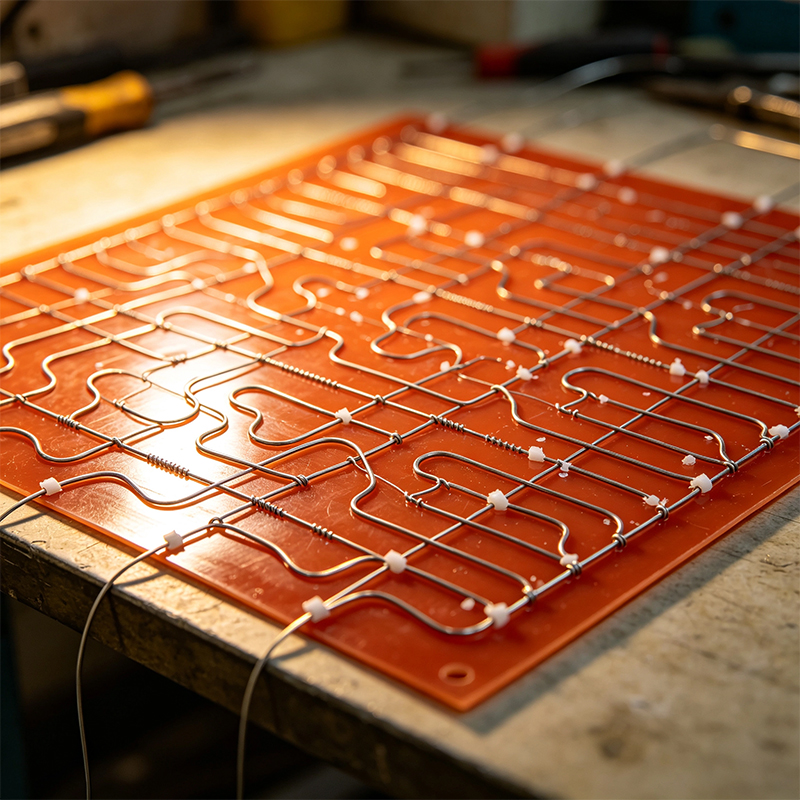
Silicone rubber flexible heaters use silicone rubber as the insulator. They're thicker than polyimide but more powerful and durable.
Specs:
Thickness: 1.0-2.0mm
Operating temperature: -40°C to 300°C (long-term use recommended below 200°C)
Max power density: 2.0 W/cm² (twice that of polyimide)
Thermal conductivity: 1.0-1.5 W/(m·K)
Compressive strength: 200-350 kg/cm²
Advantages:
Higher power density — more heat in the same area
Higher max temperature — up to 300°C
Moisture and chemical resistant
Can be made very large — up to 18"×24" or larger
Excellent mechanical strength — pressure and wear resistant
Disadvantages:
Thicker (1-2mm)
Less flexible
Heavier
3. Flexible PCB Heaters
Flexible PCB heaters are essentially flexible heating elements made using PCB manufacturing processes. They use standard flexible circuit board technology to etch precise resistive traces onto polyimide film. Their biggest advantage: they can be as thin as 0.15mm or less, with extremely uniform heat distribution, making them ideal for precision applications that demand consistent temperature profiles.
Regardless of the insulating material, flexible heating elements also come in two heating element styles.
Etched Foil: A thin metal foil is chemically etched to create a circuit pattern.
Advantages:
Extremely uniform heating — trace spacing can be as tight as 0.004"
Very thin — overall thickness can be as low as 0.005"
Larger surface area — runs cooler and lasts longer
Flexible customization — complex heating patterns are easy to produce
Wire Wound: Resistance wire is wound into a serpentine or spiral pattern and embedded in the insulator.
Advantages:
Lower cost
Suitable for large sizes — typically used when length or width exceeds 10" (254mm)
Higher temperature capability
In short: precision, thin, uniform heat → etched foil; large size, cost-sensitive → wire wound.
Flexible heating elements are far more common than you might think.
Medical Devices
Patient warming equipment
PCR testing equipment heating
Medical diagnostic temperature control
Sterile environment applications
Automotive
Seat and steering wheel heating
Mirror defogging
EV battery preheating
Diesel exhaust fluid freeze protection
Aerospace
Aircraft wing de-icing
Satellite component warming
Weight-sensitive applications — every kilogram saved reduces fuel costs
Consumer Electronics
Wearable device heating
LCD display heating
Bathroom mirror defogging
Industrial and Food
Food processing temperature control
Industrial equipment heating
Laboratory equipment
Choosing a flexible heating element comes down to three factors:
Temperature: How hot does it need to get? Polyimide handles up to 260°C; silicone rubber handles up to 300°C. Above 300°C, consider mica heaters.
Space and weight: Extremely tight on space and weight-sensitive? Choose polyimide (ultra-thin and lightweight). More room and need high power? Choose silicone rubber.
Environment: Chemical exposure? Repeated bending? Outgassing requirements? Choose the material that fits your environment.
One-sentence summary: precision, thin, expensive → polyimide; high power, durable, cheaper → silicone rubber.
A flexible heating element is a bendable electric heating pad. It generates heat when current flows through a resistive material and can conform to almost any surface.
Two main types: Polyimide (Kapton®) is ultra-thin and lightweight, ideal for precision applications. Silicone rubber is thicker, more durable, more powerful, and better for industrial use. Heating elements come in etched foil (thin and uniform) and wire wound (cheaper and larger) technologies.

Kaboer manufacturing PCBs since 2009. Professional technology and high-precision Printed Circuit Boards involved in Medical, IOT, UAV, Aviation, Automotive, Aerospace, Industrial Control, Artificial Intelligence, Consumer Electronics etc..


 English



 Wechat
 +86 13670210335
 +86 13670210335
 E-mail