
Date: 2026-06-21
You have a PCB in your hand. The pads are shiny gold, flawless. You send it to SMT assembly, it goes through reflow, everything looks perfect. A few months later, your customer starts reporting failures. BGAs are dropping off. Solder joints are cracking. Components are falling off for no apparent reason.
You’re baffled. The boards looked perfect. What went wrong?
The problem was hiding where you couldn’t see it. Its name is Black Pad.
Black Pad is the most common — and most insidious — defect in the ENIG (Electroless Nickel Immersion Gold) surface finish process.
ENIG is one of the most popular high-end PCB surface finishes. First, a layer of electroless nickel is deposited on the copper pad. Then, a very thin layer of immersion gold is plated on top of the nickel. The nickel blocks diffusion between copper and gold. The gold protects the nickel from oxidation and ensures good solderability.
So where does Black Pad come in? It’s all about nickel corrosion.
During the immersion gold process, gold ions are deposited onto the nickel surface, displacing nickel atoms into the solution. Normally, this exchange reaction is controlled and uniform. But when it goes wrong, the nickel surface is over‑corroded. What’s left is a rough, porous, phosphorus‑rich dark layer.
That dark layer looks gray or black — hence the name “Black Pad”. But here’s the catch: you can’t see it with the naked eye. The gold layer on top still looks perfectly shiny.
Black Pad is caused by two main factors:
1. Excessive nickel corrosion — the primary cause
During immersion gold plating, if the displacement reaction is too aggressive, the nickel layer is severely consumed. The nickel surface becomes rough and porous, and nickel oxides form. Gold atoms — which have a larger atomic radius than nickel — deposit unevenly on the corroded surface, forming a loose, porous grain structure instead of a dense protective layer.
2. Abnormally high phosphorus concentration
The electroless nickel layer contains phosphorus (typically 6‑11%). In a healthy ENIG finish, the phosphorus is evenly distributed. But when nickel is over‑corroded, much of it dissolves away, leaving behind a phosphorus‑rich layer. This fragile layer cannot form a proper intermetallic bond with solder, resulting in extremely weak joints.
Other contributing factors include bath contamination (e.g., copper ions), overly thin gold or nickel layers, and improper process parameters.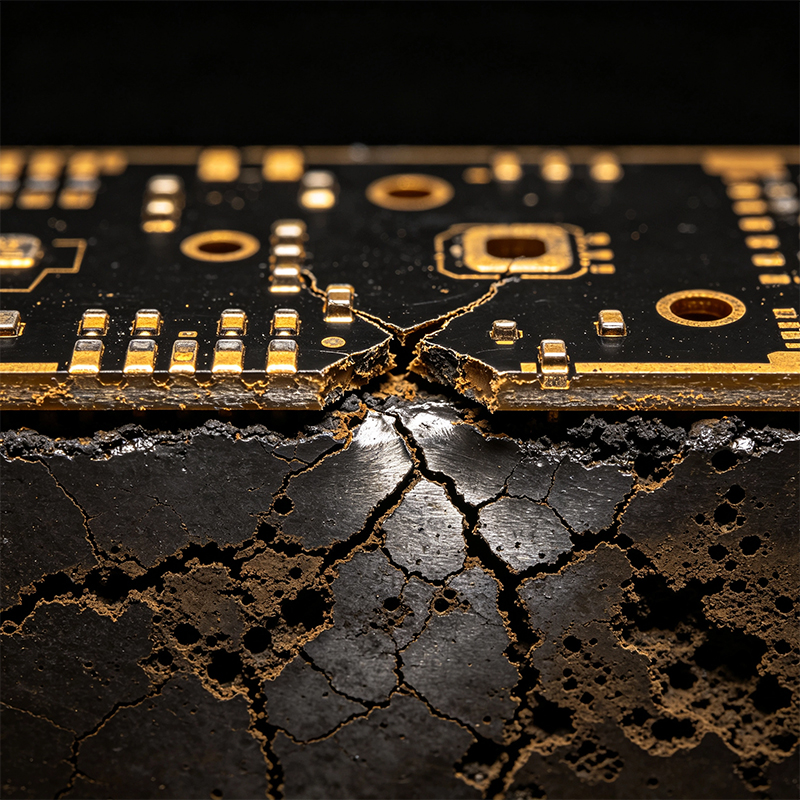
Black Pad causes three serious problems:
1. Brittle solder joints — the worst case
A Black Pad joint looks soldered — but it isn’t. The phosphorus‑rich layer or nickel oxide blocks the formation of a proper intermetallic compound between the solder and the nickel. The joint is extremely weak and cracks under the slightest stress. In drop tests, the solder peels clean off the nickel surface, leaving a smooth, dark fracture interface.
2. Poor wetting
Black Pad pads have terrible solderability. The solder won’t spread evenly — you get non‑wetting or dewetting.
3. Impossible to visually detect
This is the most terrifying part. You can’t detect Black Pad by visual inspection before assembly. The board looks perfect — shiny gold, just like a good board. You solder it, ship it, and only start seeing failures months later. And as of today, there is no non‑destructive test that can 100% confirm Black Pad presence.
Black Pad doesn’t hit every pad equally. It prefers fine‑pitch pads — like BGA and QFP pads. You’re far less likely to see it on large resistor or capacitor pads.
Why? Small pads have different local plating chemistry and faster exchange rates. They’re more vulnerable to localized over‑corrosion. And BGA joints are already tiny — combine that with Black Pad, and reliability goes to zero.
Black Pad is insidious, but with tight process control, you can dramatically reduce its occurrence.
1. Control the nickel bath chemistry
This is the most critical step. pH, temperature, nickel concentration, hypophosphite concentration, and stabilizers must all be tightly controlled. In 2002, IPC released IPC‑4552 specifically to standardize ENIG process control and reduce Black Pad.
2. Control the immersion gold bath activity
The displacement reaction shouldn’t be too aggressive. Monitor the bath temperature, pH, and gold ion concentration.
3. Gold thickness must be right
Too thin, and the nickel isn’t protected. Too thick, and you get gold embrittlement. IPC recommends 3‑8 microinches (0.075‑0.2µm) of gold.
4. Use proven ENIG chemistry
Different ENIG brands perform differently. Choose a supplier with a solid track record.
5. Ask for solder float testing
IPC has a solder float test — float the board on 288°C solder for 5 seconds, then check pad adhesion. It’s not a full guarantee, but it helps.
If Black Pad keeps you up at night, you have options:
ENEPIG (Electroless Nickel Electroless Palladium Immersion Gold) : A palladium layer between nickel and gold blocks corrosion — much lower Black Pad risk.
Immersion Silver: No nickel layer, no Black Pad. But silver tarnishes easily and has a shorter shelf life.
OSP (Organic Solderability Preservative) : Cheap and flat, but short shelf life and not for contact pads.
ENEPIG is currently the best solution for Black Pad — but it costs more than ENIG.
Black Pad is a hidden defect in ENIG surface finish where the nickel layer is over‑corroded during immersion gold plating. It’s devastating — joints look soldered but are extremely weak and crack under stress. And you can’t see it until it’s too late. The only way to confirm is destructive analysis, like SEM.
If you’re seeing unexplained solder joint cracking, BGA failures, or components falling off — and your boards looked perfect — Black Pad is probably the culprit. Choose reliable PCB suppliers, demand tight ENIG process control, and consider ENEPIG as a safer alternative.

Kaboer manufacturing PCBs since 2009. Professional technology and high-precision Printed Circuit Boards involved in Medical, IOT, UAV, Aviation, Automotive, Aerospace, Industrial Control, Artificial Intelligence, Consumer Electronics etc..


 English



 Wechat
 +86 13670210335
 +86 13670210335
 E-mail