
Date: 2026-06-17
You’ve definitely seen one before. Inside your computer, your TV remote, your phone charger, your car’s control module — almost any electronic device you open up has a stiff, hard board inside. That’s a rigid circuit board, also called a rigid PCB.
It’s the most basic, most common, and most widely used type of circuit board in the electronics industry. In this guide, I’ll explain what a rigid circuit board is, what types exist, what materials they’re made from, and where they’re used. Plain English, no fluff.
A rigid circuit board is exactly what it sounds like — a circuit board that is hard and cannot bend. Its base material is stiff (usually FR4, a fiberglass and epoxy laminate), so unlike flexible boards, you can’t roll it up or fold it.
Try to bend it? It will crack.
You might ask: what’s so good about a board that can’t bend? The advantage is precisely that it’s hard and stable.
The “hardness” of a rigid circuit board provides several key benefits:
Strong and durable — It holds components firmly and resists damage from vibration and shock.
Supports high-density layouts — You can pack many layers and fine traces into a small space.
Suitable for automated assembly — The flat, stable surface works perfectly on SMT production lines, making mass production cheaper.
Good heat dissipation — Rigid materials transfer heat efficiently, especially when paired with metal-core substrates.
Based on layer count and structure, rigid circuit boards come in three main types:
1. Single-sided
Copper on only one side of the board. Components are mounted on the copper side. This is the simplest and cheapest type, suitable for very basic circuits.
Typical uses: calculators, electronic toys, remote controls, timing circuits.
2. Double-sided
Copper on both sides, with plated holes (vias) connecting the two sides. Double the routing space means you can build much more complex circuits.
Typical uses: mobile phones, amplifiers, power supplies, appliance control boards.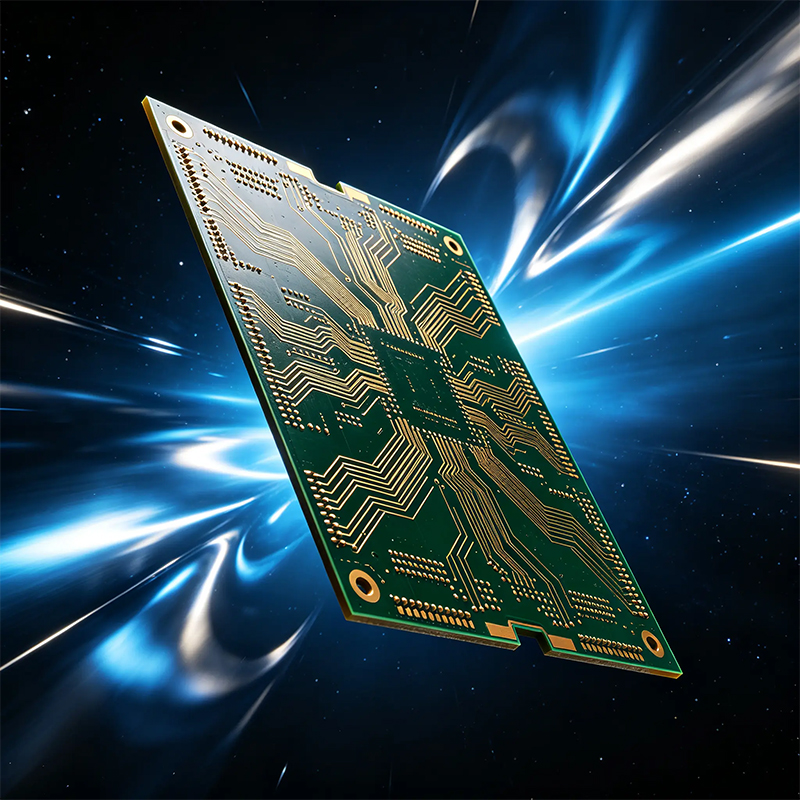
3. Multilayer
Three or more copper layers stacked together, separated by insulating material. More layers mean more complex routing and better signal quality. Common layer counts are 4, 6, and 8 layers — complex products can go up to 20+ layers.
Typical uses: computer motherboards, servers, medical equipment, communication devices.
The vast majority of rigid circuit boards use a material called FR4. FR4 is essentially fiberglass cloth impregnated with epoxy resin and pressed into sheets. “FR” stands for Flame Retardant — meaning the material won’t easily catch fire and will self-extinguish if it does.
FR4 has several key properties:
Strong — It supports heavy components without deforming.
Good insulation — Copper traces won’t leak current to each other.
Cheap — Mature manufacturing processes keep costs low.
Heat resistant — Standard FR4 handles 120-130°C; high-Tg FR4 handles 150-180°C.
Beyond FR4, there are special materials for specific applications:
Aluminum-core PCB — Excellent heat dissipation, used in LED lighting and power circuits.
Ceramic PCB — Very high thermal conductivity, used in high-power modules and extreme‑reliability applications.
High-frequency materials (Rogers, PTFE) — Low signal loss, used in 5G antennas, radar, and satellite communications.
Rigid circuit boards are the absolute workhorse of the electronics industry. You’ll find them in almost every electronic device:
Consumer Electronics
Smartphones (motherboards), computers (motherboards and graphics cards), tablets, TVs, routers, set‑top boxes — all use rigid boards.
Automotive Electronics
Engine control units (ECUs), sensors, infotainment systems, body control modules. As vehicles become more electronic, rigid PCB demand keeps growing.
Industrial Control
PLCs (programmable logic controllers), motor drives, variable frequency drives, industrial instruments.
Medical Devices
X‑ray machines, MRI systems, patient monitors, ultrasound equipment.
Communication Equipment
Base stations, switches, optical modules, satellite communication equipment.
Aerospace
Flight control systems, radar systems, navigation equipment.
Simply put: if your product doesn’t need to bend and requires high reliability, a rigid board is the way to go.
The manufacturing process for rigid circuit boards goes something like this:
Step 1 – Inner layer patterning
A photosensitive layer is applied to copper‑clad laminate. UV light transfers the circuit pattern, and chemicals etch away the unwanted copper, leaving the traces. For multilayer boards, each layer is processed separately.
Step 2 – Lamination
The finished layers (copper and insulating layers) are stacked and pressed together under high heat and pressure. The layer count in a multilayer board is always even — this ensures the board stays flat.
Step 3 – Drilling
Holes (through‑holes, blind vias, or buried vias) are drilled where needed, then plated with copper to connect different layers.
Step 4 – Solder mask and surface finish
A solder mask coating (usually green, but also red, blue, black, etc.) is applied to protect the copper traces from oxidation and prevent solder from bridging during assembly. Then a surface finish (ENIG, HASL, OSP, etc.) is applied to the pads to ensure good solderability.
Step 5 – Silkscreen
White text and outlines are printed on the board (component labels like R1, C2, U3) to show assembly operators where each part goes.
Step 6 – Electrical testing
The board is tested for shorts and opens.
Many people confuse rigid and flexible boards. Here’s a quick comparison:
| Feature | Rigid Board | Flexible Board |
|---|---|---|
| Can it bend? | No — it cracks | Yes — bends, folds, rolls |
| Base material | FR4 (fiberglass + epoxy) | Polyimide (PI film) |
| Thickness | Typically 0.8mm‑1.6mm | Can be as thin as 0.1mm |
| Cost | Cheaper | More expensive |
| Best for | No bending needed, high volume, cost‑sensitive | Bending required, tight spaces, lightweight |
| Typical uses | Computer motherboards, automotive ECUs, appliances | Phone cables, wearables, foldable screens |
In one sentence: rigid boards are the “economy workhorse,” flexible boards are the “special forces.” Most ordinary products use rigid boards — you only need flexible boards when bending or extreme space constraints are required.
While rigid boards are the industry standard, they’re not perfect:
Can’t bend — If you need to fit a circuit board into a curved enclosure, rigid boards won’t work.
Take up space — Thickness and rigidity mean they can’t conform to irregularly shaped housings like flexible boards can.
Heavier — For the same area, rigid boards weigh significantly more than flexible boards.
If your product needs to bend, is extremely thin, or has an irregular shape, you might need to consider flexible or rigid‑flex boards.
A rigid circuit board is a hard, non‑bendable circuit board. It uses FR4 as its base material and comes in single‑sided, double‑sided, and multilayer varieties. It’s strong, reliable, cheap, and perfect for mass production — making it the absolute workhorse of the electronics industry.
From the phone in your hand to the car on the road, from the X‑ray machine at the hospital to the airplane flying overhead — almost every electronic device contains at least one rigid circuit board. It’s not as “cool” as flexible boards, but this humble, hard board is what holds the modern electronic world together.

Kaboer manufacturing PCBs since 2009. Professional technology and high-precision Printed Circuit Boards involved in Medical, IOT, UAV, Aviation, Automotive, Aerospace, Industrial Control, Artificial Intelligence, Consumer Electronics etc..


 English



 Wechat
 +86 13670210335
 +86 13670210335
 E-mail