
Date: 2026-03-07
You know that feeling when you open a box of PCBs and see them all connected in one big sheet, looking like a sheet of postage stamps waiting to be separated? That's a PCB panel. And if you've ever wondered why boards aren't just made one by one, the answer comes down to one word: efficiency.
Here's the thing: making individual PCBs one at a time would be like baking cookies one by one instead of a full tray. It's slower, more expensive, and just doesn't make sense once you're past the prototype stage. That's where panelization comes in.
Let's talk about what PCB panels actually are, how they're designed, and why getting this right matters for your bottom line.
A PCB panel (sometimes called an array) is a larger board that contains multiple individual PCB units connected together . Think of it as a sheet of stamps—you get multiple units on one sheet, process them all at once, and separate them later.
The typical panel size varies by manufacturer, but common dimensions are around 18" x 24" (or 450mm x 600mm) for rigid boards, with specific limits depending on the fabricator's equipment . For flexible circuits, panel sizes are often smaller—JLCPCB, for example, uses maximum panel sizes of 250mm x 500mm for FPC .
SMT efficiency. Pick-and-place machines are fast, but they lose time every time they have to load a new board. When you panelize multiple units together, the machine loads once and keeps running . For a board that's 50mm x 50mm, running six-up instead of single units can cut assembly time by 70-80%.
Cost per board. PCB material comes in standard sheet sizes. If your design doesn't efficiently fill that sheet, you're paying for wasted material. Good panelization can improve material utilization by 15-30% .
Handling stability. Small boards are hard to handle—they tip, they shift, they don't feed well through automated lines. A panel with a proper waste frame adds rigidity and keeps everything flat through solder paste printing and reflow .
Testing efficiency. Fly probe testing works on individual boards, but if you're doing fixture-based testing, having multiple units in one panel speeds up the process.
V-scoring cuts a V-shaped groove from both the top and bottom of the board, leaving a thin web of material holding the units together .
When to use it: Perfect for rectangular boards. You can set spacing between units to zero, maximizing panel density .
The 1/3 rule: For standard 1.6mm boards, the cut depth is 1/3 from top and 1/3 from bottom, leaving 1/3 material thickness remaining .
Important note for thin boards: For 0.4mm or 0.6mm boards (common in wearables), the 1/3 rule doesn't work well. Instead, manufacturers target a specific residual thickness—typically 0.2mm ±0.05mm—to ensure enough strength for assembly while allowing clean separation .
V-cut limitations: The cuts must be straight lines—no curves, no angles. And they typically need to run the full length or width of the panel .
For irregular shapes or boards with components near the edge, tab-routing is the way to go. A CNC router mills out most of the board outline, leaving small tabs to hold everything together .
With breaking holes (mouse bites): Small holes—typically 0.5mm to 0.8mm in diameter—are drilled in the tabs, spaced 0.25mm to 0.5mm apart . This creates a perforation that snaps cleanly.
Solid tabs: No holes, just a solid connection. These need to be cut with a router or saw during depaneling—manual snapping won't work.
Tab dimensions: The bridge connection length is typically 0.7-1.0mm for standard boards . For areas with steel stiffeners, you might need longer tabs (around 1mm) and more of them to prevent deformation during assembly .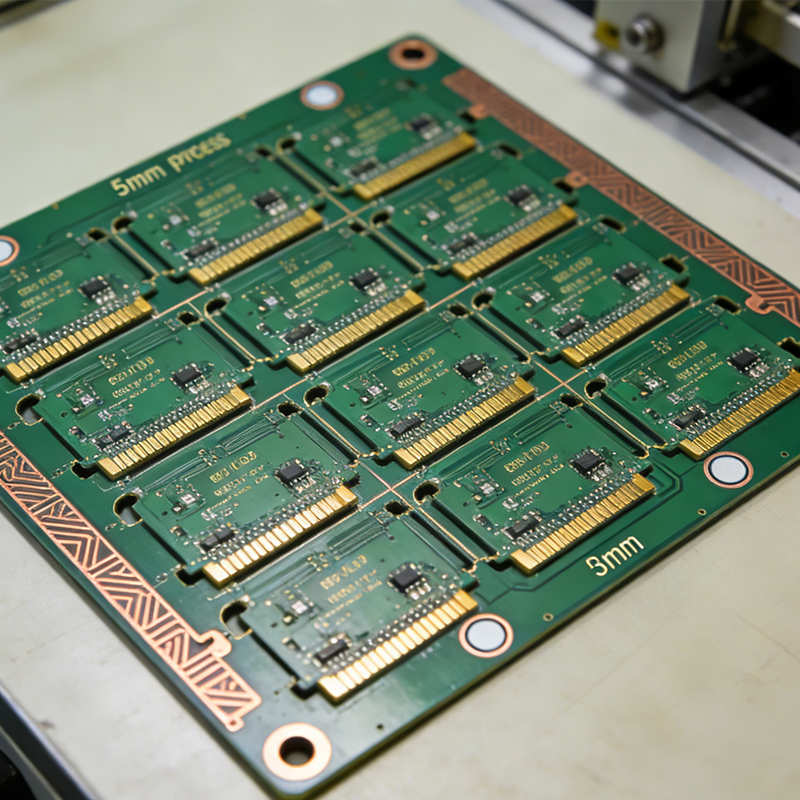
Flexible PCBs are a different animal. You can't use V-scoring on flex, and standard mouse bites don't work the same way. For FPC panelization, the industry typically uses bridge connections .
Spacing requirements: Generally, maintain 2mm between boards. If you have steel stiffener reinforcement, increase that to 3mm .
Process edge: Add a 5mm process edge on all sides, with copper coverage and four 2mm positioning holes. Include four SMT optical points (1mm diameter) for pick-and-place alignment .
Panel size limits: For FPC, keep panels between 70mm x 70mm and 250mm x 500mm . Smaller than that and handling becomes difficult; larger and you risk distortion.
SMT lines need something to grab onto. Standard practice is to add 5-7mm rails on the left and right sides of the panel . These rails get removed after assembly, so don't put components there.
Pick-and-place machines need optical reference points. Standard fiducials are 1.0mm copper circles with a 2.0mm clearance around them . Place at least three on the panel—two for alignment, one for checking.
Add 3.05mm non-plated holes (typically four) in the process edge for fixturing during test and wave soldering .
Components near breakaway points can crack during depaneling. Industry rule of thumb: keep components at least 3mm away from tab-routed edges, and 1mm away from V-cut lines . For ceramic capacitors (MLCCs), be even more conservative—they're brittle and don't like mechanical stress .
Uneven copper distribution causes board warpage during reflow. Adding dummy copper patterns ("thieving") in the process edges balances copper density . It's not just extra copper—it's there for a reason.
Different thicknesses have different limits :
| Board Thickness | Maximum Panel Size |
|---|---|
| 0.6mm | 100mm x 100mm |
| 0.8mm - 1.2mm | 200mm x 200mm |
| 1.6mm | 300mm x 300mm |
These limits exist because thin panels flex more and can warp or break during processing. If your design needs a larger panel, you might need thicker material or additional support rails.
How you separate boards matters. Snapping by hand is never recommended for professional assembly—it stresses components and can crack solder joints, especially on 0402 and smaller parts .
For V-scored boards: A V-cut saw or special depaneling machine gives clean, stress-free separation.
For tab-routed boards: Options include:
Router machines for solid tabs
Punch tools for high volume
Laser depaneling for the ultimate in precision (especially for 01005 components and flex circuits)
Laser depaneling is becoming the 2026 standard for high-end boards because it's completely stress-free. No mechanical vibration means no micro-cracks in sensitive components .
Here's something buyers don't always consider: panel utilization directly affects price .
When you get quotes, ask for the panel drawing and utilization percentage. If one fabricator uses 85% of the panel and another uses 70%, the first one should have lower per-board pricing. If they don't, you're paying for their inefficiency .
Also, consider letting your manufacturer panelize for you. Many fabricators offer "panel by manufacturer" services where their CAM engineers optimize the layout . This often yields better utilization than what you can do yourself, especially for odd-shaped boards.
At Kaboer, we've been manufacturing custom circuit boards since 2009—sixteen years of experience turning designs into reality for companies around the world. We're based in Shenzhen, at the heart of global electronics manufacturing, with a factory equipped for the full spectrum of work.
We handle both rigid and flexible circuit panelization with precision:
Rigid PCBs: Panels up to 450mm x 600mm, V-scoring and tab-routing options
Flexible PCBs (FPC) : 1-20 layers, 0.075mm to 0.4mm thick, with proper bridge connections and process edges
Rigid-Flex Boards: 2-30 layers, combining rigid stability with flexible interconnects
HDI High-Density Boards: Microvias, fine lines (down to 2mil), advanced stackups
We don't just take your files and run them. Our engineers review your panel design for:
Proper rail width and tooling hole placement
Component keep-out distances
Copper balance and thieving
Optimal material utilization
This DFM review catches issues before they cost you time and money.
We don't just make boards—we assemble them too. Our in-house PCBA facility means you get fully assembled, tested modules ready for integration. One partner, one quality standard, no finger-pointing between fab and assembly.
We're certified to ISO 9001, IATF 16949, ISO 14001, UL, RoHS. IPC Class 2 and Class 3 when you need the highest reliability.
We're in Shenzhen. If you want to see how your panels are made, you're welcome to visit. Walk the floor, meet the team, ask whatever you want.
PCB panels aren't just about fitting more boards on a sheet—they're about efficiency, quality, and controlling costs. The right panel design makes everything downstream easier.
If you need custom PCBs or want us to optimize your panel layout, send us your Gerber files or requirements. We'll get back to you with a free quote and DFM feedback within 2 hours.
Better yet—come visit us in Shenzhen. See for yourself how we turn panel designs into real, working boards.

Kaboer manufacturing PCBs since 2009. Professional technology and high-precision Printed Circuit Boards involved in Medical, IOT, UAV, Aviation, Automotive, Aerospace, Industrial Control, Artificial Intelligence, Consumer Electronics etc..


 English



 Wechat
 +86 13670210335
 +86 13670210335
 E-mail