
Date: 2026-01-31
When you need a custom circuit board, one of the first questions is: "How much does this circuit board cost?" However, much like you can't get a firm quote for a car without specifying the model, trim, and options, a PCB doesn't have a fixed price tag. Its cost is the sum result of a series of design choices and manufacturing parameters. Understanding these factors helps you make smarter decisions during design and procurement to manage costs effectively.
A circuit board's price is largely determined by your design files before production even begins. Suppliers base their quotes on several key dimensions:
1. Physical Specs: Size, Layers, and Material
This is the cost foundation. The board size directly determines how many boards can be produced from a standard-sized raw material sheet. Larger or irregular shapes that lead to lower material utilization increase the unit cost. The number of layers is one of the primary price drivers—each additional two layers requires more material, longer lamination and drilling times, and a significant price jump. Common FR-4 material offers the best value, but costs rise if your design requires special materials like high-frequency laminates, high-Tg, flex, or metal-core boards.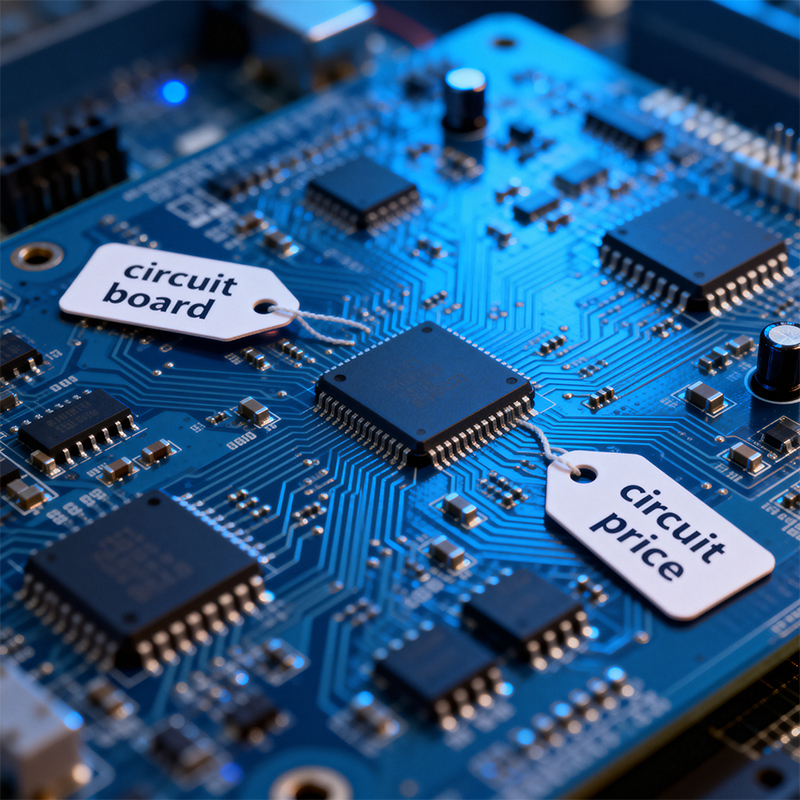
2. Process Complexity: The Devil's in the Details
Trace Width & Spacing: Finer traces and tighter spacing demand higher precision and stability from manufacturing equipment, potentially affecting yield and increasing cost.
Hole Size & Count: Laser drilling is more expensive than mechanical drilling; blind and buried vias are more complex than through-holes. Thousands of dense, small holes on a board significantly increase drilling time and cost.
Special Processes: Does the design require impedance control (extremely high trace precision), gold fingers (extra plating), or via-in-pad? Each special requirement adds process steps and cost.
3. Surface Finish: Balancing Performance and Cost
The protective coating on the solder pads directly affects solderability and long-term reliability. Common HASL (Lead/Lead-free) is the most economical. ENIG (Electroless Nickel Immersion Gold) offers better performance for fine-pitch components, while Immersion Silver or ENEPIG are for higher-end applications. The price difference between these options can be substantial.
4. Order Quantity: The Power of Scale
This is another critical factor for unit price. The fixed costs of production (like engineering, setup, and stencil fees) are spread across every board. The unit price for 5 prototype boards and 5,000 mass-production boards will be worlds apart, as large volumes drastically improve material utilization and production line efficiency.
Beyond the bare board, external factors and services influence the final total:
Component Costs: If you're procuring PCBA (assembled boards), the cost of resistors, capacitors, chips, and other components often far exceeds that of the bare board and is subject to significant market fluctuations.
Testing Requirements: Flying probe test, AOI, functional testing—more comprehensive testing means higher assurance and higher cost.
Certifications & Standards: Meeting specific industry standards (like UL or IPC Class 2/3) also imposes higher requirements on materials and processes.
The most effective way is to provide potential suppliers with clear files and requirements:
Provide Standard Fab Files: Include Gerber files, drill drawings, and a stack-up diagram.
Specify Technical Parameters: Clearly state material type, board thickness, solder mask color, surface finish, etc.
Indicate Quantity & Timeline: Your expected order volume and desired delivery time.
In summary, circuit board price is a function of design complexity and production scale. Understanding this pricing logic not only helps with more accurate project budgeting but also leads to more efficient communication with manufacturers, ultimately helping you find the optimal balance between cost, performance, and timeline.

Kaboer manufacturing PCBs since 2009. Professional technology and high-precision Printed Circuit Boards involved in Medical, IOT, UAV, Aviation, Automotive, Aerospace, Industrial Control, Artificial Intelligence, Consumer Electronics etc..


 English



 Wechat
 +86 13670210335
 +86 13670210335
 E-mail