
Date: 2026-03-03
Ever wondered how your smartwatch bends with your wrist, or how a foldable phone can open and close thousands of times without breaking? The answer lies in a remarkable piece of engineering—the flex PCB.
Flexible printed circuit boards, or flex PCBs, are exactly what they sound like: circuit boards that can bend, twist, and fold. Unlike traditional rigid boards made from hard FR-4 fiberglass, flex PCBs use thin, flexible materials that let them fit into spaces where rigid boards simply can't go .
This guide covers everything you need to know about flex PCBs—from what they are and how they're made, to their advantages, applications, and how to choose the right manufacturing partner.
A flex PCB is a printed circuit board built on a flexible polymer substrate instead of rigid fiberglass. Think of it as the difference between a stiff piece of cardboard and a flexible plastic sheet—both can hold circuits, but only one can bend .
The most common base material for flex PCBs is polyimide, a high-performance plastic that maintains its properties across a wide temperature range and can withstand repeated bending . Some applications use polyester (PET) for cost-sensitive designs where extreme durability isn't required.
Flex circuits aren't just wires on plastic. They're complete electrical systems that can include:
Single or multiple conductive copper layers
Protective coverlay instead of traditional solder mask
Stiffeners in areas that need extra support for components
Adhesives that bond everything together
The manufacturing process for flex PCBs shares some steps with rigid board production, but with important differences that account for the flexible materials .
Everything starts with a design created in CAD software. Flex designs must account for bending requirements, layer counts, and component placement in ways that rigid designs don't .
Material selection is critical. The base is typically polyimide film, available in various thicknesses. Copper foil is chosen based on current requirements—thicker copper handles more current but reduces flexibility .
The polyimide substrate is cleaned and prepared to ensure proper adhesion of the copper layers. This step removes contaminants that could cause defects later .
A light-sensitive photoresist is applied to the copper-clad polyimide. Using precision lasers or photographic techniques, the circuit pattern is transferred onto the material. The exposed areas harden, protecting the copper that will become traces .
Chemical baths remove the unprotected copper, leaving only the desired circuit patterns behind. After etching, the remaining photoresist is stripped away, revealing the bare copper circuitry .
Unlike rigid boards that use liquid solder mask, flex circuits use a coverlay—a thin polyimide film with adhesive that's laminated over the circuits. The coverlay protects the copper while maintaining flexibility .
Openings are precut or laser-ablated where components will be soldered. This requires precise alignment to ensure pads are exposed correctly .
In areas where components will be mounted or connectors attached, stiffeners are added. These can be made from polyimide, FR-4, or even stainless steel, providing rigid support exactly where needed while leaving the rest flexible .
Every flex PCB undergoes rigorous testing:
Electrical testing checks for continuity and isolation
Visual inspection examines for defects under magnification
Environmental testing may include thermal cycling and flex testing
Flex circuits come in several configurations, each suited to different applications :
Single-sided flex: One copper layer on a flexible substrate. Simple, cost-effective, and ideal for applications like RFID tags and basic interconnects.
Double-sided flex: Copper on both sides of the substrate, with plated through-holes connecting the layers. More routing density for complex circuits.
Multilayer flex: Three or more copper layers stacked with insulating layers between them. Used for high-density designs where single or double-sided won't suffice.
Rigid-flex: Rigid board sections connected by flexible circuits. Combines the stability of rigid boards with the flexibility of interconnects. Perfect for designs that need both .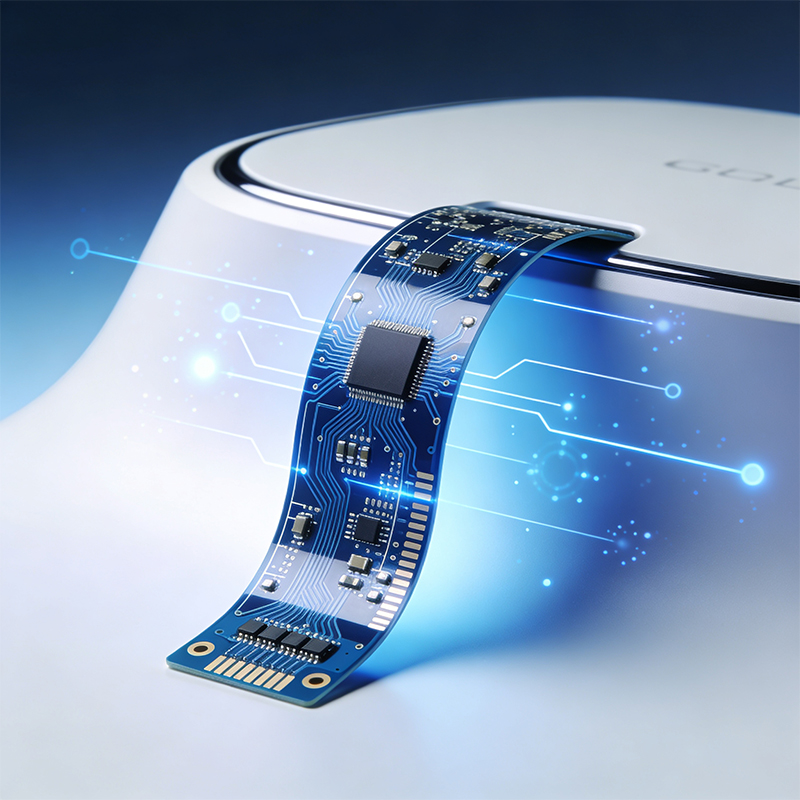
Flex PCBs offer benefits that rigid boards simply can't match :
Flex circuits can be folded into three-dimensional shapes, fitting into enclosures that rigid boards couldn't possibly occupy. This is why your smartphone can be so thin yet so powerful .
Polyimide is much lighter than FR-4. In applications like aerospace and automotive, every gram counts—flex circuits can reduce weight by up to 60% compared to rigid alternatives .
Dynamic flex applications—where circuits bend repeatedly during use—are impossible with rigid boards. Flex PCBs handle millions of flex cycles in devices like foldable phones, laptop hinges, and hard disk drives .
Without connectors and with inherently flexible construction, flex circuits excel in high-vibration environments like automotive and industrial applications .
Rigid-flex designs can eliminate connectors entirely by building the interconnects right into the board structure. Fewer connectors means fewer failure points and simpler assembly .
Thin polyimide dissipates heat better than thicker materials. Some applications use metal-core flex for even better thermal performance .
A single rigid-flex assembly can replace multiple rigid boards, cables, and connectors—reducing part count, simplifying inventory, and speeding up production .
Flex circuits are everywhere in modern electronics. Here are some of the most common applications :
Your phone is packed with flex circuits—display connections, camera module interconnects, battery connections, antenna circuits. Without flex, foldable phones wouldn't exist .
Fitness trackers, smartwatches, and health monitors all rely on flex circuits to fit complex electronics into tiny, curved enclosures that rest comfortably on your body .
Modern cars contain dozens of flex circuits—in infotainment systems, dashboard displays, engine control units, and advanced driver assistance systems. Flex handles the vibration, temperature extremes, and tight spaces under the hood .
Hearing aids, insulin pumps, patient monitors, and implantable devices all use flex technology. The combination of small size, reliability, and biocompatibility makes flex ideal for medical applications .
Robotics, control systems, and sensors benefit from flex circuits' ability to withstand harsh environments and tight spaces.
Weight savings, reliability, and the ability to fit into complex shapes make flex circuits essential in aircraft, satellites, and military equipment.
Even your gaming console uses flex circuits—controllers, internal connections, and displays all rely on flexible technology .
Designing for flex requires different thinking than rigid board design. Here are the essential guidelines:
The most critical rule: don't bend too tightly. For single-layer flex, the bend radius should be at least six times the material thickness. For double-layer, at least ten times. For multilayer, twenty times or more .
A tighter radius than these recommendations will stress the copper and can cause cracking or delamination.
Traces should run perpendicular to the bend direction, not parallel. Parallel traces in bend areas are more likely to crack or delaminate .
Use curved traces rather than sharp corners in flex areas. Teardrop-shaped pads help distribute stress where traces meet pads .
Vias create rigid spots in flexible areas. Keep them in flat, unbent sections of the circuit. Placing pads in bend areas invites cracking and pad lifting .
Use coverlay in flex areas, not traditional solder mask. Solder mask is brittle and will crack when bent. Coverlay is designed for flexibility .
Unlike rigid boards, flex circuits can't easily use resin-plugged vias-in-pad. The process can cause solder wicking during assembly, leading to unreliable joints. Avoid this design unless your manufacturer specifically approves it .
For large copper areas, use hatched or cross-hatched patterns rather than solid pours. This maintains flexibility and prevents air trapping during lamination .
Add stiffeners where components or connectors mount, but keep them out of bend areas. Stiffeners can be FR-4, polyimide, or metal depending on requirements .
Flex circuits can be panelized in bent or "unraveled" shapes to maximize space during manufacturing—something rigid boards can't do .
With proper design and under suitable conditions, flex PCBs can last as long as rigid boards—often longer in dynamic applications because they're designed to move .
Often yes, but it requires attention to material selection, bend radius, component placement, and specific design rules for flexible circuits .
Thickness depends on layer count and copper weight, but flex circuits can be as thin as 0.075mm for single-layer designs—thinner than a sheet of paper .
Yes, quality flex PCBs are compatible with standard surface-mount assembly processes. Stiffeners help support the board during assembly .
Base materials include polyimide (PI), polyester (PET), and polyethylene naphthalate (PEN). Copper is the standard conductor, with coverlay materials matching the base .
At Kaboer, we've specialized in flexible circuit technology since 2009. Based in Shenzhen, China—the heart of global electronics manufacturing—we've spent over 16 years perfecting the processes that turn flex designs into reliable, high-performance reality.
We manufacture the full spectrum of flexible circuits:
Flexible PCBs (FPC) : 1-20 layers, thickness from 0.075mm to 0.4mm—ideal for wearables, medical devices, and compact consumer products
Rigid-Flex Boards: 2-30 layers, combining rigid stability with flexible interconnects in a single integrated design
HDI Flex: Advanced high-density interconnect technology with microvias and fine lines for the most demanding applications
High-Frequency Flex: Low-loss materials for 5G, radar, and RF systems requiring signal integrity in flexible formats
Metal-Core Flex: For applications demanding superior heat dissipation
We don't just make bare flex boards—we populate them. Our in-house PCBA facility means you get fully assembled, tested modules ready for integration. One vendor, one quality standard, one point of accountability.
We're certified to international standards:
ISO 9001:2015 (Quality Management)
IATF 16949:2016 (Automotive)
ISO 14001:2015 (Environmental Management)
UL and RoHS compliance
Our flex boards meet IPC 6013 standards for flexible and rigid-flex circuits, including Class 2 and Class 3 requirements for applications that demand the highest reliability.
With monthly capacity exceeding 15,000 square meters for flexible and rigid-flex boards, we handle everything from quick-turn prototypes to high-volume production.
We believe the best partnerships are built on trust. That's why we welcome our global clients to visit our factory in Shenzhen. Walk our production floors. Meet our engineering team. See firsthand how your flex circuits will be made.
From smartphones and wearables to automotive battery management and medical devices, we've helped companies around the world solve their toughest flex circuit challenges. We'd love to help you with yours.
Flex PCBs are enabling a new generation of electronics—sleeker, lighter, more reliable, and more innovative than ever before. Whether you're designing a wearable fitness tracker, a foldable phone, or a life-saving medical device, flex technology can help you get there.
Understanding how flex circuits are made, what design rules matter, and which applications benefit most helps you make better decisions for your products.
Ready to bring your flex PCB design to life? Contact Kaboer today. Better yet—come visit us in Shenzhen and see for yourself how we turn flexible circuit designs into reality.

Kaboer manufacturing PCBs since 2009. Professional technology and high-precision Printed Circuit Boards involved in Medical, IOT, UAV, Aviation, Automotive, Aerospace, Industrial Control, Artificial Intelligence, Consumer Electronics etc..


 English



 Wechat
 +86 13670210335
 +86 13670210335
 E-mail