
Date: 2026-07-04
You're developing a new product. Maybe a wearable device, a foldable phone, an automotive sensor, or a medical endoscope. You know you need flexible circuit boards. You search online and find dozens of "flex PCB manufacturers" with prices ranging from cheap to expensive, promises ranging from modest to outrageous. How do you actually choose?
Flexible PCB fabrication is completely different from rigid board manufacturing. Pick the wrong manufacturer, and you'll face delayed deliveries, low yields, or even a scrapped project. In this guide, I'll explain what flex PCB fabrication really involves, what to look for in a manufacturer, and how to make the right choice.
The global flexible PCB market was valued at approximately $28.36 billion in 2025** and is projected to reach **$31.07 billion in 2026, growing at a CAGR of 9.5%. Other reports project it to reach $41.7 billion by 2030 — nearly doubling from its 2024 value.
Consumer electronics accounts for over 38% of FPCB demand, while electric vehicles and 5G infrastructure are the fastest-growing drivers. If your product is in any of these areas, flexible circuit boards are a technology you can't ignore.
Flex PCB fabrication requires specialized equipment and processes — from polyimide substrate handling and precision coverlay lamination to laser drilling and specialized lamination.
1. Material Selection
The substrate is the most critical part. Most flex boards use polyimide (PI) — DuPont's Kapton® is the most well-known brand. It withstands 260°C, survives hundreds of thousands of bend cycles, and has excellent dielectric properties.
Copper selection matters too. Rolled annealed (RA) copper is far more bend-resistant than electrodeposited (ED) copper. For dynamic, repeated bending, RA copper is non-negotiable.
2. Circuit Etching
Flex PCB etching is much finer than rigid board etching. Traditional processes rely on multi-step chemical sequences, each introducing variability and yield loss. Newer technologies like Dry Phase Patterning — a fully dry, mechanical roll-to-roll method — are emerging for higher precision and better environmental performance.
3. Drilling
Flex boards can't use standard mechanical drills — the soft material deforms. High-end flex boards use laser drilling for micron-level precision.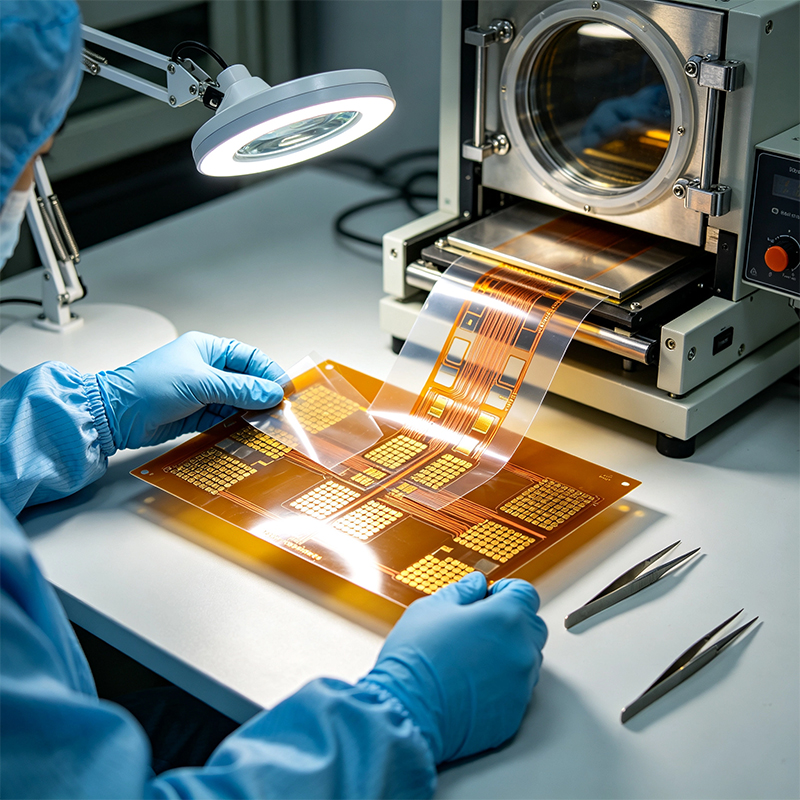
4. Coverlay Lamination
Flex boards don't use the green solder mask that rigid boards use. Instead, they use a polyimide coverlay laminated onto the board to protect the traces. Temperature, pressure, and precision during lamination directly affect reliability and bend life.
5. Plating and Surface Finish
Flex board plating is harder to control than rigid boards — the material is soft, thin, and prone to warping. Surface finishes like ENIG, immersion silver, and OSP require different process parameters on flex boards.
6. Cutting and Shaping
Flex boards can't be routed like rigid boards — routing frays and tears the soft material. They must be laser-cut or die-punched.
A lot of people assume flex board assembly is the same as rigid board assembly. It's not.
Flex boards lack rigidity — they warp, shift, and misalign during SMT placement. They must be mounted on rigid carriers from paste printing through placement and reflow.
Flex boards also warp under heat during reflow, requiring custom support fixtures and optimized temperature profiles. A standard SMT shop without flex-specific carriers and reflow profiles won't get good yields.
This is why flex PCBA requires an experienced manufacturer.
Rigid-flex boards are even harder to manufacture than pure flex boards. Rigid and flex sections must be laminated into one piece, and the transition zone is the most fragile point. In 2025, OKI launched rigid-flex boards with embedded copper coins for improved heat dissipation in space equipment. The global HDI rigid-flex PCB market was valued at $934 million in 2025** and is projected to reach **$1.4 billion by 2032.
HDI high-frequency boards are another dimension entirely. 5G, radar, and optical modules require ultra-low-loss materials — LCP, PTFE, Rogers. The 5G PCB market was valued at $59.8 billion in 2026, growing at a staggering 73.4% CAGR. High-frequency materials are extremely difficult to process — not every factory can handle them.
Flexible PCB reliability is governed by strict industry standards. IPC-6013 is the core specification for flexible board qualification and performance, covering single-sided, double-sided, multilayer, and rigid-flex boards.
IPC-6013 divides flex boards into three classes based on end-use application:
Class 1: General electronic products — function is all that matters
Class 2: Dedicated service electronics — requires continuous, reliable operation
Class 3: High-reliability products — aerospace, medical, military — the strictest standards
A qualified flex PCB manufacturer should be able to produce and inspect to IPC-6013 requirements.
We are not a standard rigid-only PCB shop. We are a one-stop manufacturer that designs and makes flexible PCBs, rigid-flex boards, HDI high-frequency boards, and then does full PCBA.
All in-house: Flex, rigid-flex, HDI fabrication and PCBA assembly under one roof. No hand-offs.
Over a decade of flex experience: We know how to avoid flex-to-rigid transition cracks, design proper stiffeners, and control impedance.
High-precision manufacturing: Minimum trace/space 0.05mm, minimum laser blind via 0.075mm. Supports 1-order to any-layer HDI.
High-frequency material experience: Rogers, PTFE, LCP — we've done them all for 5G and radar applications.
Dedicated flex SMT line: Custom carrier fabrication, high-precision placement, 3D SPI, and AOI. Assembly yield consistently above 98%.
IPC-6013 compliant: We fabricate and inspect to IPC-6013 standards — Class 1, 2, and 3.
Free DFM review: Send your design files, get a DFM report within 24 hours with potential issues and optimization suggestions.
Three simple steps:
Send your files: PCB design files (Gerber or source), BOM, special requirements (bend radius, impedance, materials, etc.).
We review and quote: Within 24 hours, you'll receive a DFM report, stackup recommendation, and sample/volume pricing.
Sample, then scale: We build 10-20 samples. You test functionality and bend reliability. Then we move to volume.
Flexible PCB fabrication is not "rigid board manufacturing, just smaller." It requires completely different materials, processes, equipment, and experience. A rigid-only shop — no matter how cheap — won't deliver good flex boards.
If you're looking for a manufacturer that truly understands flex, send us your requirements. We won't push a contract — we'll first run a free DFM review and let our expertise speak.
When you contact us, please include:
Product type and application
Whether bending is required (dynamic or static)
Estimated annual quantity (samples, small batch, or mass production)

Kaboer manufacturing PCBs since 2009. Professional technology and high-precision Printed Circuit Boards involved in Medical, IOT, UAV, Aviation, Automotive, Aerospace, Industrial Control, Artificial Intelligence, Consumer Electronics etc..


 English



 Wechat
 +86 13670210335
 +86 13670210335
 E-mail