
Date: 2026-07-04
You've definitely seen what water does to electronics. Flickering screens, dead buttons, corroded charging ports—sometimes a whole device destroyed. Water is one of the biggest enemies of circuit boards. But some products have to work in wet or humid environments. Smartwatches that track swimming, outdoor sensors that sit in rain, automotive sensors that deal with water and slush, medical devices that get wiped down with disinfectant.
How do these circuit boards survive? The answer is waterproof PCB technology.
In this guide, I'll explain what waterproof PCBs are, the different ways to protect them, what IP ratings mean, and what to watch out for in design. Plain English, no fluff.
First, let's understand what water actually does to a circuit board.
1. Short circuits
Water isn't pure. It contains dissolved ions—minerals in tap water, salt in seawater, electrolytes in sweat. These ions make water conductive. When water bridges two pads that shouldn't be connected, it creates a short circuit. A short can cause signal errors, system crashes, or even fry components.
2. Electrochemical Migration (ECM)
In humid conditions with an electric field, copper can dissolve into ions and grow tiny metallic "dendrites" between adjacent traces. These dendrites grow slowly—over weeks or months—until they bridge two traces, causing a permanent short. By the time it fails, it's too late.
3. Corrosion
Copper oxidizes and rusts in humid environments. Corroded solder joints develop high resistance and intermittent connections. Over time, component leads can break and pads can peel off.
4. Mold growth
Flux residue left on the board is organic matter—food for mold in humid environments. Mold can eat through traces, contaminate solder joints, and degrade insulation.
If your product works in wet conditions, waterproofing is non-negotiable.
Waterproofing isn't one single technology. It's a combination of methods:
1. Conformal Coating
Conformal coating is a thin protective lacquer sprayed or brushed onto the board. It covers components and traces, keeping water and moisture out.
Common types:
Acrylic (AR): Most common—easy to apply and rework
Polyurethane (UR): Abrasion-resistant and chemical-resistant—great for harsh environments
Silicone (SR): Flexible, works from -65°C to 200°C—used in high-reliability applications
Epoxy (EP): Hard and highly insulating—but nearly impossible to rework
The coating is typically only 25-75 micrometers thick—thinner than a hair. It works for most indoor and light outdoor use. The catch: it's not a perfect seal. Submerge the board, and water can still seep in through component gaps.
2. Potting / Encapsulation
Potting means pouring resin or silicone over the entire board (or part of it). Components are completely sealed in the potting material—water has zero chance of reaching the circuit.
Common potting materials are epoxy (hard and strong) and silicone (soft and flexible—good for vibration-heavy environments).
Potting can achieve IPX8—continuous immersion. The catch: once potted, the board is unrepairable. You'd have to dig the potting out, which usually destroys the board.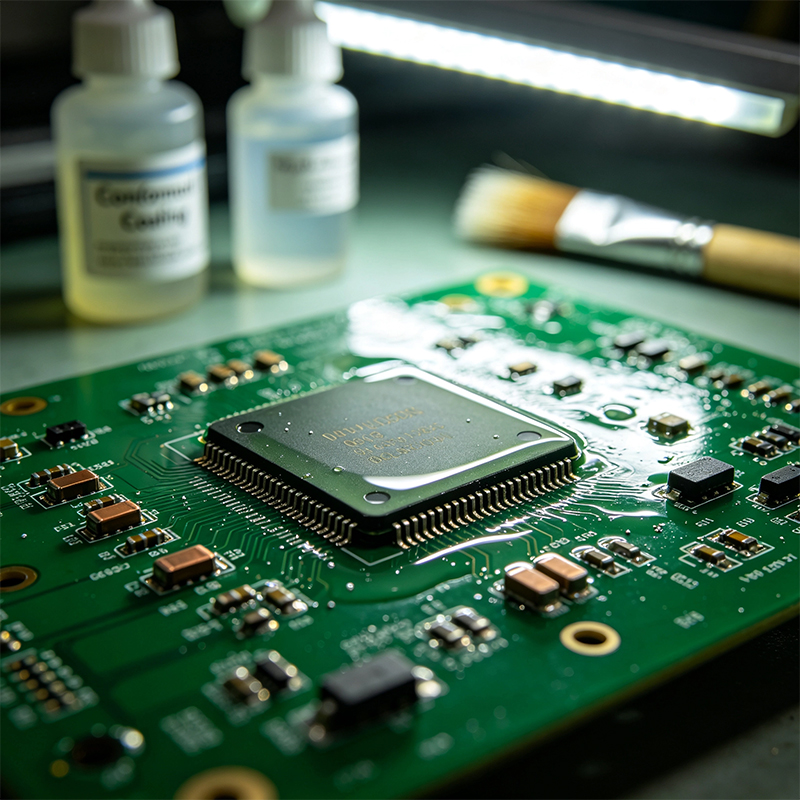
3. Enclosure Sealing
Instead of coating the board itself, you put the whole board inside a sealed enclosure. Rubber O-rings at the seams create a watertight box when screwed shut.
Advantages: the board itself is untouched—repairable and upgradeable. Disadvantages: enclosures take space, add cost, and O-rings age and need replacement.
4. Hydrophobic Coating
A newer approach. A hydrophobic coating (like fluoropolymer) makes water bead up and roll off the board instead of spreading out—like water on a lotus leaf. It's often used together with conformal coating for extra protection.
IP stands for Ingress Protection. It has two digits:
First digit: Dust protection (0-6)
Second digit: Water protection (0-8)
Water protection goes from IPX0 to IPX8:
| Rating | Protection Level |
|---|---|
| IPX0 | No protection |
| IPX1 | Vertical dripping |
| IPX2 | Dripping at 15° tilt |
| IPX3 | Spraying water (up to 60°) |
| IPX4 | Splashing water (any direction) |
| IPX5 | Water jets (6.3mm nozzle) |
| IPX6 | Powerful water jets (12.5mm nozzle) |
| IPX7 | Short immersion (1m depth, 30 minutes) |
| IPX8 | Continuous immersion (depth/time specified by manufacturer) |
IPX7 means the board can survive 30 minutes in 1 meter of water—this is the rating for many smartwatches. IPX8 means longer or deeper immersion—diving equipment and underwater sensors use this.
The full rating is IP67 (6 = fully dust-tight, 7 = short immersion) or IP68 (6 = fully dust-tight, 8 = continuous immersion).
Waterproof PCBs are everywhere:
Consumer Electronics: Smartwatches, action cameras, waterproof phones, TWS earbud charging cases
Automotive Electronics: Engine control units (ECUs), sensors, cameras, body controllers. Electronics under the car chassis face water, high-pressure car washes, and road salt.
Medical Devices: Devices that get wiped down with disinfectant—endoscopes, surgical instruments, dental equipment. Disinfectants like alcohol and hydrogen peroxide are even more corrosive than water.
Industrial Equipment: Outdoor sensors, industrial instruments, oil and gas equipment. Chemical plants, offshore platforms, mines—boards face not just water but chemical corrosion.
Aerospace: External aircraft sensors, satellites. In low-pressure environments at high altitude, moisture vapor can penetrate more easily.
IoT: Outdoor water meters, smart streetlights, environmental monitoring stations. Sitting outside in rain, sun, and temperature swings—and battery-powered, so they can't be replaced often.
A few things to watch out for when designing waterproof boards:
1. Don't coat connectors
Connectors, test points, and key contacts need electrical access—they can't be coated. Either mask them off or use waterproof connectors.
2. Component height shadows
Conformal coating is sprayed. Tall components create shadows—short components behind them might not get coated. Put tall components at the board edge or use dip coating.
3. Potting kills heat dissipation
Potting materials are poor heat conductors. If your board has high-power components, heat becomes a problem. Use thermally conductive potting materials or attach heat-generating parts to the enclosure.
4. Enclosure sealing needs mechanical design
Enclosure seals need O-rings, compression surfaces, and screws—mechanical design, not PCB design. Work with your mechanical engineer.
5. Multi-layer boards need plugged vias
In multi-layer boards, gaps between layers can become moisture paths. Plug the vias with resin or solder mask to prevent moisture wicking through.
A waterproof PCB isn't a single material—it's a complete system of protection methods. Conformal coating keeps moisture out, potting seals everything, enclosure sealing keeps water out of the device, and hydrophobic coating makes water roll off.
Light waterproofing, indoor humidity → Conformal coating (low cost, repairable)
Moderate waterproofing, outdoor rain → Conformal coating + sealed enclosure
Heavy waterproofing, underwater → Potting (IPX8, but unrepairable)
IP ratings are the industry standard for measuring waterproofing. IPX7 survives 1 meter for 30 minutes. IPX8 survives continuous immersion.

Kaboer manufacturing PCBs since 2009. Professional technology and high-precision Printed Circuit Boards involved in Medical, IOT, UAV, Aviation, Automotive, Aerospace, Industrial Control, Artificial Intelligence, Consumer Electronics etc..


 English



 Wechat
 +86 13670210335
 +86 13670210335
 E-mail