
Date: 2025-12-29
Flexible Printed Circuit Board Assembly (Flex PCB Assembly or FPC Assembly) is the specialized process of mounting and soldering electronic components onto a flexible printed circuit. Unlike traditional rigid PCB assembly, this process involves unique materials, handling techniques, and design considerations to accommodate the board's ability to bend, fold, or flex during its operational life. It is a critical technology for enabling modern, lightweight, compact, and three-dimensional electronic products.
A Flexible Printed Circuit is built on a thin, flexible dielectric substrate, most commonly Polyimide (PI) film, known for its excellent thermal stability, chemical resistance, and mechanical endurance. Conductive traces are typically made of rolled annealed copper for superior flex life. FPCs can be single-layer, double-sided, or multi-layer, and are often combined with rigid sections to form Rigid-Flex PCBs.
Core Assembly Distinction: While the end goal—a functional electronic assembly—is the same as rigid PCBs, the assembly of FPCs requires addressing their inherent flexibility, thinness, and thermal sensitivity.
The assembly of flexible circuits follows a modified SMT/THT process flow, with critical adaptations at each stage.
Stage 1: Panelization & Support (Critical First Step)
FPCs are typically supplied on carrier panels (often made of rigid FR-4 or aluminum) using high-temperature adhesive tapes or fixtures. This "rigidization" is essential for providing the mechanical stability needed for accurate solder paste printing, component placement, and reliable conveyor transport through reflow ovens.
Stage 2: Solder Paste Printing
Due to the non-planar surface (from adhesives and fixtures) and delicate nature of FPCs, precise stencil alignment and controlled printing parameters are vital. Electropolished or nano-coated stencils are often used to ensure clean paste release.
Stage 3: Component Placement
Standard SMT pick-and-place machines can be used, but they require careful programming. The lower mechanical stability of the mounted FPC panel demands optimized placement force and speed to prevent board shifting or "bouncing," which can cause misalignment.
Stage 4: Reflow Soldering
This is a highly sensitive step. The low thermal mass of the FPC means it heats up much faster than a rigid board. A carefully profiled, low-thermal-mass reflow oven with precise zone control is mandatory to:
Prevent overheating and delamination of the polyimide.
Ensure even heating across the panel, avoiding warpage.
Account for the thermal characteristics of the carrier panel.
Stage 5: Cleaning, Depanelization & Final Inspection
Cleaning: Must use cleaners compatible with polyimide and any adhesives.
Depanelization: The individual FPCs are carefully separated from the carrier panel, often by hand or using specialized tools to avoid tearing.
Inspection: Automated Optical Inspection (AOI) can be challenging due to potential board curvature. X-ray inspection is critical for verifying solder joints on flex-specific components and in rigid-flex areas.
| Challenge | Root Cause | Professional Mitigation Strategy |
|---|---|---|
| Dimensional Instability | Polyimide films can absorb moisture (hygroscopic) and shrink/expand slightly. | Bake FPCs before assembly to drive out moisture. Store in dry environments. Use fiducials on the FPC itself (not just the carrier) for machine vision alignment. |
| Solder Joint Stress | Repeated flexing can fatigue standard solder joints, leading to cracks. | Use strain relief designs: Coverlay openings over pads, staggered component placement, and avoiding placing components directly in the bend area. Use flexible solder masks or epoxy reinforcement (glob top) for critical components. |
| Component Selection | Standard rigid components may not withstand flexing. | Specify thin-profile, lightweight components (e.g., chip-scale packages). Avoid large, heavy components (like electrolytic capacitors) on flex areas. |
| Adhesive Residue | Adhesive from the carrier panel can contaminate the FPC. | Use high-quality, temperature-stable tapes designed for SMT processes. Implement thorough but gentle post-assembly cleaning processes. |
Consumer Electronics: Smartphone displays (OLED/LCD connectors), folding phones, cameras, wearables (smartwatches, fitness bands), laptops.
Automotive: LED lighting systems, infotainment displays, sensors (in seats, doors), advanced driver-assistance systems (ADAS) cameras.
Medical Devices: Hearing aids, endoscopes, wearable monitors, implantable devices.
Industrial & Aerospace: Robotics arms, compact sensors, satellite components, military communication devices.
Rigid-Flex PCBs combine the benefits of both technologies. Their assembly is the pinnacle of complexity, requiring:
Sequential Assembly: Often, components are assembled on the rigid sections first, with the flex areas carefully masked or supported. Multiple reflow passes may be needed.
Specialized Handling: The 3D form factor requires custom fixtures throughout the assembly line.
Unified Testing: Test strategies must account for the continuous electrical connection across rigid and flex regions.
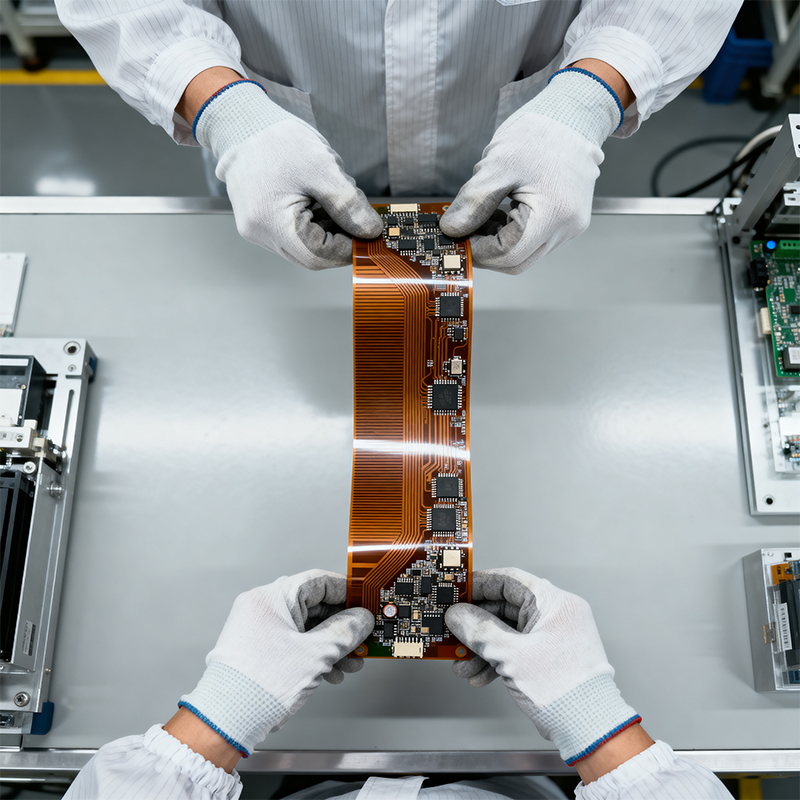
Mastering FPC assembly requires more than just standard SMT lines; it demands specialized expertise, tailored process engineering, and meticulous attention to detail—capabilities cultivated through focused experience.
At Kaboer, we have developed a dedicated proficiency in flexible and rigid-flex PCB assembly within our integrated PCBA factory in Shenzhen, China. We understand that your flexible circuit design represents a key innovation, and we are equipped to translate it into a reliable, production-ready assembly.
Why Your Flexible Project Belongs with Kaboer:
Expertise in Process Criticals: We have established controlled processes for the entire FPC assembly workflow, from dedicated baking ovens for moisture management to low-stress depanelization stations. Our engineers are adept at creating custom carrier solutions and thermal profiles that protect the integrity of your flexible substrates.
Engineering-Led DFM Support: Our team provides in-depth Design for Flex Assembly (DFFA) analysis. We go beyond standard DFM to advise on stiffener placement, bend radius compliance, component selection for flex life, and strain relief strategies—optimizing your design for both functionality and manufacturability.
Precision Handling and Inspection: Our SMT lines are configured with the precision and gentle handling required for flexible panels. We complement standard AOI with custom inspection protocols to account for potential curvature, ensuring no defect escapes to the next stage.
Supply Chain for Specialized Materials: Our location in Shenzhen provides direct access to a vast network of specialized material suppliers for polyimide films, flexible coverlays, adhesives, and thin-core materials, ensuring we can source the right materials for your project efficiently.
Seamless Rigid-Flex Integration: For complex Rigid-Flex projects, our integrated approach is a distinct advantage. We manage the entire fabrication and assembly process under one roof, eliminating communication gaps between rigid board fab and flex assembly houses. This ensures perfect alignment, simplifies logistics, and significantly reduces time-to-market.
Trust Kaboer to handle the intricacies of your flexible and rigid-flex PCB assemblies with the specialized care and technical precision they demand. Let's build the future of electronics, together.
Q1: Are FPC assemblies more expensive than rigid PCB assemblies?
A: Yes, typically. The higher cost comes from the more expensive raw materials (polyimide, rolled copper), specialized manufacturing processes for the bare FPC, and the added complexity and handling required during assembly. However, the total system cost is often lower due to space/weight savings and reduced need for connectors and wiring.
Q2: How many bend cycles can an assembled FPC withstand?
A: This is defined as flex life and varies dramatically by design. A static flex application (bent once during installation) has different requirements than a dynamic flex application (repeatedly bent in use, like in a folding phone). Dynamic designs require careful material selection, neutral bend axis design, and can achieve thousands to hundreds of thousands of cycles.
Q3: Can through-hole components be used on flexible circuits?
A: Yes, but with caution. Plated Through Holes (PTH) are common in Rigid-Flex designs and in rigid sections of FPCs. However, PTHs in a pure flex area that will experience bending are a point of high stress and potential failure. If needed, they require specific reinforcement.
Q4: What is the minimum bend radius for an assembled FPC?
A: A general rule is minimum bend radius = 10x the total board thickness for one-time static bends. For dynamic flexing, a much larger radius (e.g., 50-100x thickness) is recommended. The actual value depends on layer count, copper thickness, and material types. Always consult your manufacturer and IPC-2223 standard for guidelines.

Kaboer manufacturing PCBs since 2009. Professional technology and high-precision Printed Circuit Boards involved in Medical, IOT, UAV, Aviation, Automotive, Aerospace, Industrial Control, Artificial Intelligence, Consumer Electronics etc..


 English



 Wechat
 +86 13670210335
 +86 13670210335
 E-mail