
Date: 2026-02-07
Have you ever wondered how the brick-like mobile phones from a decade ago have transformed into today's sleek, lightweight devices that are exponentially more powerful? While advancements in chips get much of the credit, a key technology hidden inside the circuit boards plays an equally critical role – High-Density Interconnect.
In simple terms, High-Density Interconnect is an advanced technology in PCB design and manufacturing that allows for a much greater number of electronic components and more complex circuitry to be integrated onto a circuit board that is the same size or even smaller. Think of it like urban planning: traditional technology is like building a small town with only main roads and alleys; HDI technology is like constructing a modern metropolis with multi-level overpasses, underground tunnels, and intricate interchanges on the same plot of land, dramatically increasing traffic capacity and efficiency.
This technology is the foundational core enabling the miniaturization and high performance of modern electronics. From the smartphone in your pocket and the smartwatch on your wrist to the AI servers in data centers and the core computers in self-driving cars, all rely on the support of HDI.
Components on traditional circuit boards are connected across different layers through through-holes, which are like "staircases running through every floor" of a building. These holes are relatively large and occupy valuable board space.
The core breakthrough of HDI technology is the extensive use of microvias. Compared to through-holes, microvias have a much smaller diameter (typically less than 150 microns, about the width of two human hairs), and they don't necessarily go through the entire board. They are used in two main "space-saving" ways:
Blind Vias: These act like "recessed ladders embedded in a wall," connecting only from the surface of the PCB to an inner layer, without going all the way through.
Buried Vias: These are like "secret passages between floors," completely hidden within the inner layers of the PCB, connecting two or more internal layers without being visible from the surface.
By cleverly combining these microvias, engineers can pack finer traces, smaller components, and achieve shorter electrical connection paths within the same unit area.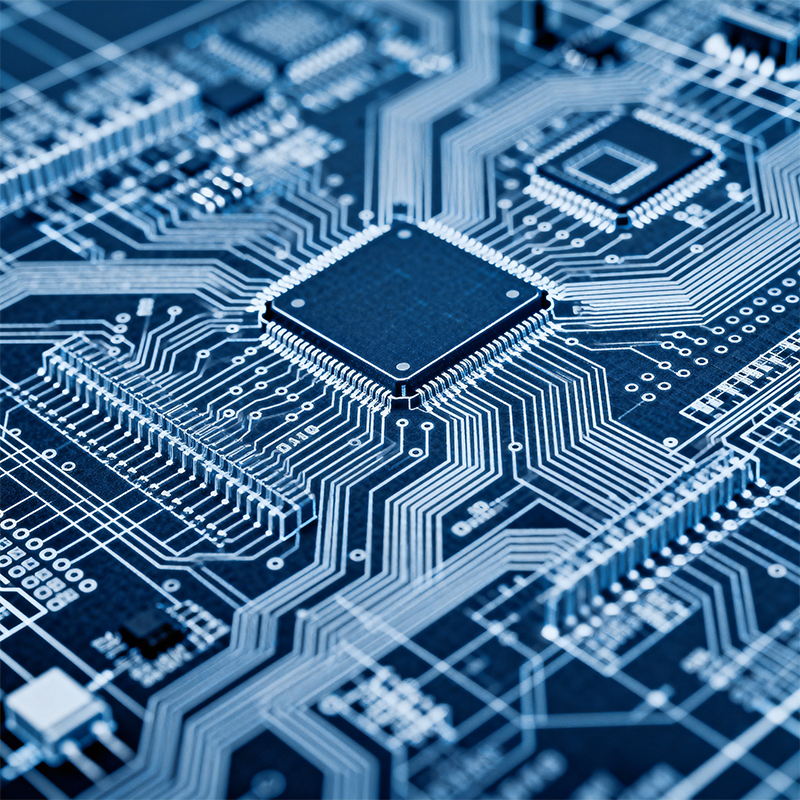
Based on the complexity of interconnections, HDI technology is typically categorized into several levels to meet the needs of different products:
Entry-Level: Adds one high-density layer using microvias on each side of a traditional multilayer board's core. This is like adding modern elevator shafts to an older building, significantly boosting connection capability. It's a common choice for many consumer electronics.
Mid-Range: Stacks two high-density layers on each side of the core. This offers greater design freedom and signal integrity, often used in high-end communication equipment and complex industrial controllers.
Advanced/Any-Layer HDI: This is the most advanced form currently available, where any layer of the PCB can be directly connected to any other layer via microvias. It's like having a direct passage from every room to every other room in a building. It enables the highest routing density and optimal electrical performance, making it the preferred choice for flagship smartphones, high-end graphics cards, and AI accelerator cards.
The benefits HDI brings are direct and multifaceted:
Device "Slimming": This is the most obvious advantage. Smaller holes and finer traces mean the PCB itself can be smaller, freeing up space for other components like larger batteries or camera modules, or simply making the end device thinner and lighter.
Enhanced Performance & Reliability: Shorter electrical paths mean signals travel faster, with less energy loss and a lower chance of interference. This is crucial for processors and communication modules handling high-speed data. Furthermore, fewer through-holes and more reliable microvia connections improve the board's mechanical strength and long-term reliability.
Greater Design Flexibility: Engineers gain more freedom to layout components in three-dimensional space, allowing large chips (like processors and memory) to be placed closer together, optimizing overall system performance.
As technology progresses, HDI itself continues to evolve. Future trends may include:
More Extreme "Miniaturization": The diameter of microvias and the width of traces will continue to shrink, pushing the limits of manufacturing processes.
Integration with Advanced Packaging: The boundary between HDI technology and chip-level packaging is blurring, potentially leading to new integration methods where some traditional packaging processes are performed directly on the HDI board.
Serving New Demands: Adaptation to higher speeds (like next-gen communications), higher power (like electric vehicle control), and special environments (like aerospace) will drive innovation in HDI materials and processes.
In summary, High-Density Interconnect technology is the invisible backbone of the modern electronics industry. It exists quietly in almost all high-end electronic devices, using ingenious "micro-architecture" to pack immense computing power into the palm of our hands. Understanding HDI is key to understanding how today's electronics have become so powerful yet so refined.

Kaboer manufacturing PCBs since 2009. Professional technology and high-precision Printed Circuit Boards involved in Medical, IOT, UAV, Aviation, Automotive, Aerospace, Industrial Control, Artificial Intelligence, Consumer Electronics etc..


 English



 Wechat
 +86 13670210335
 +86 13670210335
 E-mail