
Date: 2025-12-24
In electronic component terminology, inductors are fundamentally passive devices. They store energy in a magnetic field but cannot add energy to a circuit. However, the concept of an “active inductor” refers to a clever circuit synthesis technique that uses active components like transistors and op-amps to emulate the behavior of an inductor. This guide explains the key differences and helps you decide which approach suits your design.
A passive inductor is a two-terminal component typically made from a coil of wire (often around a magnetic core). Its operation is based on Faraday’s Law of Induction.
Core Principle: It resists changes in current. When current increases, it stores energy in its magnetic field; when current decreases, it releases that energy.
Key Characteristics:
Value (Inductance L): Fixed, determined by physical properties (number of coil turns, core material, geometry).
Parasitics: Has inherent series resistance (DCR) and inter-winding capacitance.
Linearity: Operates linearly within its current and frequency limits.
Power: Cannot provide gain; only stores and delivers energy passively.
Common Applications: Power supply filters (LC circuits), RF tuning, noise suppression chokes, energy storage in converters.
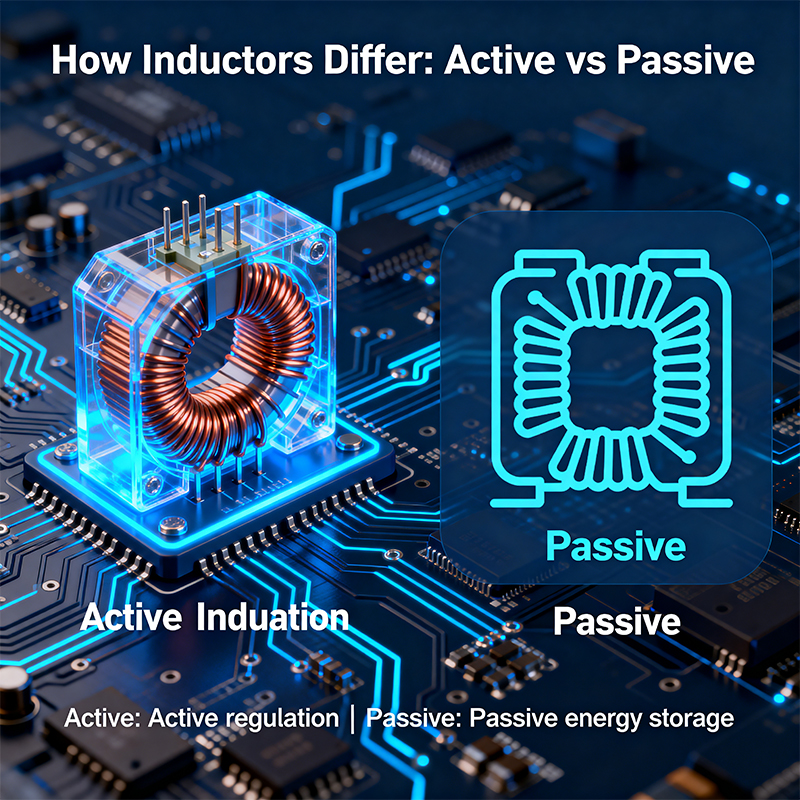
An active inductor is not a single component but an active circuit network (often an IC or a discrete transistor-based circuit) designed to have an impedance that mimics an ideal inductor over a specific frequency range. This is achieved through negative impedance conversion and gyrator circuits.
Core Principle: Uses an active device (e.g., an op-amp with feedback) to make a capacitor behave like an inductor. Mathematically, the impedance of a capacitor is Z_C = 1/(jωC). An active circuit can invert this relationship to produce Z = jωL, where L is a “synthesized” inductance value.
Key Characteristics:
Value (Inductance L): Tunable, often via a resistor value or control voltage/current.
Size & Integration: Can simulate very large inductance values without the physical size, weight, or core saturation issues of a passive coil. Suitable for monolithic IC integration.
Quality Factor (Q): Can achieve a very high and tunable Q factor, which is difficult with passive inductors, especially at low frequencies.
Power Consumption: Requires a power supply to operate the active components.
Noise & Linearity: Limited by the noise and linearity of the active components; has a finite dynamic range and operating frequency window.
| Feature | Passive Inductor | Active Inductor (Circuit) |
|---|---|---|
| Nature | Discrete, fundamental passive component. | Synthesized behavior using an active circuit. |
| Energy | Stores and releases energy; cannot add energy. | Consumes DC power to emulate inductive impedance. |
| Inductance Value | Fixed, determined by physical construction. | Tunable or programmable via external components. |
| Size at Low Frequencies | Large and heavy for high inductance values. |
Very compact, even for large simulated L.
|
| Quality Factor (Q) | Limited by core losses and wire resistance (DCR). | Can be designed for very high and tunable Q. |
| Integration | Difficult on-chip; requires external components or special processes. | Fully integrable into a silicon IC. |
| Power Handling | High for power applications. | Low to moderate; limited by active device ratings. |
| Cost | Low for standard values; high for custom/precision. | Lower system cost when integration and tunability are key. |
Choose a Passive Inductor when:
Designing power circuits (DC-DC converters, power filters) that handle substantial current.
Working with high-frequency RF circuits where the simplicity and performance of a passive component are optimal.
Cost sensitivity is extreme for standard values.
The design requires high reliability and simplicity with no need for tuning.
Consider an Active Inductor Circuit when:
You need a large, tunable inductance on an integrated circuit (e.g., for on-chip filters).
Designing low-frequency analog filters (audio range, below ~100 kHz) where passive inductors would be prohibitively large.
Tunability or programmability of the filter characteristic is required during operation.
High-Q, compact filtering is needed in a small form factor, and power consumption is not a primary constraint.
Q1: Is an active inductor a real inductor?
A: No, it does not store magnetic energy like a coil. It is an active circuit whose input impedance mathematically mimics that of an inductor over a designed frequency band.
Q2: What is the main advantage of an active inductor?
A: Its primary advantage is the ability to provide a large, tunable, high-Q inductive impedance in a very small size, making it perfect for integrated circuit design where physical inductors are impractical.
Q3: What are the major drawbacks of active inductors?
A: They consume power, introduce more noise than passive coils, have limited signal amplitude handling (due to active device linearity), and operate effectively only within a limited frequency range.
Q4: Can I replace any passive inductor in my design with an active equivalent?
A: Absolutely not. They are not interchangeable. Active inductors are specialized solutions for specific low-power, small-signal, often integrated applications, particularly in filtering and tuning. They cannot handle the energy storage or high currents of power applications.

Kaboer manufacturing PCBs since 2009. Professional technology and high-precision Printed Circuit Boards involved in Medical, IOT, UAV, Aviation, Automotive, Aerospace, Industrial Control, Artificial Intelligence, Consumer Electronics etc..


 English



 Wechat
 +86 13670210335
 +86 13670210335
 E-mail