
Date: 2026-06-25
You've definitely seen it. That thin yellow ribbon connecting the screen to the motherboard inside your phone. The flat cable bending back and forth through the hinge of your laptop. The moving cable inside a printer. These unassuming flat ribbons are called FFCs.
FFC stands for Flexible Flat Cable. It's an extremely thin, flat cable with multiple conductors running side by side, all wrapped in a flexible insulating film. They're inside the phone in your pocket, the laptop on your desk, the TV on your wall, and the car in your driveway.
In this guide, I'll explain what an FFC is, what's inside it, what specs it comes in, where it's used, and how it's different from FPC. Plain English, no fluff.
An FFC is simply a flat, bendable ribbon cable.
It's different from regular round wires — round wires are bulky and take up space. An FFC takes multiple conductors, flattens them, and bonds them together inside a thin insulating film. The result is a flat ribbon that's usually only 0.1-0.3mm thick.
Think of it as "flat ribbon cable" — for the same number of conductors, an FFC is much thinner, much lighter, and much more flexible than traditional round cables. Perfect for slipping into those thin, tight spaces.
A typical FFC has three components:
Conductors: Flat metal strips running parallel inside the cable, usually tinned copper or gold-plated copper, carrying current and signals.
Insulation: The thin plastic film wrapping the conductors, typically polyester (PET) or polyimide (PI), providing insulation and protection.
Stiffener: A small rigid piece attached to the back of the exposed ends, making it easier to insert into a connector and preventing bending or misalignment.
The ends of an FFC are usually exposed conductors, designed to plug into ZIF (Zero Insertion Force) connectors. Based on the orientation of the conductors at each end, FFCs come in two main types:
Type A (Same Side): Conductors face the same direction on both ends.
Type B (Opposite Side): Conductors face opposite directions.
FFC specs are defined by three main parameters:
1. Pitch
Pitch is the distance from the center of one conductor to the center of the next. Common pitches include: 0.5mm, 0.8mm, 1.0mm, 1.25mm, 2.0mm, and 2.54mm. 0.5mm and 1.0mm are the most common. Smaller pitch means more conductors in the same width — but requires more precise connectors.
2. Pin Count
FFCs can have anywhere from 2 to 55 or more conductors. Common counts include 4, 6, 8, 10, 14, 16, 20, 30, 40, and 50 pins.
3. Length
FFCs can be custom-made in various lengths, from a few centimeters to several dozen centimeters or more. Common lengths include 30mm, 50mm, 75mm, 100mm, 150mm, 200mm, and 300mm.
An FFC has one core job: transfer electrical signals or power between two parts of an electronic device.
Its applications are incredibly wide:
Consumer Electronics
Smartphones: connecting screens to motherboards
Laptops: routing through hinges from screen to主板
Tablets, digital cameras, gaming consoles
LCD/LED displays: connecting driver boards to control boards
Automotive
Infotainment systems, instrument clusters, camera connections
Medical Devices
Imaging equipment, portable diagnostic tools
Printers and Office Equipment
Print head cables — the print head moves back and forth constantly, and FFCs survive the repeated bending
Industrial Equipment
Robotics, sensors, automation equipment
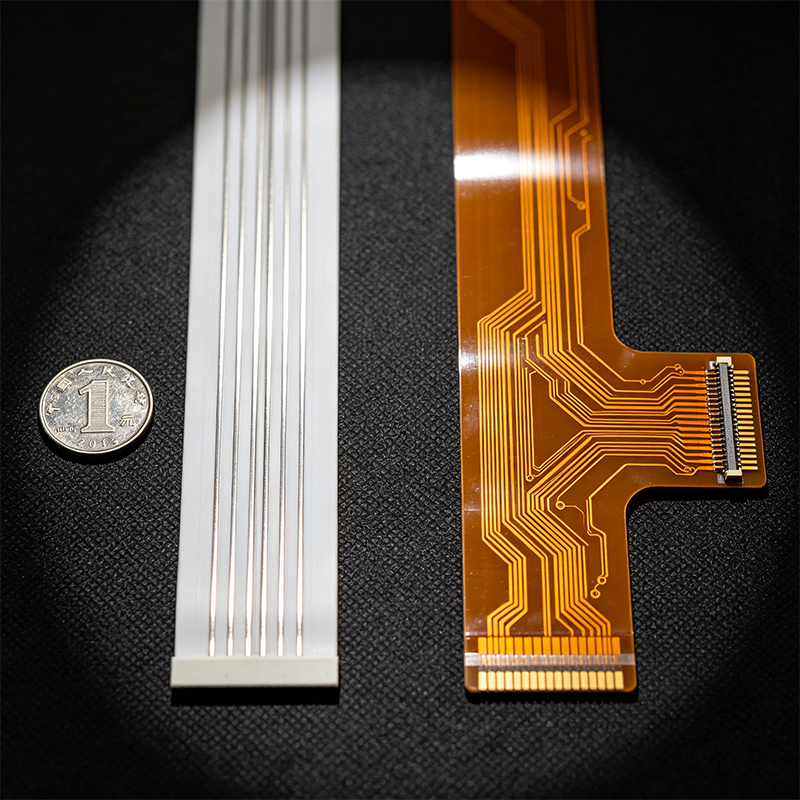
A lot of people confuse FFCs and FPCs — they look similar, both are flat and flexible. But they're different things.
| Feature | FFC | FPC |
|---|---|---|
| Full Name | Flexible Flat Cable | Flexible Printed Circuit |
| Construction | Flat conductors side by side + insulating film | Copper traces etched on a flexible substrate |
| Can traces cross? | No — straight through only | Yes — multi-layer with crossings |
| Can mount components? | No — just wires | Yes — can solder components onto it |
| Shape | Usually rectangular and uniform | Can be any shape — bends and angles |
| Cost | Cheaper | More expensive |
Here's the simple way to remember it: FFC is a flat ribbon cable — conductors flattened and bundled together. FPC is a flexible circuit board — a complete circuit built on a flexible board.
If you just need a straight connection from Point A to Point B, with no crossing traces and no components — use an FFC. It's cheap and does the job. If you need complex routing, crossed traces, or components mounted on the flex — that's FPC territory.
An FFC (Flexible Flat Cable) is a flat, bendable ribbon cable. It has multiple flat conductors running side by side, wrapped in a thin insulating film — thin, light, and flexible.
It's used everywhere you need to connect two components in a tight space — phones, laptops, cars, medical devices. Compared to FPC, FFC is simpler, cheaper, and straight‑through; FPC is more complex, more expensive, and can do any shape and crossing traces.

Kaboer manufacturing PCBs since 2009. Professional technology and high-precision Printed Circuit Boards involved in Medical, IOT, UAV, Aviation, Automotive, Aerospace, Industrial Control, Artificial Intelligence, Consumer Electronics etc..


 English



 Wechat
 +86 13670210335
 +86 13670210335
 E-mail