
Date: 2026-04-23
Let’s be honest: when most people look at a circuit board, they just see a "green thing." But if you’re building hardware, you know that the "green thing" is actually a complex sandwich of different materials. Choosing the right materials for a circuit board is a lot like picking the right foundation for a house—if you get it wrong, the whole thing might come crashing down when things get hot or fast.
If you’ve ever touched a PCB, it was probably made of FR-4. This is the industry standard. It’s basically fiberglass cloth soaked in epoxy resin. It’s cheap, tough, and handles most everyday tasks like a champ.
But here’s the catch: FR-4 doesn't like high heat. If your project is going inside an engine or a high-performance server, standard FR-4 might start to char or lose its shape. That’s why engineers often look for "High-Tg" (Glass Transition Temperature) versions to keep things stable.
Ever wonder how the screen on your smartphone connects to the motherboard through that tiny hinge? That’s thanks to Polyimide. This is the go-to material for Flex PCBs.
Unlike FR-4, Polyimide is incredibly thin and can fold thousands of times without cracking. It’s also a beast when it comes to heat resistance. This is why you’ll see it in everything from medical wearables to space satellites.
If the substrate is the "land," the copper is the "highway system." Most circuit boards use a thin layer of copper laminated onto the substrate.
In the industry, we talk about copper in "ounces" (oz). A standard board uses 1oz copper, but if you’re building something that draws a lot of power—like an EV charger—you’ll need "Heavy Copper" (2oz or more). Think of it like widening the lanes on a freeway to prevent a traffic jam (and overheating).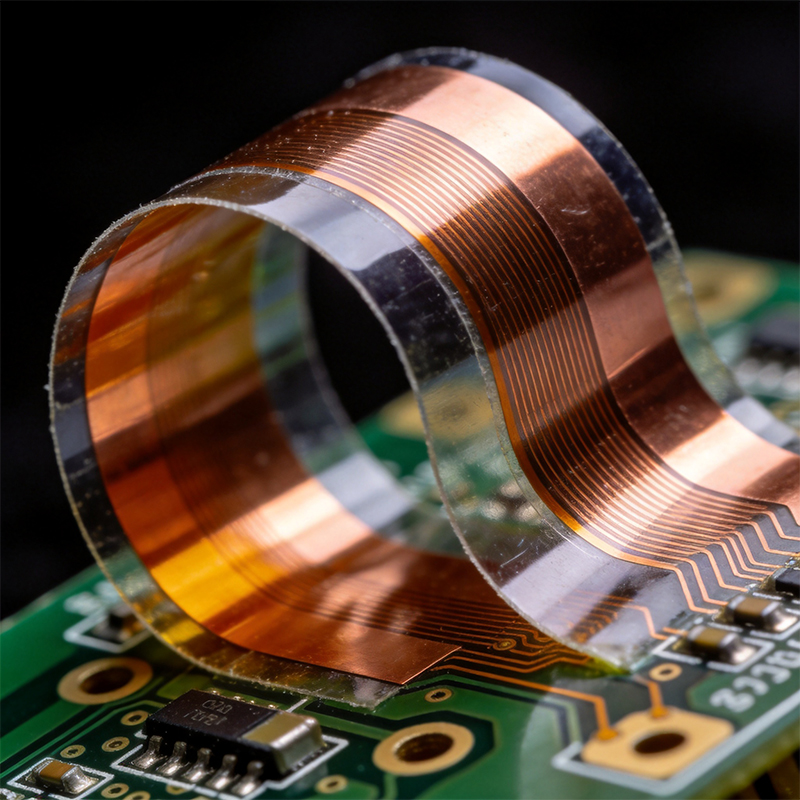
In 2026, with AI and 6G everywhere, standard materials often can't keep up. Signals start to "leak" out of the traces at high frequencies.
This is where specialized materials like Rogers or Taconic come in. These aren't just fiberglass; they use ceramic or PTFE (Teflon) to ensure that your high-speed data arrives where it’s supposed to without getting messy. They are much more expensive than FR-4, but if you're building a radar or a high-speed router, they are non-negotiable.
Finally, we have the "skin." That green color we all know is the solder mask. Its main job isn't to look pretty; it's to keep the solder from sticking where it shouldn't and to prevent shorts. On top of that, we have the silkscreen—the white text that tells you where "R1" or "C5" is.
Picking the right materials for your circuit board isn't just about price; it’s about environment and performance. If you're building a simple toy, stick with FR-4. If it's a foldable gadget, go for Polyimide. And if you're pushing the limits of speed, invest in high-frequency laminates. Your hardware (and your sanity) will thank you!

Kaboer manufacturing PCBs since 2009. Professional technology and high-precision Printed Circuit Boards involved in Medical, IOT, UAV, Aviation, Automotive, Aerospace, Industrial Control, Artificial Intelligence, Consumer Electronics etc..


 English



 Wechat
 +86 13670210335
 +86 13670210335
 E-mail