
Date: 2026-07-14
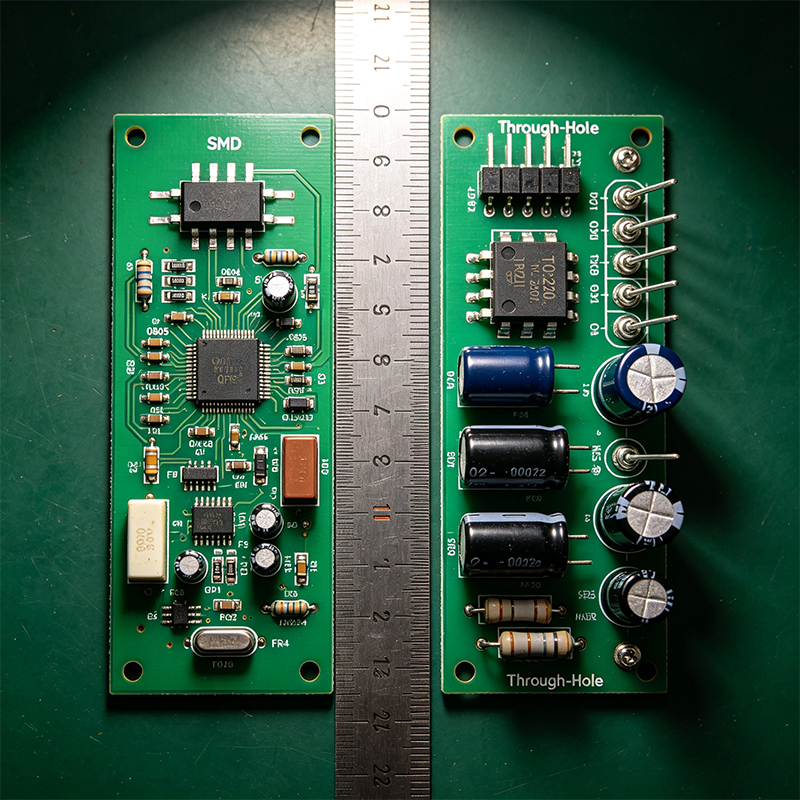
You've definitely seen both types of components on a circuit board. Flat little squares sitting right on the surface, and older-style parts with long metal "legs" poking through to the other side. These two different mounting methods represent two completely different approaches to electronics assembly——Surface Mount Technology (SMT) and Through-Hole Technology (THT).
In this guide, I'll explain what each technology is, their pros and cons, where they're used, and how to choose between them. Plain English, no fluff.
Surface Mount Technology (SMT) is the process of mounting components directly onto the surface of a circuit board.
Components assembled with SMT are called Surface Mount Devices (SMDs) . They don't have long leads——instead, they have very short terminals, pads, or solder balls. SMDs sit directly on the board's surface pads and are secured with solder paste and reflow soldering.
Think of it this way: SMT is like placing flower pots on the ground——no digging required.
Through-Hole Technology (THT) is the process of inserting component leads through pre-drilled holes in the circuit board and soldering them on the opposite side.
THT components typically have long metal leads that pass through the board and extend to the back, where solder secures the leads to the hole walls.
Think of it this way: THT is like planting trees——the roots must go through the soil to stand firm.
Here's a quick comparison:
| Feature | SMT (Surface Mount) | THT (Through-Hole) |
|---|---|---|
| Mounting method | Components sit on the board surface | Leads pass through holes, soldered on the back |
| Drilling required? | No | Yes——holes must be drilled |
| Component size | Small, lightweight, flat | Large, heavy, with long leads |
| Board utilization | Double-sided, very high density | Usually single-sided, lower density |
| Assembly method | Fully automated (pick-and-place + reflow) | Manual or wave soldering |
| Assembly speed | Very fast (>100k parts/hour) | Slow (manual insertion is the bottleneck) |
| High-volume cost | Low | High |
| Mechanical strength | Moderate——needs reinforcement | Very strong——excellent for vibration and shock |
| High-frequency performance | Excellent (GHz-capable) | Poor (large parasitic effects) |
| Repair difficulty | Difficult (needs hot air or X-ray) | Relatively easy (just a soldering iron) |
| Typical applications | Phones, computers, wearables | Power supplies, connectors, aerospace/military |
Advantages:
Smaller and lighter: SMD components are tiny and lightweight, fitting more components in the same space.
Higher density: No holes needed, and both sides of the board can be populated.
Faster: Automated pick-and-place machines can place over 100,000 parts per hour.
Better high-frequency performance: Extremely short leads mean parasitic inductance and capacitance are an order of magnitude lower than THT.
Lower cost at scale: Highly automated——lower per-board cost at high volume.
Disadvantages:
Weaker mechanical strength: Solder joints rely on surface tension——not as strong as THT.
Difficult to repair: Tiny components require hot air stations and microscopes.
Design requirements: Requires precise pad design and strict DFM rules.
Advantages:
Excellent mechanical strength: Leads pass through the board——great for vibration and shock.
Easy to repair: Leads are accessible——just use a soldering iron.
Good heat dissipation: Leads and large solder joints conduct heat away.
Beginner-friendly: Large leads are easy to handle and solder.
Disadvantages:
Takes up space: Long leads and large packages——not suitable for miniaturization.
Slow: Requires manual or semi-automated insertion——efficiency bottleneck.
Higher cost: Requires drilling, more materials, more labor.
Poor high-frequency performance: Long leads introduce parasitic inductance and capacitance——high-frequency signals can't get through.
Choose SMT when: Your product needs miniaturization, high density, high-volume production, or handles high-frequency signals (smartphones, computers, wearables, IoT, medical devices).
Choose THT when: You need high mechanical strength, high power, frequently plugged connectors, or the product operates in harsh environments (power supplies, industrial equipment, aerospace/military).
Mixed assembly: Most modern electronics actually use SMT + THT mixed——SMT for high-density sections, THT for connectors and power components. For example, a computer motherboard has densely packed chips using SMT, but the USB ports and power sockets——the parts that get plugged and unplugged frequently——use THT.
The quality of both SMT and THT soldering is governed by IPC-A-610, which defines what acceptable solder joints should look like. Regardless of which technology you use, this is the standard for acceptance.
SMT and THT aren't about "good" vs "bad"——they're about what fits your needs. SMT is the workhorse of modern electronics miniaturization; THT remains essential where reliability and power handling matter most. Smart design knows when to use SMT, when to use THT, and when to combine them.

Kaboer manufacturing PCBs since 2009. Professional technology and high-precision Printed Circuit Boards involved in Medical, IOT, UAV, Aviation, Automotive, Aerospace, Industrial Control, Artificial Intelligence, Consumer Electronics etc..


 English



 Wechat
 +86 13670210335
 +86 13670210335
 E-mail