
Date: 2026-01-24
Imagine building a complex server, a powerful network switch, or a industrial control system. You have all the key components: the processor board, the memory cards, the storage drives, and the network interfaces. Now, how do you make them all talk to each other at lightning speed, reliably, and in an organized way? You don't connect them with a tangled mess of individual cables. Instead, you plug them all into a common, structured backbone. That backbone is called a backplane.
Think of it as the central nervous system or the main highway interchange inside an electronic chassis. Its primary job isn't to process data, but to be the ultra-reliable, high-speed platform that allows all the other intelligent cards (often called "daughterboards" or "blades") to connect and communicate.
To understand a backplane, it helps to compare it to something more familiar: the motherboard in your computer.
A Motherboard is the active, intelligent hub. It has a CPU socket, memory slots, and chipsets soldered directly onto it. Its components define the computer's core capabilities. It's like a city's central downtown, where the major offices, government, and services are built right into the streets.
A Backplane is typically a passive, connective hub. It usually has no major processing chips on it. Instead, it's covered with rows of standardized slots and connectors. Its intelligence comes from the specialized cards you plug into it. It's like a city's grand central train station. The station itself doesn't create the trains or decide their destinations; it provides the tracks, platforms, and signaling systems that allow many different train lines (the cards) to efficiently connect and transfer passengers (data).
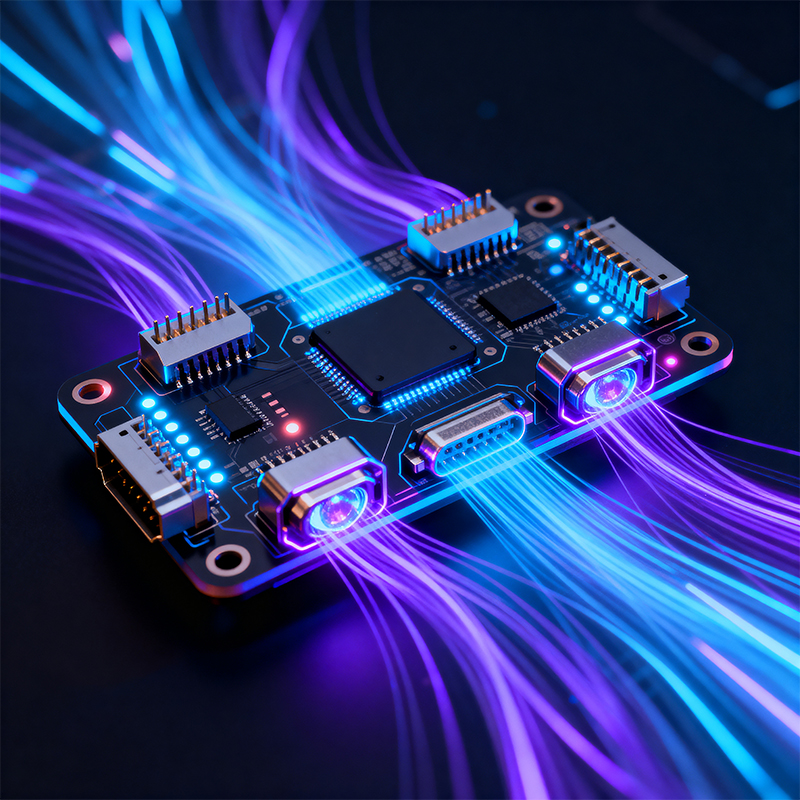
A backplane is essentially a highly specialized, oversized printed circuit board (PCB). But instead of being populated with chips and resistors, it's designed with one main feature: high-density connectors.
Physical Structure: It's mounted permanently inside a rack or chassis. On one side (usually the front), you see slots where you can slide in various cards, like a server blade or a network interface card. On the other side, the backplane is a maze of copper traces that route signals and power between all these slots.
The Connection Magic: When you insert a card, its edge connector mates with a corresponding connector on the backplane. Instantly, that card is electrically connected to a shared power supply and a common data "bus" or a network of high-speed serial links (like Ethernet or PCI Express) that link all the slots.
Communication Pathways: The traces on the backplane create the predetermined pathways for data and power. A well-designed backplane ensures signals travel cleanly and quickly from any slot to any other slot, minimizing delays and interference.
Why go through the trouble of this extra layer? Because backplanes solve big system-level problems:
Modularity & Scalability: This is the biggest benefit. Need more processing power? Add another CPU card. Need more network ports? Insert another interface card. You can upgrade or repair the system by swapping cards, not by replacing the entire chassis. It's the ultimate "Lego block" approach to system design.
High Reliability & Serviceability: Since the backplane itself is passive (no chips to burn out), it's extremely reliable. If a single card fails, a technician can often hot-swap it (replace it without powering down the whole system) while the rest of the system keeps running.
Optimized Signal Integrity & Power Distribution: Designing a single, robust backbone for all high-speed signals is easier than trying to manage dozens of separate cables. The backplane provides clean, controlled-impedance pathways and stable, distributed power to every slot.
Space Efficiency & Organization: It eliminates a rat's nest of point-to-point wiring inside the chassis, allowing for better airflow, cooling, and a much cleaner, more serviceable layout.
Not all backplanes are just dumb connectors.
Passive Backplane: The purest form. It contains only connectors and traces. All processing and control logic resides on the cards plugged into it. Most classic telecom and industrial systems use these.
Active Backplane: Includes some basic circuitry, like buffer chips or signal repeaters, to clean up and boost signals as they travel across the board. This helps maintain signal integrity over longer distances or in very dense systems.
Intelligent Backplane (or Managed Backplane): Contains embedded controllers that manage system functions like power sequencing, hot-swap control, and system health monitoring. It acts as a simple supervisor for the whole chassis.
Backplanes are the unsung heroes in equipment where uptime, density, and expansion are critical:
Telecommunications: Network routers and switches.
Data Centers: Server blades and storage arrays.
Industrial Automation: PLC (Programmable Logic Controller) racks and control systems.
Military & Aerospace: Avionics and radar systems.
Medical Imaging: MRI and CT scan machines.
So, what is a backplane? It's the fundamental architectural choice for building scalable, reliable, and high-performance electronic systems. It's the silent, sturdy platform that turns a collection of powerful components into a cohesive, flexible machine.
When you see a sleek server rack or a complex piece of industrial gear, remember that its true capability for growth and resilience likely hinges on the robust, interconnected world of its backplane. It's not the brain, but it is most certainly the strong and dependable spine.

Kaboer manufacturing PCBs since 2009. Professional technology and high-precision Printed Circuit Boards involved in Medical, IOT, UAV, Aviation, Automotive, Aerospace, Industrial Control, Artificial Intelligence, Consumer Electronics etc..


 English



 Wechat
 +86 13670210335
 +86 13670210335
 E-mail