
Date: 2026-07-27
You've definitely seen them before. Those small cylindrical components with colorful stripes on circuit boards—brown, beige, rings of color like a rainbow candy. They're everywhere, packed tightly on boards, looking unremarkable. But almost every circuit board needs them. They're called carbon film resistors.
Carbon film resistors are one of the most common, most fundamental, and most "low-key" components in electronics. They're not as smart as chips, not as flashy as LEDs, but they're one of the most widely used components in circuits—phones, TVs, radios, chargers, almost every electronic product has them. In this guide, I'll explain what a carbon film resistor is, how it works, what makes it special, and where it's used. Plain English, no fluff.
A carbon film resistor is a type of fixed resistor. Its core is a ceramic rod covered with an extremely thin carbon film—that carbon film is the "resistive element". When current flows through this carbon film, the carbon material resists the flow of electricity, converting electrical energy into heat.
How is it made? Simply put, hydrocarbon gas is decomposed under high temperature and vacuum, depositing carbon onto a ceramic rod to form a crystalline carbon film. The thickness of this carbon film determines the resistance value—thinner film means higher resistance. A spiral groove is then cut into the film to precisely adjust the resistance, leads are attached, and a protective coating is applied.
Carbon film resistors have a wide resistance range, from 1Ω to 10MΩ. Common power ratings include 0.125W, 0.25W, 0.5W, 1W, 2W, 5W, and 10W. The operating temperature range is -55°C to +155°C.
A carbon film resistor works on a very simple principle—it uses the inherent resistance of carbon material to impede current.
Think of a carbon film resistor like a narrow section in a water pipe. Water (current) flows through and encounters resistance—flow slows down and pressure drops. That's exactly what a resistor does—it holds back some of the current and dissipates the excess energy as heat.
When current flows through the carbon film, electrons collide with atoms in the carbon material, slowing down and generating heat. That's why resistors get hot—not because they "want" to, but because electrons are bumping into things.
How is the resistance value controlled? Two methods: controlling the carbon film thickness—thinner film means higher resistance; and spiral grooving—cutting a helical groove into the carbon film. The tighter the groove spacing, the longer the current path, and the higher the resistance.
Carbon film resistors became one of the most widely used resistors in circuits because of these key strengths:
Advantages:
1. Cheap—This is the biggest advantage. Simple manufacturing, inexpensive raw materials, extremely low cost in high-volume production. In budget-constrained projects, carbon film resistors are the go-to choice.
2. Wide resistance range—From 1Ω to 10MΩ, covering almost all common needs.
3. Good high-frequency characteristics—Low parasitic inductance, suitable for high-frequency signal processing.
4. Low noise—Much lower noise than older carbon composition resistors.
5. Stable performance—Voltage changes have minimal effect on resistance, with good long-term stability.
Disadvantages:
1. Low precision—Common tolerance is only ±5%, with some reaching ±2%, but that's far from metal film's ±1% or even ±0.1%.
2. Higher temperature coefficient—Carbon film resistors have a negative temperature coefficient (NTC)—resistance decreases as temperature increases. Variation ranges from -200 to -1000 ppm/°C. In environments with large temperature swings, resistance will drift.
3. Long-term drift—Resistance slowly changes over time. This can be an issue in precision circuits.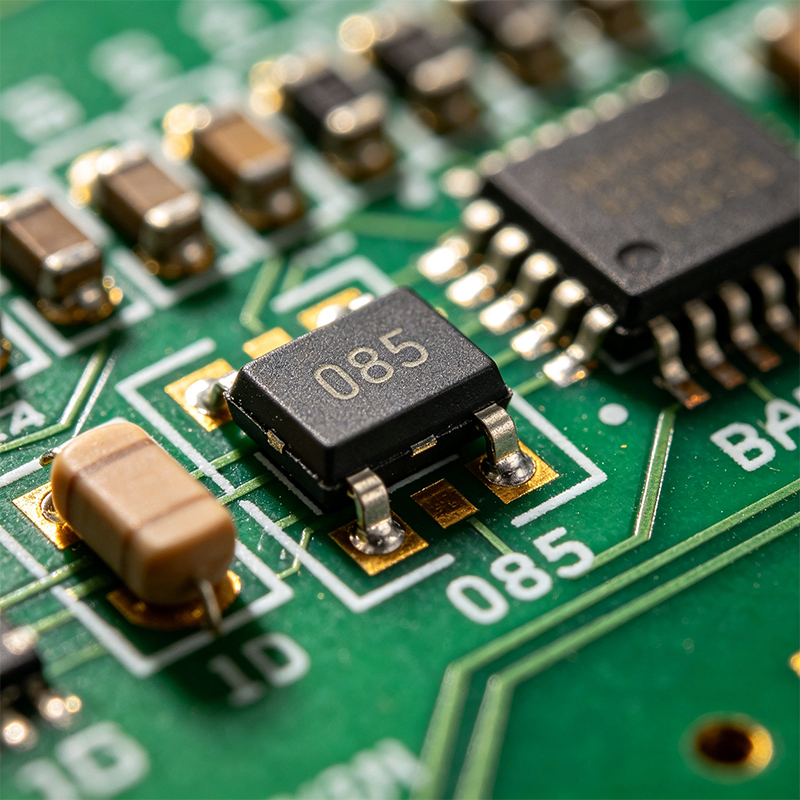
This is the most common question. Here's a quick comparison:
| Feature | Carbon Film | Metal Film |
|---|---|---|
| Resistive material | Carbon film | Metal film (nickel-chromium, etc.) |
| Tolerance | ±2% ~ ±10% | ±0.1% ~ ±1% |
| Temperature coefficient | -200 ~ -1000 ppm/°C | Extremely low (as low as 5 ppm/°C) |
| Noise | Moderate | Very low |
| Long-term stability | ~±1%~±5% drift/year | ~±0.1%~±0.5% drift/year |
| Cost | Low | High (3~10× more) |
| Best for | Cost-sensitive, general circuits | Precision, high-frequency, high-reliability |
One-sentence summary: if you need cheap and good enough → carbon film. If you need precision, stability, and low noise → metal film.
Carbon film resistors are everywhere in electronics:
Consumer electronics: Radios, TVs, computers, recorders
Power supplies: Phone chargers, computer power supplies
Current limiting, voltage division, filtering: General-purpose circuits
High-voltage applications: Operating voltage up to 15kV—used in high-voltage power supplies, radar, X-ray
High-temperature applications: Operating temperature up to 350°C
Carbon film resistors are typically marked with color bands. Four or five colored rings—each color represents a digit or multiplier. Four-band resistors are most common; five-band types are used for tighter tolerances.
Some resistors also have direct numeric markings, like "473" meaning 47kΩ.
A carbon film resistor is a resistor made by depositing a carbon film on a ceramic rod.
It's cheap, has a wide resistance range, and offers good high-frequency performance—making it one of the most widely used resistors in circuits. Phones, TVs, chargers, power supplies—almost every electronic product contains them. But it has low precision and a higher temperature coefficient, making it unsuitable for precision circuits. When choosing resistors: cheap and good enough → carbon film; precision and stability → metal film.

Kaboer manufacturing PCBs since 2009. Professional technology and high-precision Printed Circuit Boards involved in Medical, IOT, UAV, Aviation, Automotive, Aerospace, Industrial Control, Artificial Intelligence, Consumer Electronics etc..


 English



 Wechat
 +86 13670210335
 +86 13670210335
 E-mail