
Date: 2026-07-29
You've definitely experienced it before. A phone placed too close to a speaker, and the speaker starts buzzing. Or a charger plugged in, and your wireless mouse starts acting up. These are all signs of the same problem — electromagnetic interference (EMI).
EMI is the invisible killer of electronic devices. If your product fails FCC or CE certification, it simply can't go to market. In this guide, I'll explain what electromagnetic shielding is, why circuit boards need it, and what the common shielding methods are. Plain English, no fluff.
On a single circuit board, high-speed clock signals run alongside switching power supply noise, RF antenna radiation, and all kinds of USB, PCIe, and HDMI noise. It's like a room full of people shouting at the same time — nobody can hear what anyone else is saying.
EMI has three main consequences:
Self-interference: Signals inside the board crosstalk, causing data errors and system crashes.
Interfering with others: The device radiates noise that disrupts nearby electronic equipment.
Being interfered with: External electromagnetic signals leak into your device, disrupting sensitive circuits.
If left unchecked, your product could be unstable at best, or blocked from the market by regulators at worst.
Electromagnetic shielding relies on three mechanisms working together: reflection, absorption, and grounding.
Reflection: When an electromagnetic wave hits a metal surface, most of its energy bounces back — like sunlight off a mirror. The better the conductivity, the stronger the reflection.
Absorption: Some of the wave penetrates the metal and is converted into tiny amounts of heat inside the material. Thicker materials with higher conductivity and magnetic permeability absorb more energy.
Grounding: This is the most critical step. If a shield isn't grounded, it doesn't protect your circuit — it becomes an antenna that radiates noise everywhere.
The three work together synergistically. Shielding effectiveness is measured in decibels (dB). Consumer electronics typically need 30-60dB, industrial systems need 60-80dB, and medical devices require even more — 80-100dB or higher.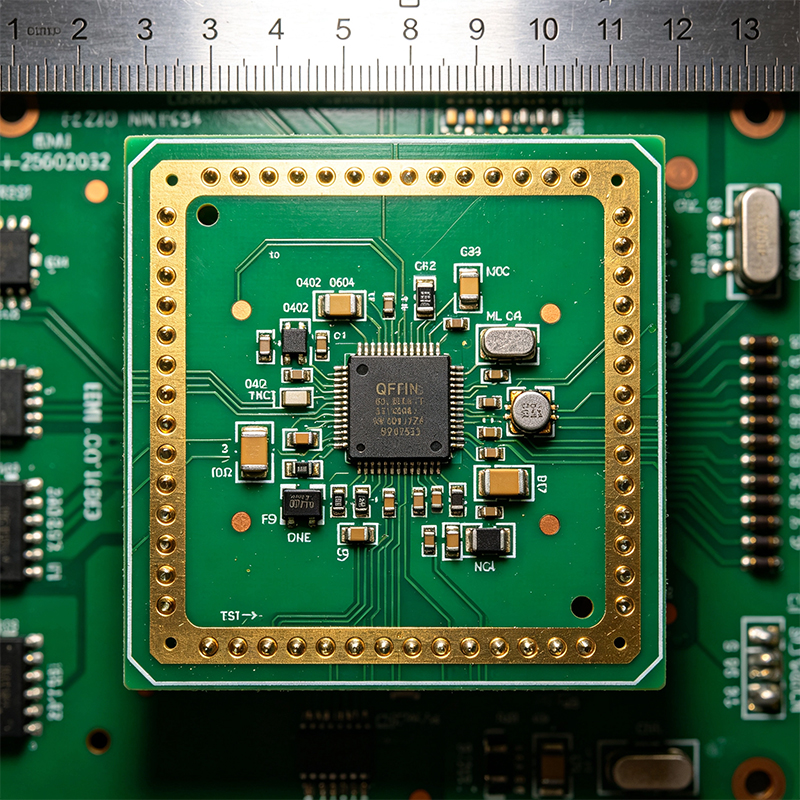
At the board level, several shielding methods are commonly used:
Shielding Cans
A shielding can is simply a metal "cap" placed over sensitive components. RF modules, WiFi and Bluetooth chips, and sensitive analog circuits usually have one of these metal covers on top.
A shielding can is a grounded conductive box. When an electromagnetic wave hits the metal surface, it induces currents in the conductor, which are shunted to the ground plane, preventing the wave from penetrating the enclosure.
Shielding cans are typically made of tin-plated steel or nickel silver, effectively blocking high-frequency electromagnetic fields. The edges of the can must be connected to the ground plane through a dense array of grounding vias (via stitching), ensuring the shield is grounded everywhere.
Conductive Coatings
Sometimes a shielding can is too bulky or heavy. Conductive coatings can be applied as a spray-on "conductive jacket" in the areas that need protection.
Ground Planes and Via Stitching
On multi-layer boards, a solid ground plane is itself a natural shield. In areas that need isolation, rows of grounded vias form a "fence" around sensitive signals, separating them from surrounding noise. Industry practice recommends via spacing of one-twentieth to one-tenth of the wavelength at the highest interfering frequency. At edges, place vias every 1-2mm, with tighter spacing at corners.
Common shielding materials include:
Copper and aluminum foil: Excellent conductivity, strong reflection — the workhorses of PCB shielding.
Tin-plated steel and nickel silver: Common materials for shielding cans, effectively blocking high-frequency fields.
Conductive foam and conductive elastomers: Gap-filling "weatherstripping" that provides both EMI shielding and moisture sealing.
Conductive inks: Silver paste printed on flexible boards — balancing flexibility with shielding.
If your product uses flex PCBs or rigid-flex boards, shielding gets significantly more challenging.
Flex boards don't have the solid ground planes of rigid boards, signals and noise couple more tightly, and repeated flexing can fatigue the shield. Shielding flex boards typically uses three methods:
Copper Layer Shielding: Adding a copper plane to the flex stackup — either solid or cross-hatched. Solid copper provides the best shielding (60-80dB) but reduces flexibility. Cross-hatched copper sacrifices about 30% of shielding effectiveness for better bendability.
Silver Ink Printing: Printing a conductive silver layer on the flex surface. Good flexibility, suitable for dynamic bending areas.
EMI Shielding Film: Specially designed shielding films laminated directly onto the board surface. Best flexibility and thinnest profile, but highest cost.
The global EMI shielding market was valued at approximately $8.0-9.4 billion in 2026** and is projected to reach **$10.9-14.2 billion by 2032. The rapid growth tells one clear story: as electronics get smaller and frequencies climb higher, shielding becomes more critical.
Electromagnetic shielding uses conductive or magnetic materials to keep electromagnetic fields where they belong — preventing them from escaping or entering.
It works through a combination of reflection, absorption, and grounding. On circuit boards, shielding cans, conductive coatings, ground planes, and via stitching are all common shielding methods. Flex and rigid-flex boards present greater shielding challenges, requiring trade-offs between flexibility and shielding effectiveness.
We are a custom manufacturer of flexible PCBs, rigid-flex boards, HDI high-frequency boards, and full PCBA services. Whether it's rigid, flexible, or rigid-flex, we can help you design and manufacture with the right EMI shielding solution — ensuring your product passes EMC testing and gets to market smoothly.

Kaboer manufacturing PCBs since 2009. Professional technology and high-precision Printed Circuit Boards involved in Medical, IOT, UAV, Aviation, Automotive, Aerospace, Industrial Control, Artificial Intelligence, Consumer Electronics etc..


 English



 Wechat
 +86 13670210335
 +86 13670210335
 E-mail