
Date: 2026-07-27
You've definitely seen it in factory videos. A circuit board placed under bright lights, with an inspector holding a magnifying glass and examining every inch of it like a detective looking for clues. Sometimes it's not a person doing the job — it's a machine, snapping high-resolution photos and telling you in seconds where the problems are.
This "searching for flaws" step is called FQC.
FQC stands for Final Quality Control. It's the last quality inspection checkpoint in the circuit board production process. Every product must pass this check before it leaves the factory. Pass — it gets packaged and shipped. Fail — it goes back for rework or gets scrapped.
In this guide, I'll explain what FQC is, what it checks, how it's done, and how it differs from other quality checks. Plain English, no fluff.
FQC is the final quality check on the circuit board production line.
Think of it like airport security. You've checked in your bags, but before you board the plane, there's one last checkpoint — security screening. Pass that, and you can get on the plane. FQC is that security checkpoint for circuit boards.
FQC has one goal: to ensure that every board leaving the factory is合格.
If a board has a problem, FQC catches it before it reaches the customer. In the factory, this step is typically placed after all production is complete and before packaging.
FQC isn't the only quality check in a factory. Quality checks happen at multiple stages:
IQC (Incoming Quality Control) : Checks incoming materials — are the components and PCB substrates合格?
IPQC (In-Process Quality Control) : Checks during production — are components placed correctly? Is the soldering temperature right?
FQC (Final Quality Control) : The final comprehensive check after all processes are complete.
OQC (Outgoing Quality Control) : The final spot check before shipping, after FQC.
IQC manages what comes in, IPQC manages the process, FQC manages the finished product, and OQC manages what goes out. FQC is the most thorough and strictest inspection on the entire production line.
FQC isn't just a quick glance. It's detailed and follows clear standards.
1. Visual Inspection
This is the most basic and most important part of FQC. Inspectors look for:
Solder mask (green coating) : Dirt, debris, misalignment, exposed copper
Silkscreen text : Blurred, incomplete, or misaligned text
Board edges : Burrs, white spots
Surface finish : Uneven coating, oxidation
These checks can be done manually (with magnifying glasses under standard lighting) or with AVI (Automated Visual Inspection) machines that compare photos to a reference.
2. Hole Quality
Checking whether holes are blocked and whether they've been filled as required. Typically done by holding boards up to light, or using automated hole inspection machines.
3. Board Warpage Check
If a board is bent or warped, it causes major problems during SMT assembly — cold joints, tombstoning, poor soldering. FQC measures flatness using standard methods.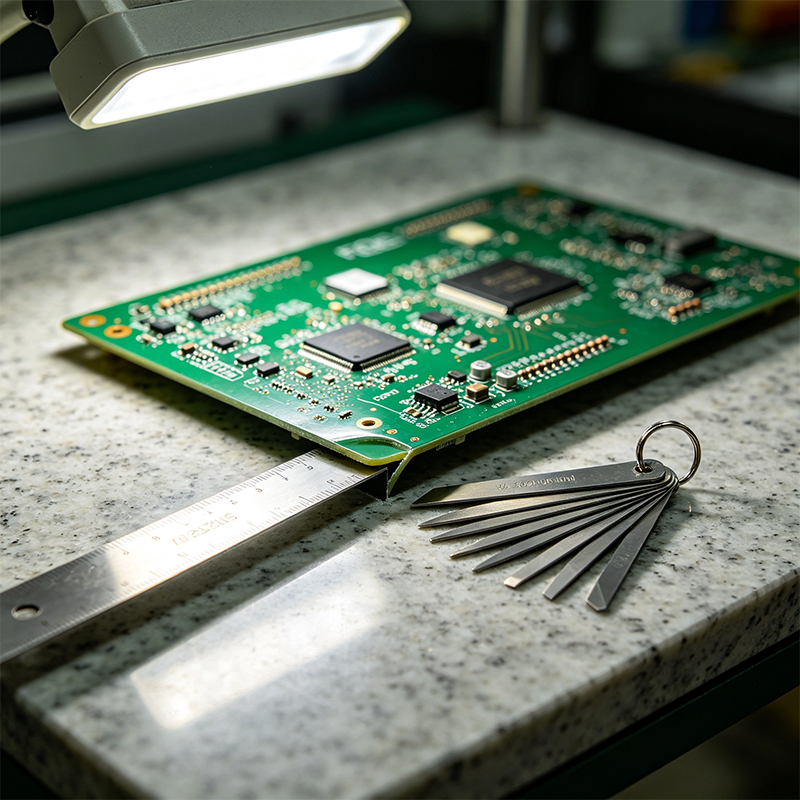
4. Functional Testing
After visual inspection, boards are powered up and tested. Specialized equipment simulates real operating conditions to verify that the board works.
5. Reliability Testing
Some products also undergo environmental testing — high temperature, low temperature, high humidity — to see if the board can survive extreme conditions.
FQC doesn't rely on "the inspector's feeling." It follows clear industry standards.
The most common standards are IPC-A-600 (Acceptability of Printed Boards) and IPC-A-610 (Acceptability of Electronic Assemblies). These standards use hundreds of color photos and illustrations to show what's acceptable and what's not.
Most visual inspection items in FQC can be found in IPC standards. A few items not explicitly covered are determined by agreement between the customer and the supplier.
IPC standards divide products into three classes:
Class 1: General consumer electronics — more relaxed standards
Class 2: Industrial, communications equipment — moderate standards
Class 3: Medical, military, aerospace — the strictest standards
Your product's class determines which FQC standards apply.
FQC's value goes beyond just "picking out bad boards."
First, it's the last line of defense.
Every previous step — placement, soldering, testing — can introduce defects. FQC is the final checkpoint that catches what was missed earlier.
Second, it reduces rework costs.
Fixing a board at the factory costs a few dollars. Finding the problem after it reaches the customer means returns, rework, and compensation — costs that are dozens or even hundreds of times higher.
Third, it builds customer trust.
When customers receive good boards, they come back for more.
FQC (Final Quality Control) is the last quality checkpoint before circuit boards ship.
It checks visual appearance, hole quality, board warpage, and runs functional and reliability tests. It uses international standards like IPC-A-600 and IPC-A-610 as its judgment basis. Together with IQC (incoming inspection) and IPQC (in-process inspection), it forms a complete quality control chain.

Kaboer manufacturing PCBs since 2009. Professional technology and high-precision Printed Circuit Boards involved in Medical, IOT, UAV, Aviation, Automotive, Aerospace, Industrial Control, Artificial Intelligence, Consumer Electronics etc..


 English



 Wechat
 +86 13670210335
 +86 13670210335
 E-mail