
Date: 2026-06-27
You've probably had this happen. A circuit board passes every functional test. It works perfectly. You ship it to your customer. A few weeks later, it fails — short circuit, leakage, or even burns out. What went wrong?
The problem was hiding in the insulation. Some defects only show up when you push them with high voltage.
That "push" is called a Hi-Pot test.
Hi-Pot stands for High Potential Test. It's also called a Dielectric Withstand Voltage (DWV) test. Simply put, it's applying a much higher voltage than normal to a circuit board to see if the insulation can handle it.
In this guide, I'll explain what a Hi-Pot test is, why you need it, how it's done, how to set the voltage, and what counts as a failure. Plain English, no fluff.
Here's the core question: a Hi-Pot test doesn't check if the circuit works — it checks if the insulation is good.
Between copper traces, between different layers, between components and the chassis — there's insulation everywhere. PCB substrate, optocouplers, transformers, and even air gaps all act as insulation. Their job is to keep electricity where it belongs.
But insulation isn't always perfect. Manufacturing can introduce micro-cracks, bubbles, or contamination. Materials can age or absorb moisture. At normal voltage, these defects might not cause problems. But during voltage spikes, lightning strikes, or switching surges, they can break down instantly — damaging the device or even causing a fire.
A Hi-Pot test simulates these extreme conditions — applying a much higher voltage than normal to see if the insulation can survive. If it survives, the insulation is good. If it fails (leakage current spikes or the insulation breaks down), there's a hidden problem.
A Hi-Pot test isn't optional in many industries — it's mandatory.
Reason 1: Find hidden manufacturing defects
Some defects are invisible to the eye and undetectable with a multimeter. Micro-bubbles between PCB layers, insufficient insulation thickness, micro-cracks from soldering. Only high voltage forces these problems to reveal themselves.
Reason 2: Meet safety certification requirements
If you're exporting to the US or Europe, you'll need UL, CE, or CSA certification. Almost all of these require Hi-Pot testing. Without it, your product can't get certified and can't enter the market.
Reason 3: Protect your users
This is the most important reason. Insulation failure can cause electric shock, fire, and equipment damage. A product that hasn't passed Hi-Pot testing is a ticking time bomb.
The principle is simple: apply high voltage between two points that should be isolated, and measure the leakage current.
"Two points" could be:
Power input and ground
Primary and secondary circuits
Circuit and chassis (or exposed metal)
Power and ground planes in a PCB
The voltage starts at zero and ramps up slowly over 1 minute to the target value. Then it's held for a set time — typically 60 seconds for type testing, or 1-2 seconds for production line testing (with the voltage increased by about 20%). During the test, the instrument continuously monitors leakage current.
Test voltage isn't random — there's a standard formula. The most common rule is "2 × working voltage + 1000V".
Example: For a product with 220V working voltage, basic insulation test voltage is 220 × 2 + 1000 = 1440V, typically rounded to 1500V.
But different standards and product types have different requirements:
| Standard / Scenario | Formula | Example (220V working) |
|---|---|---|
| IEC 60950 (IT equipment) | Working × 1.414 + 1000V (basic) | 220×1.414+1000≈1310V → 1500V |
| IEC 60950 (reinforced) | Basic × 1.6 | 1500×1.6=2400V → 2500V |
| IEC 60601 (medical) | Working × 1.414 + 1500V (basic) | 220×1.414+1500≈1800V |
| IEC 60601 (reinforced) | Working × 1.414 + 3000V | 220×1.414+3000≈3300V |
| UL/CSA | Fixed values | 1250V AC or 1500V DC |
Important: Test voltage cannot exceed the component's own voltage rating (like Y-capacitors or optocouplers), or you'll damage the component.
Also, if you use DC instead of AC, the DC voltage needs to be √2 times (about 1.414×) the AC voltage to match the AC peak voltage.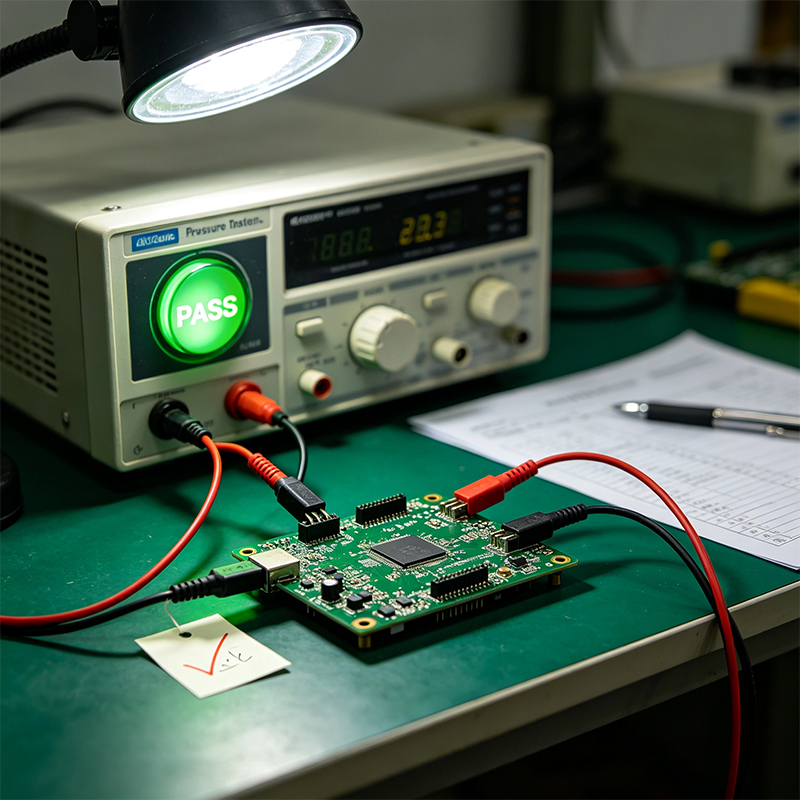
A Hi-Pot test doesn't just check "pass or fail" — it also measures leakage current.
Insulation isn't perfect. Under high voltage, a tiny current always flows through it. This is called leakage current. The lower the leakage current, the better the insulation.
Different products and standards have different limits:
| Standard / Scenario | Leakage Current Limit |
|---|---|
| IEC 60950 (basic insulation) | ≤3.5mA (AC) or ≤2mA (DC) |
| IEC 60950 (reinforced insulation) | ≤0.25mA |
| IEC 60601 (medical BF type, normal) | ≤0.1mA |
| IEC 60601 (medical BF type, single fault) | ≤0.5mA |
| Automotive (ISO 16750) | ≤1mA (500-1000V DC) |
| In-house standards | Often 50-80% of standard (safety margin) |
If leakage current exceeds the limit, the insulation is compromised. If it suddenly spikes (e.g., from 0.1mA to over 10mA), the insulation has broken down.
Failure isn't always a loud "pop." Three things count as failure:
First: Leakage current spikes — from microamps to milliamps, the instrument alarms.
Second: Test voltage drops — the voltage can't be maintained, meaning the insulation has broken down and created a conductive path.
Third: Visual or audible signs — sparks, smoke, or a "pop" sound.
Important distinction: Capacitive leakage current is normal — it rises slowly and stabilizes at a low value. Breakdown is sudden, irreversible.
Hi-Pot testing can be done with AC or DC — each has its pros and cons.
AC Hi-Pot:
Most common, simulates real-world voltage fluctuations
More sensitive to localized defects and weak spots
But capacitive loads (like circuits with Y-capacitors) produce larger capacitive current, which can cause false failures
DC Hi-Pot:
Lower leakage current, more precise insulation measurement
Can detect defects without causing localized breakdown
DC voltage must be √2× the AC voltage to be equivalent
A Hi-Pot test is applying a much higher voltage than normal to a circuit board to verify that the insulation can withstand it.
It doesn't test if the circuit works — it tests if the insulation is good. It finds hidden defects that are invisible to the eye and undetectable with a multimeter — micro-cracks, bubbles, material aging. Passing a Hi-Pot test is a requirement for UL, CE, and other safety certifications.

Kaboer manufacturing PCBs since 2009. Professional technology and high-precision Printed Circuit Boards involved in Medical, IOT, UAV, Aviation, Automotive, Aerospace, Industrial Control, Artificial Intelligence, Consumer Electronics etc..


 English



 Wechat
 +86 13670210335
 +86 13670210335
 E-mail