
Date: 2026-06-27
You're designing an electronic product. Maybe a wearable device, an industrial controller, a medical instrument, or an automotive sensor. You've drawn the schematic, picked the components, and received the bare boards. Now what? You need to mount those components onto the boards and turn them into working devices. That process is called PCBA.
PCBA stands for Printed Circuit Board Assembly. It's the process of mounting electronic components onto a bare PCB to create a functional, powered circuit.
Simply put, PCB is the empty board; PCBA is the finished, assembled product. Turning a bare board into a functional module involves solder paste printing, component placement, reflow soldering, inspection, and testing. In this guide, I'll explain what PCBA is, how it's done, how quality is controlled, and how to choose the right manufacturing partner. Plain English, no fluff.
These two terms are the most commonly confused in electronics manufacturing.
A PCB (Printed Circuit Board) is an empty board — it has copper traces and pads but no electronic components mounted on it. Think of it as a city's road network — the roads are built, but there are no houses or residents yet.
A PCBA (Printed Circuit Board Assembly) is the fully assembled board — components are soldered on, and it works when powered up. Think of it as a complete, functioning city — roads, houses, residents, everything works together.
Remember: PCB = bare board, PCBA = finished board.
A typical PCBA contains various components: resistors, capacitors, inductors, diodes, transistors, integrated circuits (ICs), connectors, crystals, and more. More components, higher density — the harder the PCBA becomes.
Turning a bare board into a finished assembly typically involves these steps:
Step 1: File Preparation and DFM Check
Before the board hits the production line, the factory needs a complete file package: Gerber files (defining board layers), BOM (listing all components), and Pick & Place files (telling the placement machine where each component goes and its orientation).
Once the files are received, the factory runs a DFM (Design for Manufacturing) check — looking for potential issues: do component footprints match the pads? Is there enough clearance between components? Are fiducials properly placed? This step catches problems before they become expensive physical defects.
Step 2: Solder Paste Printing
After DFM clearance, the board enters the SMT line. The first step is solder paste printing — using a stencil to deposit solder paste precisely onto the PCB pads. The paste is a mixture of microscopic solder spheres and flux. Modern lead-free processes typically use SAC305 alloy (96.5% tin, 3% silver, 0.5% copper).
Step 3: Component Placement (SMT)
With the solder paste printed, pick-and-place machines position components onto the pasted pads. High-speed machines handle small passives (0201, 0402). High-precision machines handle ICs (QFNs, BGAs).
Step 4: Reflow Soldering
The populated board goes through a reflow oven. Heat melts the solder paste, then cools it to solidify, permanently attaching the components to the board.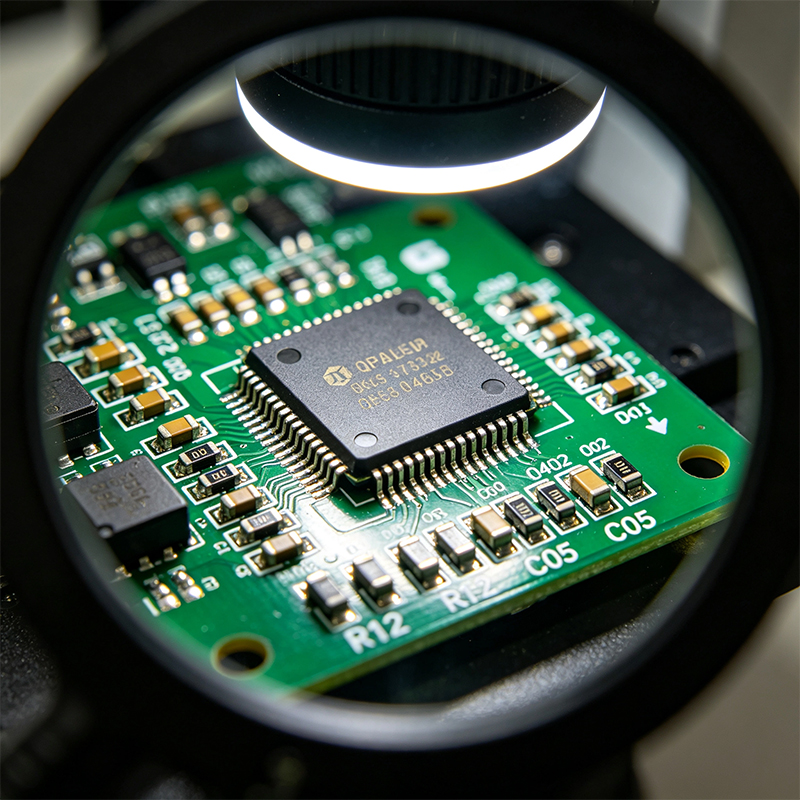
Step 5: Inspection (AOI, X-Ray)
After reflow, boards go through Automated Optical Inspection (AOI) — high-resolution cameras compare the board to a standard, automatically detecting missing parts, wrong polarity, bridging, tombstoning, and other defects. For hidden solder joints (like BGAs), X-Ray inspection checks for voids or bridging.
Step 6: Through-Hole Assembly (DIP/THT)
Some components (large capacitors, terminal blocks, connectors) can't be placed by SMT machines. They must be inserted manually or by machine, then wave-soldered or hand-soldered. This is called DIP or through-hole assembly.
Step 7: Testing (ICT, FCT)
After assembly, boards undergo electrical testing. ICT (In-Circuit Test) checks each component's soldering quality and circuit connections before power-up. FCT (Functional Test) powers up the board and simulates real operating conditions to verify functionality.
Step 8: Cleaning and Packaging
Passing boards are cleaned, dried, placed in ESD bags, padded with anti-static foam, and boxed for shipping.
PCBA quality isn't ensured by a "final check" — it's controlled at every step.
The most important quality standard is IPC-A-610 — the most widely used electronic assembly acceptance standard in the world. It uses hundreds of photos and illustrations to show what good solder joints look like versus bad ones.
IPC-A-610 divides electronic products into three classes:
Class 1: General consumer electronics. Function is all that matters — cosmetic imperfections are acceptable.
Class 2: Industrial and professional equipment. Requires continuous, reliable operation. Servers, communication equipment, and industrial instruments fall here.
Class 3: High-reliability products. Aerospace, medical, defense — one bad joint can cost lives. The strictest standards apply.
In manufacturing, PCBA quality control covers solder joint quality, component placement, polarity and orientation, mechanical integrity, and more.
If your product uses flex PCBs or rigid-flex boards, PCBA is significantly harder than rigid board assembly.
Flex boards lack rigidity — they warp, shift, and misalign during paste printing and placement. They must be mounted on rigid carriers from paste printing through placement and reflow.
The challenge with rigid-flex is thermal stress control at the rigid-to-flex transition. The rigid and flex sections expand at different rates during reflow. Poor temperature control causes cracking and delamination at the transition. Flex materials also absorb moisture, so they must be pre-baked before assembly to prevent delamination from steam during reflow.
The global PCBA market was valued at approximately $97.9 billion in 2025**, projected to reach **$103.4 billion in 2026 and $148.4 billion by 2032.
Key growth drivers include consumer electronics miniaturization, automotive electronics proliferation, and HDI demand driven by 5G and AI. If your product is in any of these areas, PCBA is a technology you can't ignore.
We are not a standard rigid-only PCB shop. We are a one-stop manufacturer that designs and makes flexible PCBs, rigid-flex boards, HDI high-frequency boards, and then does full PCBA.
All in-house: PCB fabrication, SMT, DIP, testing, and assembly under one roof. No hand-offs.
Flex/rigid-flex expertise: Dedicated carriers and reflow profiles for flex boards. Hundreds of flex PCBA projects completed.
High-precision placement: Supports 01005 passives, 0.4mm pitch QFN, and BGAs.
SPI + AOI + X-Ray: Every step from paste to final assembly is inspected.
In-house FCT fixture design: Custom functional test fixtures built for your product.
Free DFM review: Send your Gerber and BOM, get a DFM report within 24 hours with potential issues identified.
PCBA projects we've served: consumer electronics (TWS earbuds, smartwatches), industrial (PLCs, motor drives), automotive (BMS, camera modules), medical (patient monitors, glucometers), communications (routers, optical modules).
Three simple steps:
Send your files: Gerbers, BOM, and Pick & Place data if available.
We review and quote: Within 24 hours, you'll receive a DFM report, sample and volume pricing, and lead time estimate.
Sample, then scale: We build 10-20 samples. You test functionality and reliability. Then we move to pilot and volume production.
PCBA is the last mile from a drawing to a real product — and it's the step where the most can go wrong. One bad solder joint on a board with hundreds of components can kill the whole assembly.
If you're looking for a reliable PCBA partner, especially if your product involves flex PCBs, rigid-flex boards, or high-density SMT, send us your files. We won't push a contract — we'll first run a free DFM review and let our expertise speak.
When you contact us, please include:
Product type and basic functionality
Whether it uses flex or rigid-flex boards
Estimated annual quantity (samples, small batch, or mass production)

Kaboer manufacturing PCBs since 2009. Professional technology and high-precision Printed Circuit Boards involved in Medical, IOT, UAV, Aviation, Automotive, Aerospace, Industrial Control, Artificial Intelligence, Consumer Electronics etc..


 English



 Wechat
 +86 13670210335
 +86 13670210335
 E-mail