
Date: 2026-06-27
You've definitely seen flexible circuit boards. That thin yellow ribbon connecting your phone's screen to its motherboard. The bendable cable inside a foldable phone's hinge. The ultra-thin circuit inside a smartwatch. All of these can bend and flex because of one material: polyimide.
Polyimide (abbreviated PI) is a high-performance polymer material. DuPont has a famous brand called Kapton®, which is probably the most well-known polyimide product. But whatever you call it, it's essentially a high-performance "super plastic".
In this guide, I'll explain what polyimide is, what makes it special, and why flexible circuit boards can't live without it. Plain English, no fluff.
Polyimide is a high-performance polymer material. That sounds academic, but you only need to know three things:
It's incredibly heat-resistant: Its decomposition temperature typically exceeds 500°C. It can maintain structural integrity at temperatures above 400°C, and in some cases even approaching 600°C. Long-term operating temperature is 260°C, with short-term tolerance up to 400°C.
It's tough: Tensile strength can exceed 170MPa, with tensile strength reaching 220MPa. It's thin but tough — hard to tear.
It has excellent insulation properties: It's one of the most important high-temperature insulating materials in the electronics and motor industries.
In plain terms, polyimide is a plastic film that can handle extreme heat, is hard to tear, and doesn't conduct electricity. And it can be incredibly thin — as thin as 25 micrometers, thinner than a human hair.
Flexible circuit boards can bend and fold because polyimide is their base material.
Rigid boards use fiberglass (FR4) — stiff like a wooden plank. Polyimide is a film — like a plastic card — it bends, folds, and rolls.
In a flexible circuit board, polyimide does two jobs:
First, as the substrate: The copper traces are bonded onto the polyimide film. Just like a building needs a foundation, copper traces need a "base" — polyimide is that base.
Second, as the coverlay: Flexible boards don't use the green solder mask that rigid boards use. Instead, they use a polyimide coverlay to protect the copper traces. This coverlay prevents oxidation, scratches, and chemical corrosion, and can withstand over 200,000 bend cycles without cracking.
Polyimide dominates the flexible circuit board world because of several "superpowers":
Superpower #1: Extreme heat resistance
Most plastics soften at a couple hundred degrees. Polyimide can handle 260°C long-term and 400°C short-term. This means it can survive lead-free soldering temperatures and is used in automotive engine compartments and aerospace equipment.
Superpower #2: Thermal expansion matches copper
This is a critical property. Polyimide's coefficient of thermal expansion closely matches copper. What does that mean? When the board heats up, copper and polyimide expand at roughly the same rate. If they expanded at different rates, the copper traces would "peel" off the substrate. A matched thermal expansion coefficient means better reliability and longer life.
Superpower #3: Excellent dielectric properties
Polyimide can achieve a dielectric constant (Dk) below 2.8 (at 10GHz) and a dissipation factor (Df) below 0.003. This means minimal signal loss at high frequencies. For 5G, radar, and high-speed digital signals, this is a huge advantage.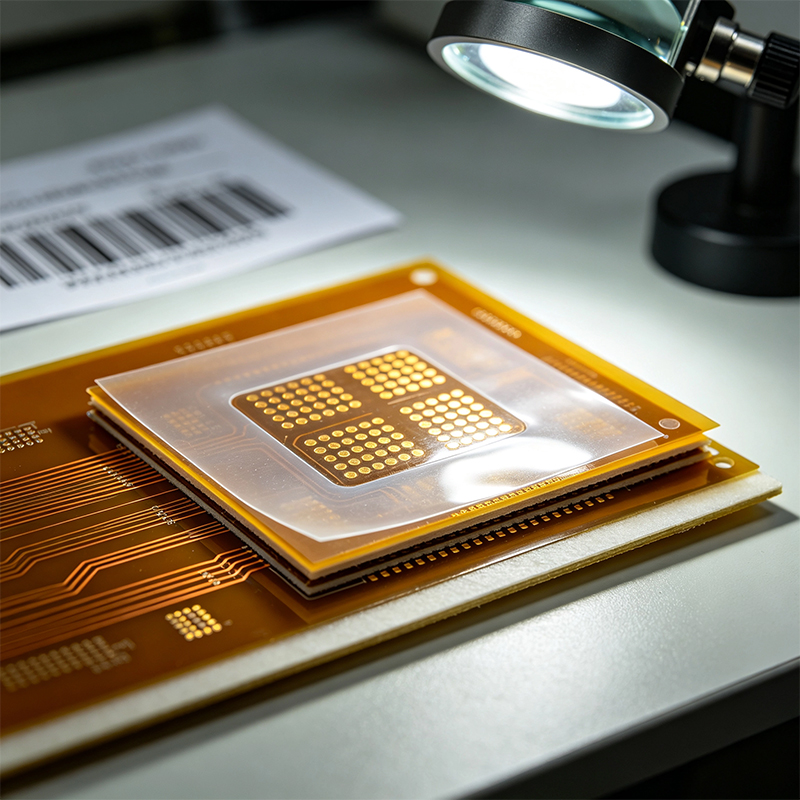
Superpower #4: Thin and lightweight
Polyimide film can be as thin as 25 micrometers. Flexible circuit boards can be under 0.1mm thick. This is over 70% lighter than rigid boards — ideal for drones, wearables, and medical implants.
Polyimide is far more common than you might think:
Consumer Electronics: Phones, tablets, smartwatches, TWS earbuds, foldable phones — anywhere that needs flexible circuits.
Automotive Electronics: EV battery management systems, automotive sensors, camera modules. Electronic components near the engine get very hot — polyimide can handle it.
Medical Devices: Pacemakers, defibrillators, medical monitoring equipment. These devices need to be tiny and extremely reliable — polyimide is the standard.
Aerospace: Satellites, aircraft instrumentation, communication systems. From the deep ocean to outer space, polyimide works.
5G and Communications: High-frequency, high-speed circuit boards need low-loss materials. Polyimide's low dielectric constant and low dissipation factor are exactly what 5G needs.
Polyimide is a super heat-resistant, tough, and highly insulating plastic film. It's the "soul material" of flexible circuit boards — it's both the substrate that copper traces sit on and the coverlay that protects them.
It can handle 260°C long-term, has a thermal expansion coefficient that perfectly matches copper, has excellent dielectric properties, and can be as thin as 25 micrometers. Phones, cars, medical devices, satellites, 5G — anywhere that needs "circuits that bend," you'll find polyimide.

Kaboer manufacturing PCBs since 2009. Professional technology and high-precision Printed Circuit Boards involved in Medical, IOT, UAV, Aviation, Automotive, Aerospace, Industrial Control, Artificial Intelligence, Consumer Electronics etc..


 English



 Wechat
 +86 13670210335
 +86 13670210335
 E-mail