
Date: 2026-07-29
You've definitely seen a computer CPU before — a square chip with a model number printed on top. But you might not know that some "chips" that look like a single piece of silicon are actually multiple chips packaged together as one. They share a common substrate and a single package, and from the outside, they look like a single chip. That's a multi-chip module.
A Multi-Chip Module (MCM) is an electronic assembly that incorporates multiple integrated circuits (ICs), semiconductor dies, and/or discrete components onto a single unifying substrate. Instead of packaging each chip separately and then mounting them on a PCB, MCM mounts the bare dies directly onto a common substrate and encapsulates them as one module.
Think of it like turning a three-bedroom apartment into an open loft — each room (chip) used to have its own door (package). Now you knock down the walls, share the living room and kitchen (substrate and package), and from the outside it looks like one big space.
In this guide, I'll explain what a multi-chip module is, how it works, how it differs from regular chips, and where it's used. Plain English, no fluff.
Single chips are getting bigger and more complex. But bigger chips have two problems:
First, lower yield. One defect anywhere on a large chip kills the whole chip. The larger the die, the higher the chance of hitting a defect.
Second, higher cost. The more advanced the process node, the more expensive it is. If you build the entire chip on the most advanced node, the cost skyrockets.
The MCM approach is simple: split a large chip into several smaller chips, manufacture them separately, and then assemble them together. Each smaller chip can be built on the process that suits it best — compute cores on the most advanced node, memory interfaces on cheaper, mature nodes. They get assembled together, delivering performance without the cost of a monolithic chip.
At the heart of every MCM is a substrate — a "baseboard" that all the chips sit on. The substrate has dense internal wiring that connects the chips to each other and to the outside world.
Chips are attached to the substrate in three main ways:
Wire bonding: Ultra-fine gold or copper wires connect pads on the chip to pads on the substrate.
Flip chip: The chip is flipped over, and solder bumps on its underside are directly soldered to the substrate — shorter signal paths.
Tape automated bonding: A flexible tape-like carrier connects the chip to the substrate.
Once assembled, the whole module is encapsulated in molding compound. From the outside, it looks like a single chip.
MCMs are classified by their substrate material:
MCM-L (Laminate Substrate)
The substrate is a multi-layer laminated PCB — the same material as a regular circuit board. Advantages: cheap and mature processes. Disadvantages: lower routing density. Suitable for cost-sensitive applications. AMD's Zen 2 processors use this approach.
MCM-C (Ceramic Substrate)
The substrate is ceramic, typically low-temperature co-fired ceramic. Advantages: high temperature resistance, high reliability, low signal loss. Disadvantages: expensive. Used in military and aerospace applications where reliability is critical.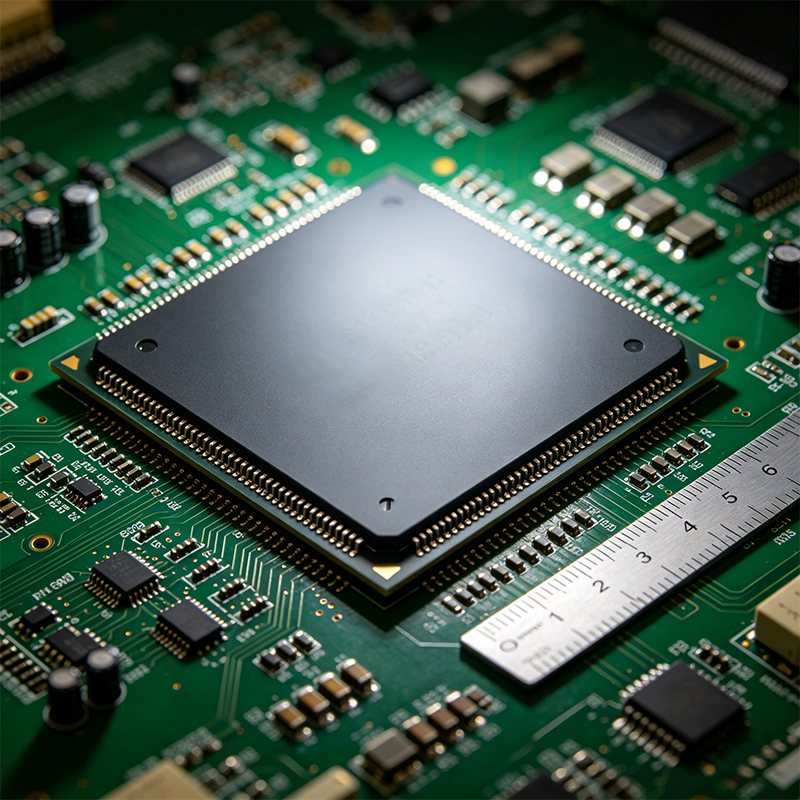
MCM-D (Deposited Substrate)
The substrate is built using thin-film deposition on silicon, ceramic, or glass. Advantages: highest routing density and best signal quality. Disadvantages: most expensive and complex. Used in high-performance computing and advanced communications.
These three are often confused.
SoC (System-on-Chip) : All functions are built on a single die. CPU, GPU, memory controller, I/O — everything on one piece of silicon. Best performance and lowest power, but extremely expensive and slow to develop.
MCM (Multi-Chip Module) : Multiple dies mounted side-by-side on the same substrate. The CPU is one die, the memory is another — they sit side-by-side. Advantages: flexible and fast to develop. Disadvantages: larger footprint and longer signal paths than SoC.
SiP (System-in-Package) : Multiple chips stacked vertically — not necessarily side-by-side, sometimes one on top of another, often including passive components like resistors and capacitors. A SiP is typically a complete "system", while an MCM is usually a subsystem or functional module.
Here's an analogy: SoC is a poured concrete building — walls and floors cast together. MCM is building blocks — blocks snapped together. SiP is stacking blocks — blocks stacked on top of each other.
MCMs are everywhere in high-performance electronics:
High-Performance Computing and Data Centers: AMD's Zen processors and Intel's Xeon processors often use MCM architecture.
AI and AI Accelerators: AI chips need to integrate compute cores, high-bandwidth memory, and high-speed I/O in the same module — MCM is the perfect solution.
Automotive Electronics: ADAS (Advanced Driver-Assistance Systems) and autonomous driving platforms need to integrate AI processors, image signal processors, and communication chips.
Mobile Communications and 5G: 5G base stations and RF front-ends need to combine digital, analog, and RF chips — all built on different processes.
Aerospace and Defense: Extreme reliability and harsh environment tolerance — MCM-C ceramic substrates are the standard.
The global multi-chip module market is growing fast. Revenue was around $9.4 billion in 2025**, with a projected **7.8% CAGR**. Other estimates put it at **$2.66 billion in 2025, growing to $5.46 billion by 2031 at a 12.73% CAGR.
Either way, the MCM market is growing at nearly double digits annually — driven by AI, 5G, and autonomous driving.
A multi-chip module (MCM) is a technology that mounts multiple bare dies on a common substrate and packages them as a single "chip."
It solves the problems of large monolithic chips — lower yield and higher cost — by letting different chips be manufactured on different process nodes and then assembled together.
It comes in three types: MCM-L (laminate), MCM-C (ceramic), and MCM-D (deposited). Compared to SoC, it's more flexible and cheaper. Compared to SiP, it's typically a subsystem rather than a complete system.
High-performance computing, AI chips, automotive electronics, 5G, and aerospace — there's probably an MCM inside every high-performance device you use.

Kaboer manufacturing PCBs since 2009. Professional technology and high-precision Printed Circuit Boards involved in Medical, IOT, UAV, Aviation, Automotive, Aerospace, Industrial Control, Artificial Intelligence, Consumer Electronics etc..


 English



 Wechat
 +86 13670210335
 +86 13670210335
 E-mail