
Date: 2026-07-11
You've definitely seen it in factory videos. A circuit board gets placed onto a special frame, probes press down with a "click," a light turns on a few seconds later, and the board passes. That frame — the thing that holds the board, presses probes against it, and runs the test — is called a PCB test fixture.
It's not complicated. It's simply a specially designed test station — you put the board in, clamp it down, power it up, and it automatically checks whether the board works. In this guide, I'll explain what a PCB test fixture is, why you need it, what types exist, and what's inside it. Plain English, no fluff.
A PCB test fixture is a specialized tool used to test and verify the functionality of PCBs during or after the manufacturing process. It provides a reliable electrical interface between the testing equipment and the board under test, enabling automated or semi-automated testing procedures.
Simply put: the board is made — now you need to know if it works. The test fixture is the tool that checks it.
A circuit board goes through many steps — SMT placement, soldering, through-hole assembly — and every step can introduce defects. Wrong component orientation, solder bridges, cold joints — you can't always see these with your eyes, but power it up and the problems show up. The test fixture is what runs that "power-up check".
You might think: "Just put the board into the product and ship it." But the reality is, if you don't test it, you're gambling.
A circuit board has hundreds or thousands of components. Every single one needs to be placed correctly and soldered properly. One bad solder joint can kill the entire board. If you don't catch it at the factory, and the customer finds it in the field — returns, rework,赔偿 — you lose not just money, but trust.
The test fixture's job is to catch bad boards before they ship. It's fast and consistent — a few seconds per board, and every board gets tested under the same conditions, no human fatigue or error.
Test fixtures aren't one-size-fits-all. Depending on test requirements and production volume, there are three main types:
1. Bed of Nails Fixture — The Most Common and Fastest
The name says it all — "a bed covered in nails". Those "nails" are actually spring-loaded test probes (pogo pins), precisely arranged to match the test points on your PCB. You place the board down, press it, and all probes contact their corresponding test points simultaneously. Testing takes just seconds.
The big advantage of bed of nails is speed — 5 to 15 seconds per board, perfect for high-volume production. The downside is cost — a custom fixture can cost anywhere from $3,000 to $20,000. And if your board design changes, that fixture might become scrap.
Bed of nails fixtures are typically used for In-Circuit Test (ICT) — checking for opens, shorts, resistance, capacitance, and component-level defects.
2. Flying Probe — No Fixture, Flexible but Slower
Flying probe is the opposite of bed of nails — it doesn't require a custom fixture. Instead, 4 to 8 movable probes travel to each test point on the board, one at a time, following a computer program.
The big advantage is cost savings and flexibility. No thousands of dollars for a custom fixture. To switch to a different board, just change the program. Ideal for prototypes, low-volume builds, and high-mix production.
The downside is speed — 1 to 5 minutes per board, too slow for high-volume production.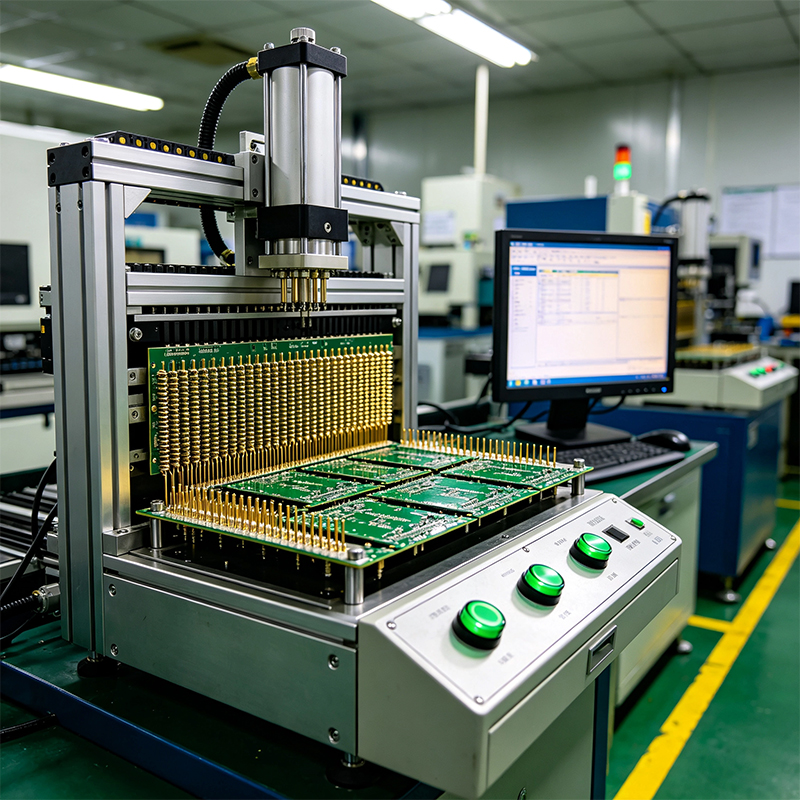
3. Functional Test Fixture — Simulating Real-World Use
Functional test fixtures don't test individual components — they simulate the product's actual operating environment to test the board's overall functionality. They apply power, signals, and loads to see if the board works as it would in the real product.
This type of test is typically used during R&D or final inspection before shipping.
A test fixture looks like a frame, but it has several key parts inside:
Test Head (also called the bed of nails): The array of spring-loaded probes that contact the board's test points.
Interface Board: Routes signals from the probes to the test instrument.
Mounting Hardware: Clamps and guides that hold the board securely against the probes.
Frame/Enclosure: Houses and protects all the electronics and moving parts.
The choice between bed of nails and flying probe comes down to volume and budget:
Prototypes, small batch (50-200 pieces) : Flying probe — no fixture cost
Medium batch (200-500 pieces) : Still flying probe — but if you plan large volumes later, invest in a fixture
High volume (1000+ pieces per batch) : Bed of nails — fixture cost amortizes across thousands of boards, and it's much faster
A PCB test fixture is a tool that holds a circuit board in place, powers it up, and automatically checks for defects. There are three main types: bed of nails (fast, expensive, high-volume), flying probe (slow, flexible, no fixture), and functional test (simulates real-world use). Inside, you'll find test probes, an interface board, mounting hardware, and a frame.

Kaboer manufacturing PCBs since 2009. Professional technology and high-precision Printed Circuit Boards involved in Medical, IOT, UAV, Aviation, Automotive, Aerospace, Industrial Control, Artificial Intelligence, Consumer Electronics etc..


 English



 Wechat
 +86 13670210335
 +86 13670210335
 E-mail