
Date: 2026-07-11
You've definitely seen an old computer CPU before. Flip it over and there's a dense forest of metal pins underneath, arranged in neat rows and columns. This type of package is called a pin grid array.
A Pin Grid Array (PGA) is a classic chip packaging technology. Simply put: the chip has a large number of metal pins on its underside, arranged in a grid pattern. These pins are the chip's "feet" — some carry data, some carry addresses, some provide power, and others provide ground or clock signals. Every pin has a specific job. When you insert the chip into the corresponding socket on the motherboard, the chip "connects" to the board.
Think of a PGA as rows and rows of metal needles — the chip "stands" on a sea of pins. These pins aren't random — every single one has a purpose. PGA is most commonly found on CPU sockets. From the 1990s through the 2000s, most desktop CPUs used PGA packages — you push it in, clamp it down, and it's locked. Want to upgrade? Pull it out and put a new one in.
This is where most people get confused. PGA and BGA both have dense arrays underneath — but the difference is critical:
| Feature | PGA | BGA |
|---|---|---|
| Connection | Pins plug into a socket | Solder balls are soldered to the board |
| Replaceable? | Yes — plug and unplug | No — soldered permanently |
| Soldering | Not soldered — pressed into socket | Reflow soldering |
| Socket | Requires a PGA socket | Soldered directly to PCB |
| Cost | Moderate (chip + socket) | Chip cheaper, but impossible to replace |
PGA pins are "hard" — they plug into a socket. BGA balls are "soft" — they're soldered to the board.
PGA's advantage is replaceability — if a chip fails or you want to upgrade, pull it out and put in a new one. BGA's advantage is smaller, thinner, and better signal quality — no socket in the way, shorter electrical path.
PGA dominated CPU packaging in the 1990s and early 2000s. Here's why:
1. Replaceable and upgradeable
For DIY enthusiasts, PGA was a blessing. Push it in, clamp it down, and the motherboard recognizes it. Want to upgrade your CPU? Pull it out, insert a new one, done.
2. No soldering required
PGA chips just plug into sockets — mechanical contact does the job. No reflow soldering on the production line, which lowers manufacturing cost and complexity.
3. Good heat dissipation
The back of the chip is flat — you can attach a heat sink and fan easily. CPUs run hot, and PGA's design made cooling straightforward.
4. Easy to repair
CPU failed? Swap it. Socket failed? Swap it. No soldering iron required.
PGA was once dominant, but new CPU designs have largely moved to BGA or LGA. Key reasons:
1. Too many pins — can't plug them in
CPU pin counts kept increasing. Every PGA pin has to fit into a corresponding hole in the socket. More pins means more insertion force, more bent pins, and harder-to-manufacture sockets.
2. High-frequency signals don't like sockets
Sockets have parasitic inductance and capacitance. The higher the signal frequency, the more the socket "corrupts" the signal. BGA solders the chip directly to the board — shorter signal path, cleaner signals.
3. Boards are getting thinner — sockets won't fit
PCBs are getting thinner and thinner (phone PCBs are 0.8mm or less). Sockets can cause board warping. BGA solders directly to the board surface — board thickness doesn't matter.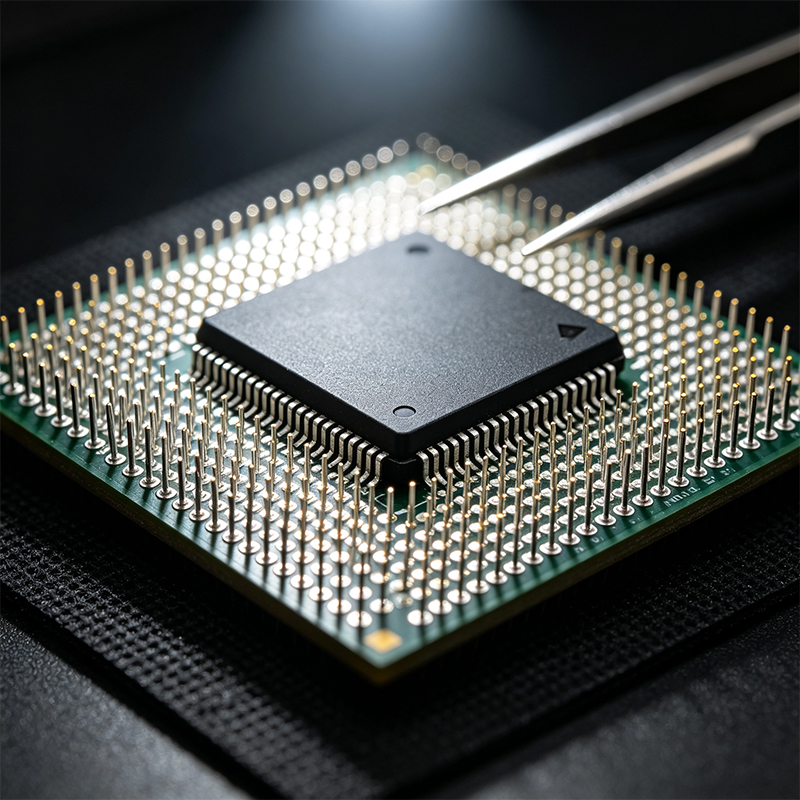
4. Higher assembly cost
PGA chips need precise alignment and insertion — often manual or specialized equipment. BGA is automated pick-and-place and reflow, much more efficient.
While consumer CPUs have mostly moved away from PGA, it hasn't disappeared. It still serves in specific areas:
1. High-End CPUs (Servers and HPC)
Although desktop CPUs have moved to LGA and BGA, some high-end server CPUs, HPC chips, and FPGAs still use PGA for field upgrades and repairs in high-value systems.
2. Programmable Logic Devices (FPGA/CPLD)
Many FPGAs and CPLDs use PGA packages, allowing developers to swap different chips during prototyping.
3. Military and Aerospace
These fields demand high reliability and repairability — PGA's replaceability is valuable over a long service life. PGA packages can also withstand higher temperatures and mechanical stress.
4. Test Sockets
PGA chips are sometimes used in development board test sockets where chips are plugged and unplugged frequently.
A Pin Grid Array (PGA) is a chip package with a large number of metal pins on the underside, arranged in a grid pattern.
Its defining feature is replaceability — if a chip fails or you want to upgrade, pull it out and swap it without soldering. The key difference from BGA: PGA uses pins in a socket; BGA uses solder balls directly on the board.
PGA was once the dominant CPU package, but due to high pin counts, high frequencies, and thinner boards, consumer CPUs have largely moved to LGA and BGA. But in servers, FPGAs, and aerospace/military applications, PGA still lives on.

Kaboer manufacturing PCBs since 2009. Professional technology and high-precision Printed Circuit Boards involved in Medical, IOT, UAV, Aviation, Automotive, Aerospace, Industrial Control, Artificial Intelligence, Consumer Electronics etc..


 English



 Wechat
 +86 13670210335
 +86 13670210335
 E-mail