
Date: 2026-06-30
You've definitely seen them. Those tiny little parts scattered across a circuit board — some smaller than a sesame seed, some tiny black squares, some flat chips with legs like a centipede. These unassuming little things are called Surface Mount Devices, or SMDs for short.
SMDs are the most common type of electronic component in modern electronics. The phone in your pocket, the watch on your wrist, the computer on your desk — nearly every component inside them is an SMD. In this guide, I'll explain what SMDs are, how they differ from older components, what types exist, and what those numbers on them mean. Plain English, no fluff.
A Surface Mount Device is simply an electronic component that sits directly on the surface of a circuit board. Its "legs" (called leads or terminals) are on the bottom or sides of the component, touching the copper pads on the board's surface and soldered in place.
You might ask: how did they do it before? The old way is called Through-Hole Technology (THT) — components had long metal leads that went through holes in the board and were soldered on the back. Think of it like planting a tree — the roots go through the soil.
SMDs don't need holes. They just sit on the surface — like placing a flower pot on the ground, no digging required.
SMDs are why electronics can be so small today. SMD components can be as tiny as a grain of sand, and you can put them on both sides of the board. Today, over 90% of electronic components are SMDs.
| Feature | SMD | THT |
|---|---|---|
| Mounting | Sits directly on board surface | Leads go through holes in the board |
| Component size | Small (down to 01005, 0.4×0.2mm) | Large |
| Board usage | Both sides, high density | One side only, low density |
| Soldering | Reflow soldering | Wave or hand soldering |
| Mechanical strength | Moderate | Strong (leads physically pass through) |
| Cost | Cheaper at scale | More expensive (more materials, more labor) |
| Best for | High-density, high-volume, compact products | High-power, high-reliability, connectors |
Modern electronics are all about "smaller, lighter, cheaper," so SMD is the dominant choice. But through-hole hasn't disappeared — high-power components, connectors that get plugged and unplugged often, and anything that needs extra strength still use through-hole.
SMD components come in many varieties, but these are the most common:
1. Chip Resistors and Capacitors (Passive Components)
These are the most numerous parts on any board. Resistors control current. Capacitors store charge and filter noise. They're those little brown or black squares — 0402 is the size of a grain of sand, 0805 is a sesame seed. Resistors usually have three digits printed on them — "103" means 10kΩ. Capacitors with "104" mean 0.1μF.
2. Chip Inductors
Inductors are used for filtering and power management. They look similar to resistors and capacitors.
3. Diodes and LEDs
Diodes only let current flow in one direction. Common diode packages include SOD-123 and SOD-323. LEDs (Light Emitting Diodes) are indicator lights and display backlights — common packages include 0603, 0805, and PLCC-2.
4. Integrated Circuits (ICs)
ICs are the "brains" of the board. Common SMD IC packages include:
SOIC/SOP: Leads on two sides
QFP: Leads on all four sides
QFN: Leads are hidden underneath
BGA: The bottom is covered in tiny solder balls — once soldered, you can't see the joints at all
5. Transistors and MOSFETs
Common packages include SOT-23 and SOT-223. They act as switches and amplifiers in circuits.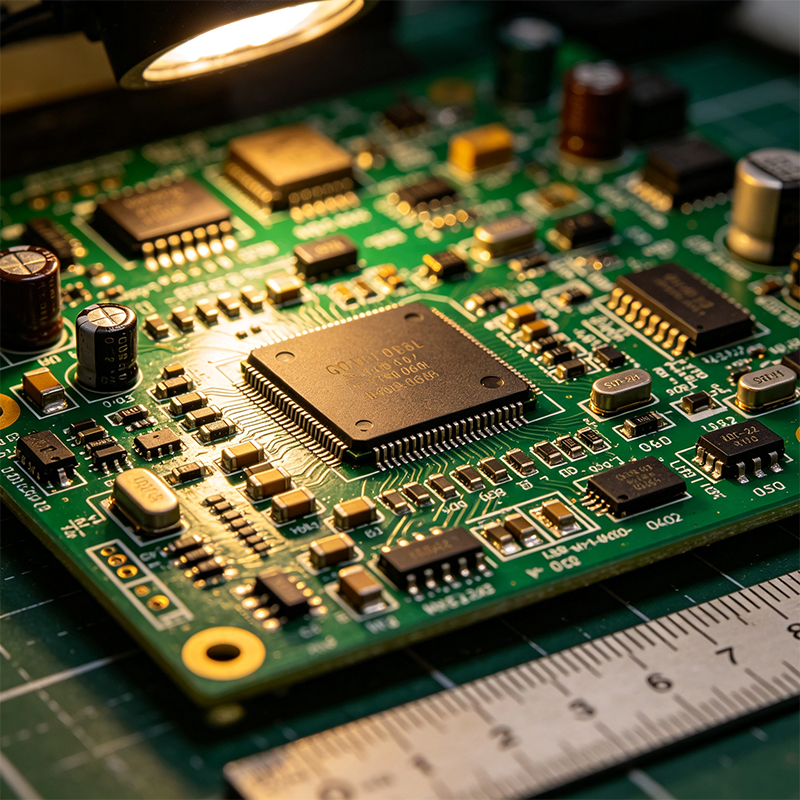
The numbers on SMD resistors and capacitors — 0402, 0603, 0805, 1206 — tell you the component's length and width. The code uses imperial units (inches) : the first two digits are length, the last two are width.
0402 = 0.04" × 0.02" = 1.0mm × 0.5mm
0603 = 0.06" × 0.03" = 1.6mm × 0.8mm
0805 = 0.08" × 0.05" = 2.0mm × 1.25mm
1206 = 0.12" × 0.06" = 3.2mm × 1.6mm
Bigger components can handle more power. 0201 can only handle 1/20W, 0805 handles 1/8W, and 1206 handles 1/4W. If you're a beginner, start with 0805 — it's big enough to solder with a regular iron and tweezers.
The process of assembling SMDs is called Surface Mount Technology (SMT) . SMD is the "part," and SMT is the "process" of putting it on the board.
Step 1: Solder Paste Printing — A stencil is used to print solder paste onto the board's pads. Solder paste is a mixture of microscopic solder spheres and flux — about the consistency of toothpaste.
Step 2: Pick and Place — A pick-and-place machine uses a vacuum nozzle to pick up components and place them precisely onto the pads. High-speed machines can place tens of thousands of components per hour.
Step 3: Reflow Soldering — The board goes through a reflow oven. Heat melts the solder paste, then cools to solidify, permanently attaching the components.
Step 4: Inspection — AOI (Automated Optical Inspection) uses cameras to check for defects. BGAs and other hidden-joint components need X-ray inspection.
Pros:
Small and light — components can be as small as 0.4×0.2mm, saving 60-70% of board space
High density — components on both sides of the board
Automated production — fast and precise, low cost at scale
Better high-frequency performance — shorter leads mean less signal loss
Cons:
Requires specialized equipment — hand soldering is difficult
Hard to repair — tiny components are tricky to replace
Less vibration-resistant than through-hole — solder joints rely on surface tension
A Surface Mount Device (SMD) is an electronic component that sits directly on the surface of a circuit board.
They're small, light, high-density, and perfect for automated production — the absolute workhorse of modern electronics. Over 90% of components are SMDs. 0402 is a grain of sand, 0603 is a grain of coarse salt, 0805 is a sesame seed. Next time you open up an electronic device and see those dense little squares on the board — you'll know exactly what they are. Each one is an SMD.

Kaboer manufacturing PCBs since 2009. Professional technology and high-precision Printed Circuit Boards involved in Medical, IOT, UAV, Aviation, Automotive, Aerospace, Industrial Control, Artificial Intelligence, Consumer Electronics etc..


 English



 Wechat
 +86 13670210335
 +86 13670210335
 E-mail