
Date: 2026-06-30
You’ve definitely seen solder before. That shiny silver wire on a spool, or those bright little bumps on a circuit board. But have you ever wondered what’s actually in that wire? Why does some solder flow beautifully and some doesn’t? Why do some electronics still use “leaded” solder?
That’s leaded solder. It’s not some obscure thing — it was the absolute standard of the electronics industry for decades, and it’s still quietly doing its job in many fields today. In this guide, I’ll explain what leaded solder is, why it’s so good, why it got restricted, and who still uses it. Plain English, no fluff.
Leaded solder is a solder alloy that contains lead (Pb) . The classic formula is 63% tin + 37% lead — commonly called 63/37 solder or Sn63Pb37. There’s also 60/40 solder (60% tin, 40% lead).
The 63/37 ratio is special because it’s eutectic — it melts at exactly 183°C and goes straight from solid to liquid with no “mushy” in-between state. Think of it like ice vs. slush: eutectic solder is like ice — it melts all at once at a precise temperature; non-eutectic solder is like slush — it goes through a long semi-solid phase before fully melting.
Leaded solder dominated electronics for decades for good reasons:
1. Low melting point, less heat stress
63/37 leaded solder melts at 183°C. Compare that to lead-free solder like SAC305, which melts at 217-221°C — almost 40°C hotter. That means less thermal stress on components with leaded solder. Heat-sensitive parts like plastic connectors, LEDs, and precision chips are much safer.
2. Excellent wetting, beautiful joints
“Wetting” is just a fancy word for how well the solder spreads. Leaded solder wets beautifully — it flows evenly over pads and leads, forming smooth, shiny, full joints. Lead-free solder joints, by contrast, are dull and grainy.
3. Eutectic behavior, easy to control
63/37 solder has no pasty range — it melts at 183°C and solidifies below 183°C. You never have to guess “is it the right temperature?” It just works. Beginners have a much higher success rate with leaded solder.
4. Tin whisker suppression
This is a hidden but serious issue. Pure tin or high-tin alloys can grow tiny metallic whiskers over time that cause short circuits. The lead in leaded solder effectively suppresses tin whiskers — which is why military, aerospace, and medical devices still use it.
5. Cheaper
Lead is much cheaper than tin, so leaded solder costs less. Lower melting points also mean lower energy costs and less wear on equipment.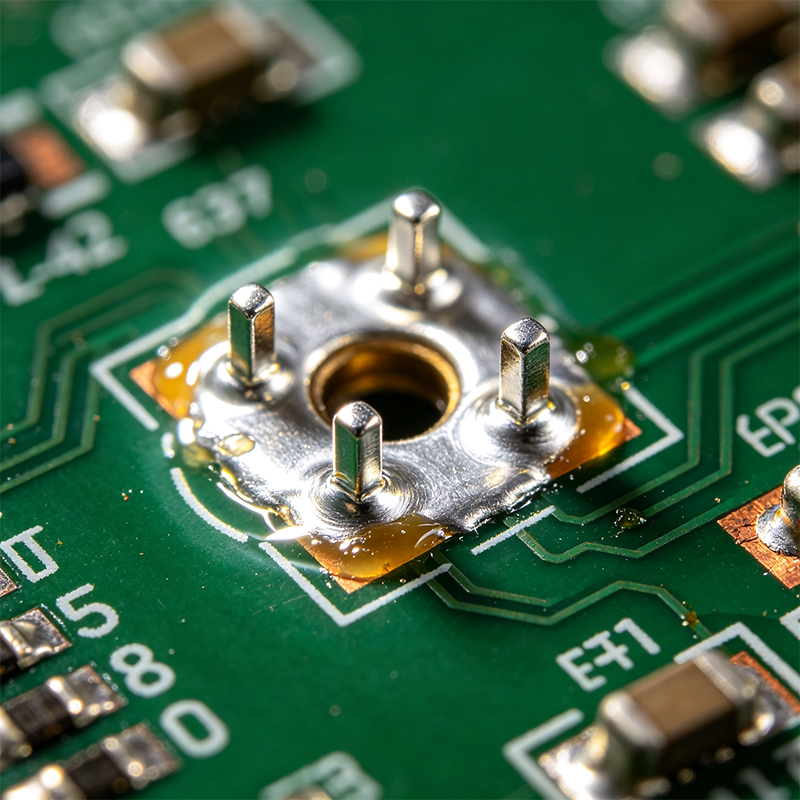
Here’s a quick comparison:
| Feature | Leaded (63/37) | Lead-Free (SAC305) |
|---|---|---|
| Composition | 63% Sn + 37% Pb | 96.5% Sn + 3% Ag + 0.5% Cu |
| Melting point | 183°C (eutectic) | 217-221°C |
| Soldering temp | Low (~320-350°C) | High (~360-380°C) |
| Wetting | Excellent | Poor, needs more flux |
| Joint appearance | Shiny, smooth | Dull, grainy |
| Tin whisker resistance | Good | Poor |
| Joint toughness | Flexible, shock-resistant | Brittle |
| Environmental | Toxic (contains lead) | RoHS-compliant |
| Cost | Low | High |
| Best for | High‑reliability, military, medical, repair | Consumer electronics, exports |
Simply put: leaded solder is easy to use, cheap, and reliable — but not环保. Lead‑free is环保, but harder to use, more expensive, and joints are more brittle.
You may have heard that “leaded solder is banned.” That’s half true.
In 2006, the EU introduced the RoHS Directive (Restriction of Hazardous Substances), restricting lead in electronic products. For consumer electronics sold in the EU, solder must contain less than 0.1% lead. That’s the “lead‑free” movement.
But RoHS isn’t a blanket ban. It allows exemptions — specific cases where leaded solder can still be used. Key exemptions include:
High‑melting‑temperature solder (≥85% lead) — for chip packaging and high‑temp processes
Military and aerospace — extreme reliability requirements
Medical devices — especially implantable devices
Servers and industrial equipment — long‑term stability required
So leaded solder hasn’t disappeared. It just moved out of consumer electronics and stayed in high‑reliability fields. Also, repair and DIY work isn’t covered by RoHS either.
Leaded solder is great to work with, but a few precautions matter:
1. Ventilation is essential
Soldering produces fumes from the flux. Even though lead doesn’t vaporize at soldering temperatures, the flux fumes are harmful. Always work in a well‑ventilated area with a fume extractor.
2. Wash your hands after soldering
Lead can be absorbed through skin contact. Always wash your hands with soap after soldering — especially before eating.
3. Dispose of waste properly
Lead‑containing waste (clippings, old solder) can’t go in regular trash. Follow your local hazardous waste disposal guidelines.
Leaded solder is an alloy of tin and lead — the classic 63/37 eutectic solder melts at 183°C. It has a low melting point, excellent wetting, shiny joints, easy handling, low cost, and suppresses tin whiskers. The 2006 RoHS directive restricted it in consumer electronics due to environmental concerns, but it remains exempt and irreplaceable in military, aerospace, medical, and server applications where reliability is critical.

Kaboer manufacturing PCBs since 2009. Professional technology and high-precision Printed Circuit Boards involved in Medical, IOT, UAV, Aviation, Automotive, Aerospace, Industrial Control, Artificial Intelligence, Consumer Electronics etc..


 English



 Wechat
 +86 13670210335
 +86 13670210335
 E-mail