
Date: 2026-06-25
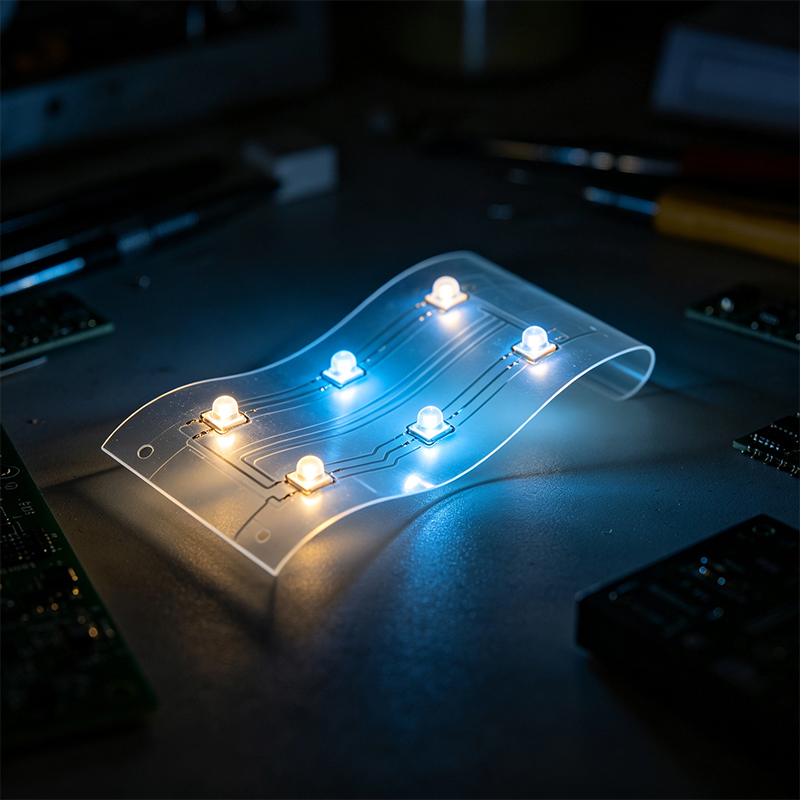
You've definitely seen a circuit board before. Green, stiff, covered in copper traces and solder points. But have you ever wondered: what if a circuit board was transparent? Not semi-transparent plastic, but truly clear — the kind you can see right through?
That thing actually exists. It's called a transparent PCB. It's not some lab-only concept — it's already inside devices you've seen: transparent smartwatches, AR glasses, automotive head-up displays, and even some high-end home appliances. In this guide, I'll explain what transparent PCBs are, how they're made, where they're used, and why they're becoming a hot topic in next-gen electronics. Plain English, no fluff.
A transparent PCB is simply a circuit board made with see-through materials. The big difference from regular boards — which use opaque FR4 (that green or yellow fiberglass stuff) — is that transparent PCBs use glass, clear PET film, or transparent polyimide that lets light pass through.
You might think: "It's just a different material — what's the big deal?" But it's not that simple. A circuit board isn't just "a board" — it has copper traces, pads, vias, and solder mask. Making all of these transparent, or at least non-obstructive, requires a completely different set of materials and processes.
Transparent PCBs come in two main types:
Semi-transparent PCB: The substrate is transparent, but the traces are still made of regular copper. You can see through the board, but the copper traces are visible — you can see the circuit's "skeleton."
Fully transparent PCB: Both the substrate and the conductive traces are transparent. This is the impressive one — the whole board looks like a piece of glass, almost invisible. These use ITO (Indium Tin Oxide), silver nanowires, graphene, or other transparent conductive materials instead of copper.
Transparent PCBs use completely different materials from regular boards. Three main categories:
1. Glass Substrates
Glass was one of the first materials used for transparent PCBs. Light transmittance can reach over 95% — almost as clear as regular glass.Glass PCBs are extremely flat and heat-resistant — the softening point can reach 1000°C, and the thermal expansion coefficient matches silicon chips perfectly.The downside: brittle — it breaks easily and can't bend.
2. Clear Polymers (PET, Polycarbonate, etc.)
PET (Polyethylene Terephthalate) is currently the most common material for transparent PCBs. JLCPCB's transparent FPCs use PET, achieving 85% light transmittance.PET is cheap, lightweight, and bendable — perfect for flexible transparent PCBs.
Other clear polymers include polycarbonate (impact-resistant), PMMA (acrylic, high transmittance), and LCP (liquid crystal polymer, heat-resistant).
3. Transparent Conductive Materials
This is the core technical challenge — regular copper is opaque. To make traces transparent, you need special materials:
ITO (Indium Tin Oxide): The most common transparent conductor. Good conductivity, but brittle.
Silver nanowires: Highly flexible, ideal for wearables.
Graphene: Ultra-thin, conductive, and flexible — considered the future of transparent circuits.
Conductive polymers (like PEDOT): Printable and flexible, good for low-cost applications.
Transparent PCBs are far more common than you might think:
Consumer Electronics
Transparent smartphone and smartwatch prototypes have been shown multiple times, drawing attention for their futuristic design.Transparent PCBs let the entire logic board sit behind a transparent enclosure or display.AR/VR headsets also use transparent PCBs extensively — control circuits sit behind the lenses, invisible to the user.
Automotive
Car designers are using transparent PCBs to create futuristic interior controls and lighting.Head-up display (HUD) systems and transparent dashboard screens need transparent PCBs to route signals without blocking the display area.Transparent PCBs can also be mounted on car windows as transparent illuminated display systems.
Wearable Devices
Smartwatches, smart glasses, health monitors — these need to be small, light, and unobtrusive.Transparent FPCs can conform to the body's surface without affecting appearance.Team USA's 2018 Winter Olympics jackets had built-in flexible heaters — this is exactly the kind of wearable application where transparent PCBs shine.
Medical Devices
Portable diagnostic tools and wearable monitors benefit from the lightweight and aesthetic advantages of transparent PCBs.
Aerospace
Glass PCBs can handle extreme temperature changes and space radiation. Low outgassing prevents contamination of precision equipment.
Pros:
Design impact: A transparent circuit board is a visual statement. Turning internal circuitry into a product's visual identity is a huge selling point in consumer electronics.
Thin and flexible: PET transparent FPCs can be as thin as 0.11mm (single-layer) and bend freely.
Easy inspection: Transparent boards make internal circuits visible at a glance — inspection and maintenance are much easier than with traditional boards.
Cons:
Expensive: Transparent materials and specialized processes drive up costs. In 2025, transparent PCBs cost roughly $25 to $70 per square inch.
Lower conductivity than copper: Transparent conductors have much higher resistance, limiting high-speed applications.
Brittle: Glass substrates break easily; ITO also cracks under stress.
Complex manufacturing: Transparent materials are more sensitive to temperature and humidity — any mistake in production affects transparency.
The transparent electronics market is growing fast. The global transparent electronic materials market was valued at $2.78 billion in 2023**, with transparent PCBs accounting for **19%** and growing at **24% annually**.By 2034, the global transparent electronics market is expected to grow from **$2.14 billion to $12.35 billion.
This isn't a niche market — it's a rapidly expanding sector.
| Feature | Traditional PCB | Transparent PCB |
|---|---|---|
| Substrate | FR4 (fiberglass, opaque) | Glass, PET, transparent polyimide |
| Traces | Copper (opaque) | Copper (semi-transparent) or ITO/silver nanowires (fully transparent) |
| Color | Green, blue, black | Clear |
| Bendable? | Rigid only (flex PCBs exist but are opaque) | PET transparent FPCs can bend |
| Cost | Low | High ($25-70/sq in) |
| Light transmittance | 0% | Up to 95%+ |
| Main use | Almost all electronics | High-end consumer, wearables, automotive, medical |
Transparent PCB manufacturing is similar to traditional PCB production, but with several unique challenges:
Balancing performance and transparency: Transparent materials may not match the electrical and mechanical properties of traditional materials. You have to balance performance, cost, and aesthetics.
Maintaining transparency during production: Any scratch, contamination, or yellowing affects the final product's appearance. Production must happen in cleanroom environments.
Higher resistance of transparent conductors: Circuit designs must be optimized to compensate — shorter traces, wider traces.
Precise temperature control: Transparent materials are more sensitive to heat. Reflow requires finer temperature control.
A transparent PCB is a circuit board made with see-through materials (glass, PET, transparent polyimide, etc.) that you can see through and sometimes bend. It comes in semi-transparent (clear substrate, visible copper traces) and fully transparent (both substrate and traces are clear) varieties.
It's changing how electronics are designed — from "hide the circuits" to "show off the circuits." Transparent smartwatches, AR glasses, automotive HUDs, wearable health devices — transparent PCBs are behind all of them.

Kaboer manufacturing PCBs since 2009. Professional technology and high-precision Printed Circuit Boards involved in Medical, IOT, UAV, Aviation, Automotive, Aerospace, Industrial Control, Artificial Intelligence, Consumer Electronics etc..


 English



 Wechat
 +86 13670210335
 +86 13670210335
 E-mail