
Date: 2026-07-04
You've definitely seen them. That thin yellow ribbon connecting your phone's screen to its motherboard. The bendable cable in a foldable phone's hinge. The ultra-thin circuit inside a smartwatch. These all have a common name — FPC.
FPC stands for Flexible Printed Circuit. It's also called a flexible circuit board, flex PCB, or simply "flex". It's not the stiff, rigid circuit board you're used to — it can bend, fold, twist, and roll without breaking.
In this guide, I'll explain what FPC is, how it differs from rigid boards, what types exist, and where it's used. Plain English, no fluff.
An FPC is simply a printed circuit board that can bend.
A rigid PCB uses fiberglass (FR4) as its base — stiff like a wooden plank. An FPC uses polyimide (PI) film or polyester (PET) film as its base — bendable like a plastic card.
A rigid board is a wooden plank. An FPC is a piece of thick paper. The plank is strong but won't bend. The paper can be rolled and stuffed into any gap.
An FPC typically has three layers: flexible insulating substrate + copper traces + coverlay. The coverlay is the flex version of solder mask — it protects the copper from oxidation and scratches.
Based on the number of copper layers, FPCs come in single-sided, double-sided, and multi-layer types. Single-layer is the cheapest; multi-layer is the most complex but most capable.
The difference between FPC and rigid PCB isn't just that one bends and one doesn't. They differ in material, structure, performance, and applications.
| Feature | FPC (Flexible) | Rigid PCB |
|---|---|---|
| Substrate | Polyimide (PI) or PET film | Fiberglass (FR4) |
| Can it bend? | Yes — bends, folds, rolls | No — cracks if bent |
| Thickness | 0.1mm-1mm | 0.8mm-1.6mm |
| Weight | Much lighter than rigid boards | Heavy |
| Best for | Wearables, foldables, tight spaces | Fixed devices, high power, high strength |
A rigid PCB is typically 0.8mm to 1.6mm thick. An FPC can be as thin as 0.1mm — thinner than a sheet of paper. And FPCs are much lighter than rigid boards of the same area.
FPCs come in several varieties.
Single-sided FPC: One copper layer. Simplest and cheapest. Best for jumpers, keypads, LED strips.
Double-sided FPC: Two copper layers with insulation between, connected by vias. Best for camera modules, sensors, circuits that need to cross traces.
Multi-layer FPC: Three or more copper layers. Best for complex modules requiring high-density routing and shielding.
Rigid-flex PCB: Rigid and flex sections laminated into one board. Rigid areas hold heavy chips and connectors; flex areas bend and connect. This is the most advanced type.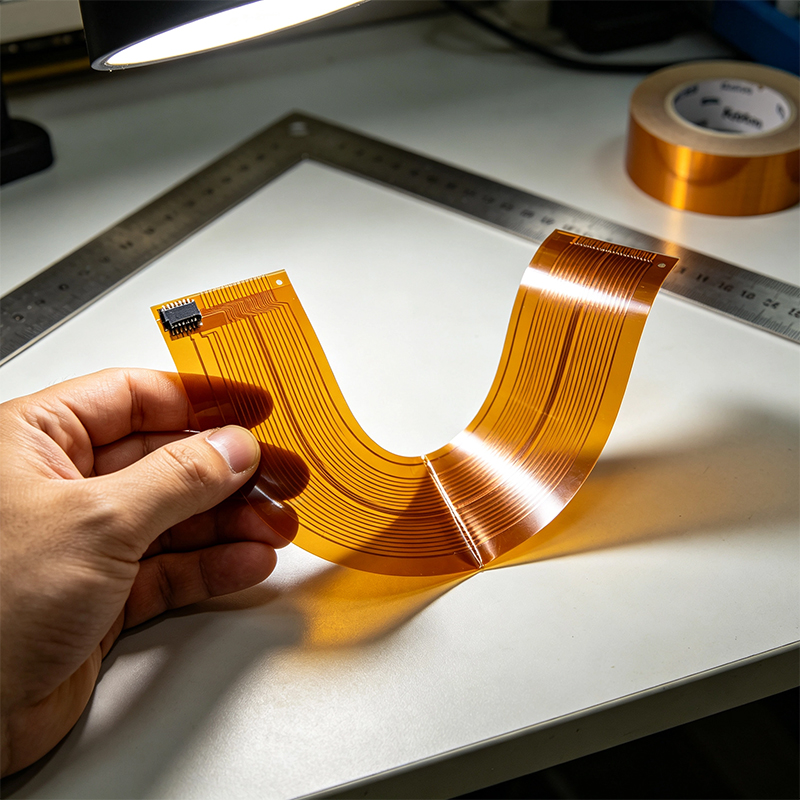
FPCs are everywhere.
Consumer Electronics: Smartphones, tablets, foldable phones, TWS earbuds, smartwatches, fitness trackers. Almost every smartphone has multiple FPCs inside — display cables, camera flexes, button boards are all FPCs.
Automotive Electronics: ADAS (Advanced Driver Assistance Systems), EV battery management systems (BMS), camera modules, infotainment systems. As cars get smarter, FPC demand keeps growing.
Medical Devices: Pacemakers, hearing aids, endoscopes, diagnostic equipment. These devices need to be tiny and extremely reliable — FPC is the standard.
Wearable Devices: Smartwatches, fitness bands, smart jewelry. FPCs conform to the human body, making devices more comfortable to wear.
Aerospace: Satellites, aircraft — demanding extreme reliability and minimal weight.
Communications: 5G base stations, optical modules, high-speed switches.
Simply put: if your product needs to bend, be thin, be light, or fit in tight spaces — FPC is the answer.
1. Bendable: This is FPC's biggest superpower. It bends, folds, twists, and conforms to the shape of the product. Rigid boards can't do this.
2. Light and thin: FPCs can be as thin as 0.1mm and much lighter than rigid boards. Drones, wearables, implantable devices — every gram counts.
3. Eliminates connectors: Traditional designs use multiple rigid boards + cables + connectors. Connectors are failure points. One FPC can replace the whole assembly — fewer connections, fewer failures.
4. Better reliability: Flexible materials absorb vibration and thermal expansion stress, reducing the risk of cracked solder joints. In high-vibration or temperature-varying environments, FPC is more reliable than rigid boards.
5. Saves space: FPCs can route in three dimensions, following the contour of the enclosure. Rigid boards lie flat; FPCs can "stand up" and go around corners.
6. Good signal quality: FPCs have excellent dielectric properties for high-frequency signals. 5G, radar, and high-speed communications all use FPCs.
FPC (Flexible Printed Circuit) is a printed circuit board that bends. It uses polyimide or polyester film as its substrate and can bend, fold, and roll. It comes in single-sided, double-sided, multi-layer, and rigid-flex types. It's thinner than rigid boards, lighter, eliminates connectors, and absorbs vibration. Smartphones, automotive electronics, medical devices, wearables, aerospace — FPCs are everywhere.

Kaboer manufacturing PCBs since 2009. Professional technology and high-precision Printed Circuit Boards involved in Medical, IOT, UAV, Aviation, Automotive, Aerospace, Industrial Control, Artificial Intelligence, Consumer Electronics etc..


 English



 Wechat
 +86 13670210335
 +86 13670210335
 E-mail