
Date: 2026-07-07
You’ve definitely seen it. On the wall of a PCB factory. On a quality report. On a supplier’s certificate. The letters “J-STD-001.” You might know it has something to do with soldering. But what actually is it? Why does it matter? And how is it different from IPC-A-610?
In this guide, I’ll explain what IPC J-STD-001 is, what it covers, and how it differs from IPC-A-610. Plain English, no fluff.
IPC J-STD-001 stands for Requirements for Soldered Electrical and Electronic Assemblies. It’s the globally recognized standard for soldering processes and materials, published by IPC (the Association Connecting Electronics Industries).
Think of it as the “how-to” manual for electronic assembly soldering. It covers everything from what to prepare before soldering, to how to do it during the process, to how to inspect it afterward — materials, process control, and acceptance criteria all in one place.
J-STD-001 is developed and updated with input from participants from 27 countries and is the only industry-consensus standard covering soldering materials and processes. The current revision is J-STD-001J, released in March 2024.
J-STD-001 covers everything from materials to processes to inspection.
Materials: Specifies approved solder alloys, flux types, solder paste, preforms, and more.
Processes: Covers hand soldering, wave soldering, reflow soldering — all the parameters and procedures.
Acceptance: Defines what’s acceptable for through-hole, surface-mount, and other joint types — solder volume, wetting angle, solder climb, and more.
Process Control: Emphasizes controlling the process to ensure consistency, rather than relying on end-of-line inspection.
In short: J-STD-001 tells you how to solder it right.
This is the most common confusion.
| Feature | IPC J-STD-001 | IPC-A-610 |
|---|---|---|
| Focus | Soldering processes | Appearance of results |
| Purpose | How to do it | What’s acceptable |
| Users | Engineers, process managers, operators | Inspectors, QA teams |
| Document type | Requirements standard | Acceptability standard |
Here’s an analogy: J-STD-001 is the recipe — ingredients, heat, timing. IPC-A-610 is the food critic — color, plating, appearance.
They’re used together. J-STD-001 controls the process. IPC-A-610 inspects the result. Use both, and you get both quality and consistency.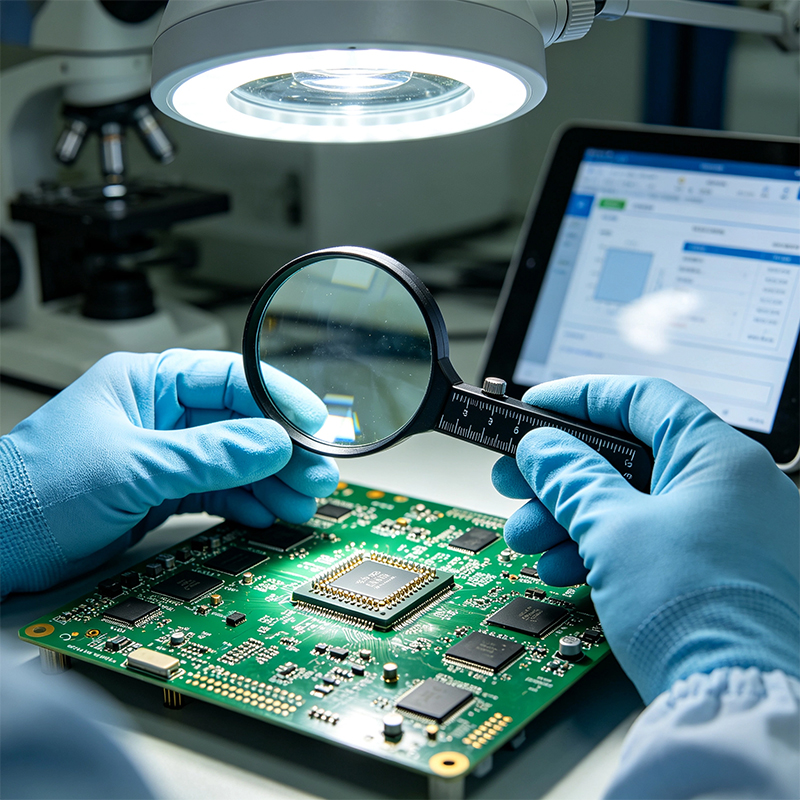
Like IPC-A-610, J-STD-001 divides products into three classes.
Class 1 — General Electronic Products: Lowest quality requirements — function is all that matters. LED lights, toys, remotes.
Class 2 — Dedicated Service Electronic Products: Requires reliable, consistent operation — stricter inspection. Smartphones, laptops, telecom gear.
Class 3 — High-Performance Electronic Products: Strictest standards — must work every time, often in harsh environments. Aerospace, military, life-support medical.
Which class you choose depends on where your product will be used.
The current main revision is J-STD-001J, released March 2024.
There are also addendums for specific industries:
J-STD-001JS (Space and Military Addendum): For assemblies that must survive the vibration and thermal cycling of space and military applications.
J-STD-001JA / IPC-A-610JA (Automotive Addendum): For automotive electronics, addressing high-volume production and harsh-environment reliability.
First, it’s the industry benchmark. J-STD-001 is the global standard for soldering quality. Without it, you have no way to judge your supplier.
Second, customers require it. Many customers — especially in aerospace, medical, and defense — demand that their suppliers comply with J-STD-001.
Third, there’s certification. IPC offers training and certification based on J-STD-001 — CIT (Certified IPC Trainer) and CIS (Certified IPC Specialist) .
J-STD-001 is the “how-to” manual for soldering electronic assemblies. It covers materials, processes, and acceptance — hand soldering, wave soldering, reflow, everything. It works together with IPC-A-610 — one controls the process, the other inspects the result.

Kaboer manufacturing PCBs since 2009. Professional technology and high-precision Printed Circuit Boards involved in Medical, IOT, UAV, Aviation, Automotive, Aerospace, Industrial Control, Artificial Intelligence, Consumer Electronics etc..


 English



 Wechat
 +86 13670210335
 +86 13670210335
 E-mail