
Date: 2026-08-03
You've definitely soldered with an iron before — one pad at a time, one joint at a time. But what if you have a board packed with surface‑mount components? Soldering each one individually would take forever.
There's a way to solder every component at once. You place the board on a heated metal plate — like cooking a steak on a griddle — and the solder paste melts, forming every joint simultaneously. That's hot plate soldering.
Hot plate soldering (also called hot plate reflow) is simple: you heat a PCB from underneath using a heated flat plate, melting the solder paste and soldering all components in one go.
In this guide, I'll explain what hot plate soldering is, how to do it, its pros and cons, and when to use it. Plain English, no fluff.
Hot plate soldering is the process of placing a PCB — already covered with solder paste and populated with components — onto a heated metal plate to melt the solder paste, then letting it cool to complete the soldering.
Think of it as a “griddle” for circuit boards. A chef cooks on a flat iron griddle — the plate heats up, the food goes on, and a few minutes later it's done. Hot plate soldering is the same: the plate heats to 200°C+, the board goes on, the solder melts, and the joints form.
The difference between a hot plate and a reflow oven: a reflow oven heats the entire chamber with hot air; a hot plate heats from underneath, directly through the board. A reflow oven is like an oven; a hot plate is like a frying pan — one uses hot air, the other uses direct contact heat.
Hot plate soldering is typically used for low‑volume production, prototyping, hobbyist projects, and flexible circuit board (FPC) assembly.
The process is simple:
Step 1: Apply Solder Paste
Use a stencil or manual application to deposit solder paste onto the PCB pads. Solder paste is a mixture of microscopic solder spheres and flux — about the consistency of toothpaste.
Step 2: Place Components
Place surface‑mount components (SMDs) onto the corresponding pads using tweezers or a manual placement tool. The paste holds them in place.
Step 3: Set the Hot Plate Temperature
Turn on the hot plate and set the temperature. For leaded solder (63/37), peak temperature is typically 205‑220°C; for lead‑free solder (SAC305), you need 230‑250°C. Lead‑free solder melts hotter, so the plate needs to be hotter.
Step 4: Place the Board on the Plate
Gently place the populated PCB onto the hot plate. The entire process takes about 3 minutes. You'll see the solder paste change from gray to silver — that's it melting.
Step 5: Cool Down
Once the solder is fully melted, turn off the hot plate and remove the board to cool. When the joints solidify, all components are soldered at once.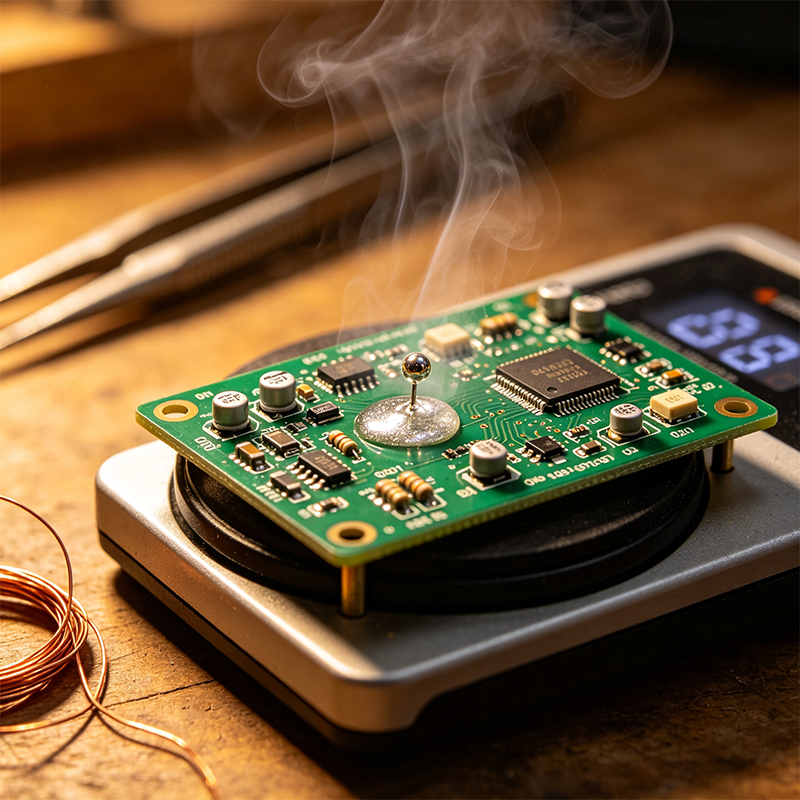
Hot plate soldering is popular in DIY and low‑volume scenarios for good reasons:
1. Cheap, Low Barrier to Entry
A professional reflow oven can cost thousands of dollars. A decent hot plate costs a fraction of that. For hobbyists, makers, and small teams, hot plate soldering is the cheapest way to do reflow.
2. Simple to Use
No complex temperature profiles, no vacuum, no nitrogen. Place the board, wait a few minutes, remove it — that's it.
3. Even Heating
The entire metal plate heats uniformly, so the board is heated evenly from underneath. Unlike a hot air gun, where some areas get hot and others stay cold.
4. Ideal for Single‑Sided Boards
For boards with components on only one side, hot plate soldering is an excellent choice. It heats from underneath, so components on top don't get blasted directly.
5. Fast
From board placement to completion, the whole process takes about 3 minutes. Much faster than soldering one joint at a time, and faster than waiting for a reflow oven to preheat.
Hot plate soldering isn't perfect. It has several clear limitations:
1. Only for Single‑Sided Boards
Since the hot plate heats from underneath, if the board has components on both sides, the bottom components will heat up first and may fall off. So hot plate soldering only works for single‑sided boards.
2. Less Precise Temperature Control
Hot plates can't match the precision of reflow ovens. High‑end ovens control ramp rate, soak time, peak temperature, and cooling rate — a hot plate basically just controls “temperature”.
3. Temperature Difference Between Top and Bottom
To get the top of the board hot enough to reflow, the plate has to be quite hot. That means the bottom of the board gets significantly hotter than the top. This temperature difference can cause board warping or overheating bottom components.
4. Not for High‑Volume Production
Hot plate soldering is “one board at a time” — not suitable for mass production. For high volume, you need a reflow oven.
5. Uncontrolled Cooling
Hot plate soldering relies on natural cooling — you can't control the cooling rate. Cooling too fast or too slow can affect joint quality.
| Feature | Hot Plate Soldering | Reflow Oven |
|---|---|---|
| Heating method | Contact heating from underneath | Hot air circulation |
| Temperature precision | Moderate | High |
| Can solder double‑sided boards? | No | Yes |
| Equipment cost | Low (a few hundred) | High (thousands) |
| Best for | Single‑sided, DIY, prototyping | High‑volume, double‑sided |
Hot plate soldering is best for:
DIY and maker projects: Making one or two boards isn't worth buying a reflow oven
Prototyping: Designs aren't finalized and you need fast iteration
Flexible circuit board (FPC) soldering: Thin flex boards have low thermal mass, making hot plate soldering ideal
Single‑sided, low‑volume boards: Only one side has components, and quantities are small
Hot plate soldering is the process of placing a solder‑pasted, component‑populated PCB on a heated metal plate to reflow all joints at once.
It's cheap, simple, and fast — perfect for DIY, prototyping, and single‑sided low‑volume production. But it can only handle single‑sided boards, has less precise temperature control than reflow ovens, and creates a temperature difference between the top and bottom of the board.

Kaboer manufacturing PCBs since 2009. Professional technology and high-precision Printed Circuit Boards involved in Medical, IOT, UAV, Aviation, Automotive, Aerospace, Industrial Control, Artificial Intelligence, Consumer Electronics etc..


 English



 Wechat
 +86 13670210335
 +86 13670210335
 E-mail