
Date: 2026-06-15
You work with electronics — maybe as an engineer, a buyer, or just a hobbyist. You‘ve definitely seen the letters “IPC” on PCB drawings, factory spec sheets, or component datasheets. But have you ever stopped to think: what actually is IPC, and why does it matter?
In this guide, I’ll walk you through IPC‘s history, its most important standards, the three product classes, and why you should care about all of this. Plain English, no fluff.
IPC started in 1957 when six PCB manufacturers in the US founded the Institute for Printed Circuits — that‘s where the acronym “IPC” came from. As more assembly companies joined, the name changed in 1977 to the Institute for Interconnecting and Packaging Electronic Circuits. Then in 1999, the association officially adopted “IPC” as its name, along with a new full name: Association Connecting Electronics Industries.
What you really need to know is three things:
IPC is a non‑profit global trade association headquartered in the US, with offices and training centers around the world.
It has more than 4,000 member companies — everyone from Apple, Intel, Boeing, and NASA down to small PCB shops, assembly houses, and material suppliers.
IPC‘s main job is developing technical standards for the electronics industry. There are over 300 active standards covering everything from PCB design to final test.
Think of IPC as the “United Nations” of electronics manufacturing. Everyone gets together, discusses, argues, votes, and eventually agrees on a set of rules everyone follows. Those rules are IPC standards.
What would the world look like without standards? You design a PCB in Beijing. You send it to a fab in Shenzhen. They make the board their way. Then you send it to an assembly shop in Shanghai, and they say: “Sorry, the solder mask dams are too narrow — our machine can‘t place parts.” The fab says: “But that’s how we always make boards!” Nobody agrees.
IPC standards kill that confusion. They give the entire industry a common technical language and a shared ruler for measuring quality. Designers follow IPC standards when drawing boards. Fabs follow them when manufacturing. Assembly shops follow them when testing. Everyone works from the same playbook. That’s how your design gets built and works no matter which country or which factory you use.
There are over 100 IPC standards. You don‘t need to memorize them all. Just focus on the core ones.
1. IPC-2221 – The “Constitution” of PCB Design
IPC-2221 is the foundation design standard that covers trace width and spacing, electrical clearance, creepage distances, material selection, thermal management, and more. For more specific needs, IPC-2222 covers rigid boards, IPC-2223 covers flex and rigid‑flex, and IPC-2226 covers HDI.
2. IPC-6012 / IPC-6013 – The “Final Inspection Report” for Bare Boards
IPC-6012 sets the performance requirements for rigid PCBs after fabrication: dimensional tolerances, hole wall quality, copper thickness, electrical testing, and more. IPC-6013 does the same for flexible and rigid‑flex boards.
3. IPC-A-610 – The “Acceptance Bible” for Assembled Boards
This is IPC’s most famous and widely used standard. Its full name is Acceptability of Electronic Assemblies. It uses hundreds of photos and drawings to show you exactly what a good solder joint looks like vs. a bad one. Industry joke: IPC-A-610 is the “Civil Code” of electronics assembly — everything goes there.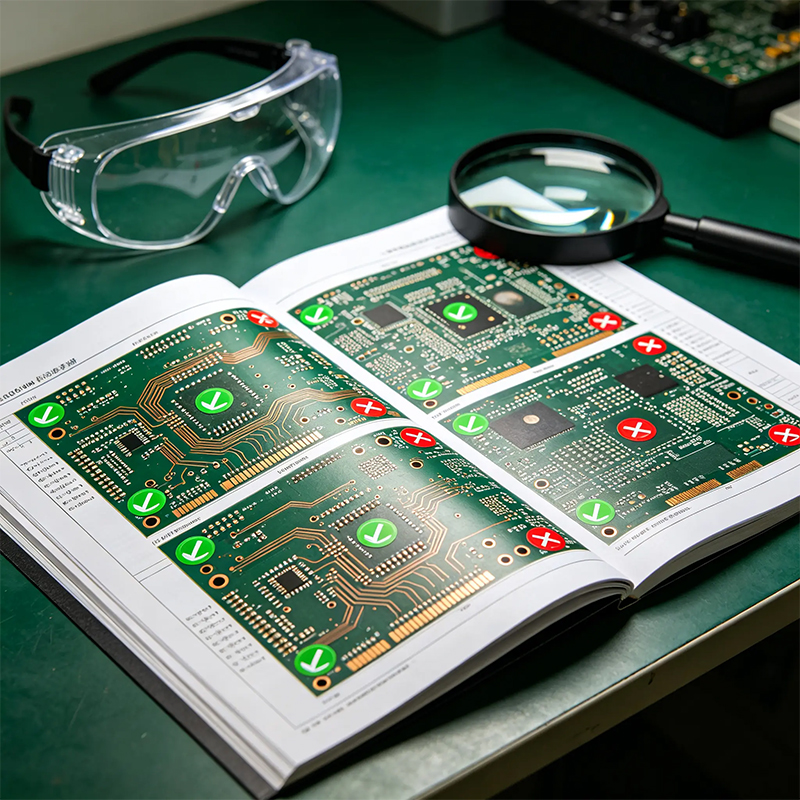
4. IPC-J-STD-001 – The “Surgery Manual” for Soldering
If IPC-A-610 tells you “what a good joint should look like,” J-STD-001 tells you “how to actually make a good joint.” It covers materials, tools, temperature profiles, and process parameters for soldering. These two standards are often used together.
5. IPC-7351 – The “Footprint Rulebook” for Component Pads
IPC-7351 tells you exactly how big, wide, and dense the PCB pads should be for surface‑mount components. It provides three geometry options (low density, nominal, high density) so you can pick the right one for your product.
Then there are many more specialized standards: IPC-4101 covers laminate material requirements; IPC-4552 covers ENIG surface finish; IPC-2581 standardizes design file exchange between you and your fab. Every step — from the moment you start drawing to the moment the finished board reaches your customer — has an IPC standard behind it.
In standards like IPC-A-600 (bare board acceptance) and IPC-A-610 (assembly acceptance), electronic products are divided into three classes. Each class has different quality requirements and inspection criteria. Which class you choose depends on where your product will be used and how much risk you can tolerate.
Class 1 — General Electronic Products
The least demanding class. Typical products: toys, basic home appliances, low‑end consumer electronics. The only real requirement is that the product works. A slightly ugly solder joint? No big deal. If it breaks, nobody gets hurt. Class 1 is the cheapest to manufacture.
Class 2 — Dedicated Service Electronic Products
This is the standard for most industrial and commercial products. Typical products: communications equipment, instruments, industrial controllers, computers, and phones. These products need to run reliably for years. Failure is inconvenient but not catastrophic. Class 2 balances cost and reliability — it’s the industry default.
Class 3 — High‑Performance Electronic Products
The most demanding class. Typical products: aerospace and military equipment, life‑support medical devices, automotive safety systems. Failure here can kill people or cause massive losses. Class 3 imposes the strictest requirements on materials, workmanship, and inspection. No shortcuts. As a result, Class 3 is the most expensive.
A simple real‑world example: a toy car‘s circuit board is Class 1; your smartphone motherboard is Class 2; an aircraft flight control computer is Class 3. The differences show up in dozens of details: solder fillet size, hole wall quality, solder mask thickness, cleanliness, and more.
You do. As the product manufacturer, it’s your responsibility to clearly tell your PCB fabricator and assembly shop which class your boards must meet based on the application, customer expectations, and market positioning. If you don‘t specify, most fabs will default to Class 2, since it’s the most common industry standard. If your product is for medical or military use, you absolutely must specify Class 3.
Reason 1 – Reduces finger‑pointing
If your product fails and you say “the joint was bad” while the shop says “our joints are perfectly fine by industry standards,” who‘s right? IPC standards settle the debate. If your spec sheet says “Inspect per IPC-A-610 Class 2,” the shop must meet that standard. If they don‘t, they own the problem. If you don’t specify, the shop uses its own judgment, and you own the problem.
Reason 2 – Improves consistency and yield
IPC standards have been tested and refined by thousands of companies over decades. Following them prevents the kind of “only you would think of that” mistakes. For example, IPC-7351 tells you the right pad size. Use it, and your SMT yield jumps from 80% to 99%.
Reason 3 – Satisfies customers and regulators
Many large customers require “IPC‑certified suppliers” in their purchase contracts or demand “IPC Class 2” product quality. If you export to Europe or North America, meeting IPC standards (for solder quality, flammability rating, etc.) is often a prerequisite for CE and UL certifications.
No — they are voluntary industry standards, not government laws. Nobody will arrest you for ignoring IPC. But in practice, the entire industry works to IPC standards. If you don‘t, fabs will find your specs unreadable, and customers will find your products untrustworthy. So while not legally required, IPC standards are effectively the “law” of electronics manufacturing.
1. What do the revision letters mean?
IPC standards get updated regularly. IPC-A-610H (the ‘H’ means the 8th major revision, released in 2024), IPC-6012E (5th major revision). New revisions don‘t kill old ones overnight, but the industry slowly migrates to the newest version. When you write your contract, be specific: “IPC-A-610H Class 2,” not just “IPC-A-610.” This avoids confusion.
2. Can I mix different classes on the same board?
Yes. You can mix — for example, require Class 3 clearance distances but accept Class 2 cosmetic defects. Just put it clearly in your contract.
3. How do I know if a shop actually follows IPC standards?
IPC offers certification and training programs. Thousands of certified IPC trainers around the world teach and test employees. Shops and individuals that pass receive IPC certification. Next time you evaluate a supplier, ask: “Do you have IPC‑certified technicians on staff?” The answer will tell you a lot.
IPC is the standards body of the electronics manufacturing industry. Its standards are the common language that everyone in the industry speaks. For anyone making electronic products, understanding IPC, using IPC, and following IPC is the shortest path to building reliable products that ship on time.
You don‘t need to memorize every standard. Just know:
IPC-2221 series covers design
IPC-6012/6013 covers bare board performance
IPC-A-610 covers assembly quality
IPC-J-STD-001 covers soldering process
Class 1/2/3 — choose based on your product’s application
Next time you see “Fabricate per IPC-6012 Class 2” or “Inspect per IPC-A-610 Class 2” in the corner of a PCB drawing, you‘ll know exactly what it means.

Kaboer manufacturing PCBs since 2009. Professional technology and high-precision Printed Circuit Boards involved in Medical, IOT, UAV, Aviation, Automotive, Aerospace, Industrial Control, Artificial Intelligence, Consumer Electronics etc..


 English



 Wechat
 +86 13670210335
 +86 13670210335
 E-mail