
Date: 2026-04-20
Have you ever wondered how your ultra-thin smartphone manages to cram a camera, a battery, and a high-speed processor all into one tiny space? It’s not magic—it’s a masterclass in space management. At the heart of this miniaturization is a small but mighty component: the board to board connector (often called a BTB connector).
If the PCB is the "city" of your electronic device, the board to board connector is the high-speed bridge connecting two islands. Let’s dive into what makes these connectors tick and why they are the unsung heroes of modern hardware design in 2026.
In the simplest terms, a board to board connector is a pair of mating components used to connect two printed circuit boards (PCBs) without using cables. One side is the "plug" (male) and the other is the "receptacle" (female).
When they click together, they create a reliable electrical and mechanical connection. This allows power and data signals to flow between, say, a main motherboard and a specialized display board or a flexible sensor array.
Why go through the trouble of using BTB connectors?
Space is King: In 2026, devices are thinner than ever. Cables and wires are bulky. BTB connectors allow for "sandwich" designs where boards are stacked directly on top of each other.
Modular Design: You can build and test your boards separately. If the camera module fails, you don't need to throw away the whole phone—you just unclick the connector.
Signal Integrity: For high-speed HDI or 6G applications, wires are like antenna that pick up noise. BTB connectors provide a much cleaner path for data.
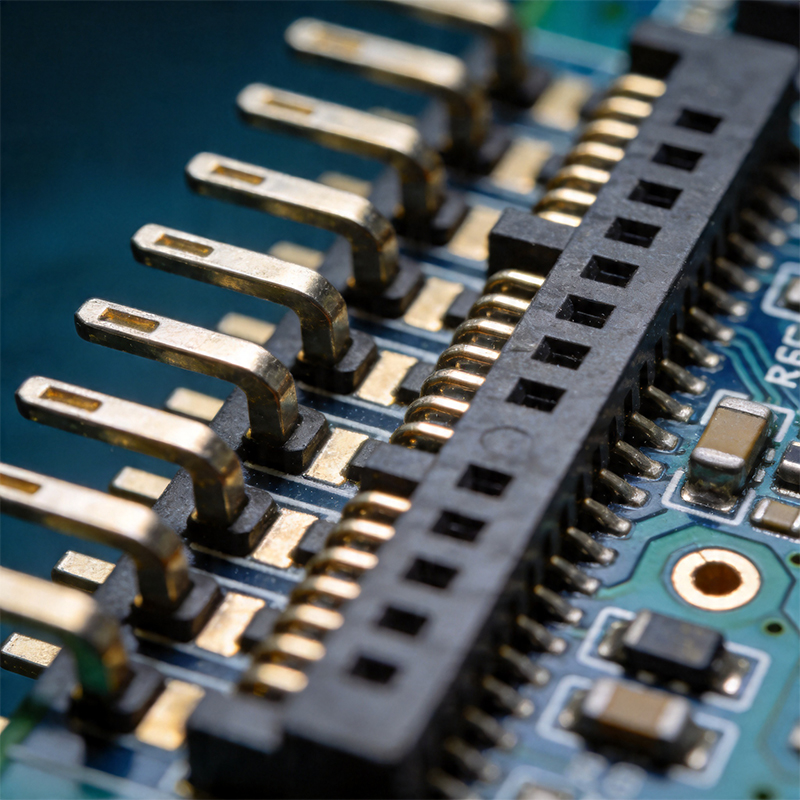
Not all bridges are built the same. Depending on your layout, you’ll see:
Mezzanine (Parallel): The most common. Two boards sit parallel to each other like floors in a building.
Perpendicular (90 Degree): One board stands upright on the other, often used for backplanes or expansion cards.
Coplanar: The boards sit side-by-side on the same plane, like two puzzle pieces joining together.
If you're an engineer, you know it’s not just about "clicking" things together. You have to consider:
The Pitch: This is the distance between the center of one pin and the next. We’re seeing pitches as small as 0.35mm today. It's tiny, and if your SMT process isn't perfect, you'll get shorts.
Stack Height: This is the gap between the two boards. Choosing the right height is a balancing act between airflow and device thickness.
Mating Force: You want it to stay connected if the device is dropped, but you don't want it so tight that it breaks the delicate HDI board during assembly.
As a manufacturer of Custom Flex and Rigid-Flex PCBs, we see BTB connectors evolving. We often use them to connect a rigid motherboard to a high-speed HDI flex circuit. This combination allows for devices that can fold or fit into irregular shapes without losing high-speed data performance.
The board to board connector might be invisible once your product is assembled, but it’s the backbone of modular, high-performance electronics. Whether you're a hobbyist or a lead engineer at a tech giant, understanding how to choose the right connector is the difference between a robust product and a costly recall.

Kaboer manufacturing PCBs since 2009. Professional technology and high-precision Printed Circuit Boards involved in Medical, IOT, UAV, Aviation, Automotive, Aerospace, Industrial Control, Artificial Intelligence, Consumer Electronics etc..


 English



 Wechat
 +86 13670210335
 +86 13670210335
 E-mail