
Date: 2026-04-20
Let’s be real: no matter how steady your hands are, everyone messes up a solder joint eventually. Maybe you’ve got a massive solder bridge on a fine-pitch QFP chip, or perhaps you’re trying to salvage a rare component from an old board. In these moments, you don't need a miracle—you need a desoldering braid.
Often called "solder wick," this tool is the ultimate "undo button" for hardware engineers. But what is it, and why does it work so well? Let’s break it down.
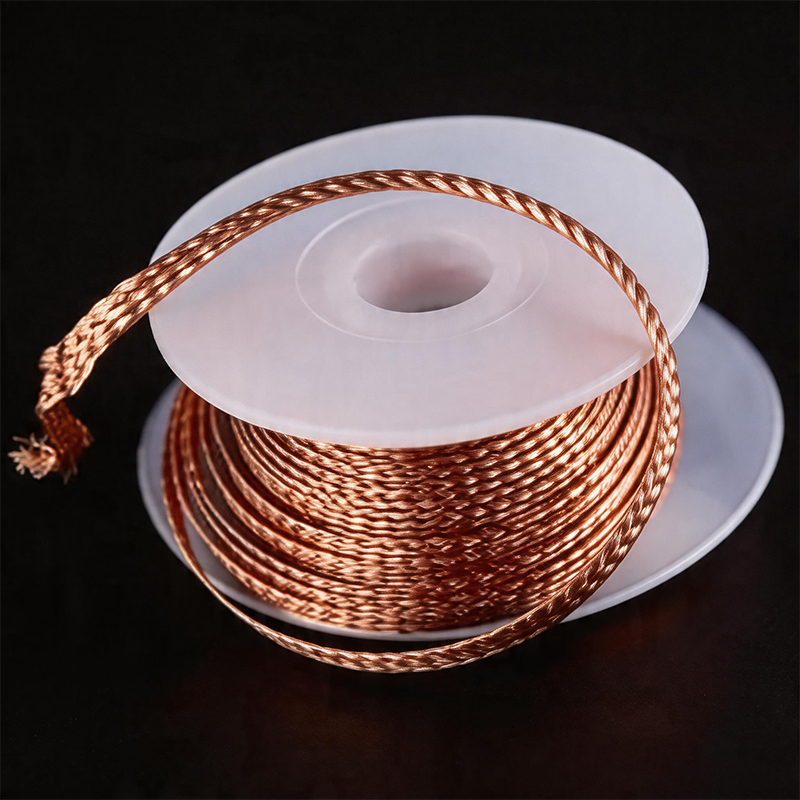
At its core, desoldering braid is a fine mesh of oxygen-free copper wires braided together. Its secret weapon? Capillary action.
Think of it like a very thirsty sponge, but for molten metal. When you heat the braid and the solder at the same time, the liquid solder is "sucked" up into the copper weave. It’s a beautiful bit of physics that allows you to lift solder away from a pad without spreading it everywhere.
If you’ve seen those big plastic "solder suckers" (vacuum pumps), you might wonder why bother with a braid.
Precision: Suckers are great for chunky through-hole parts, but they are clumsy. For surface mount components or HDI boards with tiny traces, a sucker’s recoil can actually kick components off the board.
Cleanliness: Braid leaves a flatter, cleaner pad, which is essential if you plan to re-solder a new component on the same spot.
You’ll notice that desoldering braids come in different widths and colors. Don't just grab the first one you see.
The Width: Use a braid that is roughly the same width as the pad you’re cleaning. If it’s too wide, it’ll soak up heat and take forever to work. If it’s too narrow, you’ll be there all day.
The Flux: Most high-quality braids come pre-coated with rosin flux. This is non-negotiable. Without flux, the copper will oxidize instantly under heat and won’t suck up a drop of solder. In 2026, many pros even add a tiny drop of their own tacky flux to the braid to speed things up.
The biggest mistake people make is "scrubbing" the board. Don't do that!
Place the braid directly over the unwanted solder.
Place your iron tip on top of the braid (making a "braid sandwich").
Wait for the magic: Once you see the solder start to soak into the copper (it will turn silver), slowly lift both the iron and the braid at the same time.
Cut the used end: Never reuse a part of the braid that’s already full of solder. It’s a one-way trip!
If you aren't careful, desoldering can be more destructive than the original mistake.
Too Much Pressure: You aren't scrubbing a floor. If you press too hard, you’ll delaminate the pad, especially on thin Flex PCBs.
Cold Iron: If your iron isn't hot enough, the braid will stick to the pad. If this happens, don't pull it! Add more heat until it melts, then lift. Pulling a cold braid is the fastest way to rip a trace right off the board.
A desoldering braid is a simple tool, but in the hands of a skilled technician, it’s the difference between a successful repair and a piece of e-waste. At our facility, whether we are working on Custom Rigid-Flex boards or high-speed HDI PCBA, we know that cleanliness is everything. A clean board is a reliable board.

Kaboer manufacturing PCBs since 2009. Professional technology and high-precision Printed Circuit Boards involved in Medical, IOT, UAV, Aviation, Automotive, Aerospace, Industrial Control, Artificial Intelligence, Consumer Electronics etc..


 English



 Wechat
 +86 13670210335
 +86 13670210335
 E-mail