
Date: 2026-05-19
You know those standard green circuit boards made of FR4 fiberglass? They work great for most electronics. But when things get really hot – like inside a radar sensor, a power module, or a high‑power LED light – FR4 starts to struggle. It can't handle the heat. It loses performance. Eventually, it fails.
That's where ceramic PCB comes in. It's like the superhero version of a circuit board. It takes the heat, keeps signals clean, and just keeps working when everything else would melt.
Let's break down what a ceramic PCB is, what makes it special, and why you might need it for your next project.
What Is a Ceramic PCB?
A ceramic printed circuit board uses ceramic materials as its base substrate instead of traditional fiberglass (FR4) or plastic. The most common ceramic materials are aluminum oxide (Al₂O₃, also called alumina) and aluminum nitride (AlN). Sometimes beryllium oxide (BeO) or silicon nitride (SiN) are also used for special applications.
In plain English: instead of a soft, organic material that burns when it gets hot, you're using a hard, inorganic ceramic that laughs at high temperatures.
Ceramic PCB vs. FR4 – What's the Big Difference?
Let's start with the numbers. FR4 has a thermal conductivity of about 0.2–0.5 W/m·K. That's pretty bad. Heat gets trapped under components and slowly cooks them.
Ceramic PCBs, on the other hand, are heat‑spreading champions:
Alumina (Al₂O₃): 15–35 W/m·K
Aluminum nitride (AlN): 170–230 W/m·K (some sources say up to 320 W/m·K)
That's 50 to 500 times better than FR4. Heat flows right through the board and away from your components.
But thermal conductivity isn't the only advantage. Here's a quick comparison:
| Property | FR4 | Ceramic PCB |
|---|---|---|
| Thermal conductivity | 0.3–0.5 W/m·K | 15–230+ W/m·K |
| Maximum operating temperature | ~130–150°C | Up to 800°C+ |
| CTE (thermal expansion) | ~14–18 ppm/°C | ~4.5–8 ppm/°C (matches silicon) |
| Moisture absorption | 0.1–0.2% | 0% |
| Dielectric constant (Dk) | 4.2–4.8 | 8.5–9.8 |
| Electrical insulation | Good | Excellent (10–20 kV/mm breakdown) |
| Cost | Low (20/board) | High (200+/board) |
Three More Things That Make Ceramic PCBs Special
1. Perfect Thermal Matching with Chips
Semiconductor chips (like silicon dies) have a coefficient of thermal expansion around 3–5 ppm/°C. FR4 expands at ~14–18 ppm/°C. That's a big mismatch. When the board heats up and cools down, the FR4 expands faster than the chip. Over time, solder joints crack and the chip can delaminate.
Ceramic PCBs have a CTE around 4.5–8 ppm/°C – much closer to silicon. Less expansion mismatch means fewer cracked joints and longer life.
2. Zero Moisture Absorption
FR4 absorbs a little bit of moisture (0.1–0.2%). That doesn't sound like much, but in high‑frequency applications, absorbed water changes the dielectric constant, which changes your signal timing. Ceramic PCBs absorb no water at all – 0%. They're dimensionally stable no matter how humid it gets.
3. Excellent High‑Frequency Performance
Ceramic PCBs have stable dielectric constants (Dk around 8.5–9.8) and very low dissipation factors. That means less signal loss at high frequencies. They're ideal for RF, microwave, and millimeter‑wave applications where FR4 would kill your signal integrity.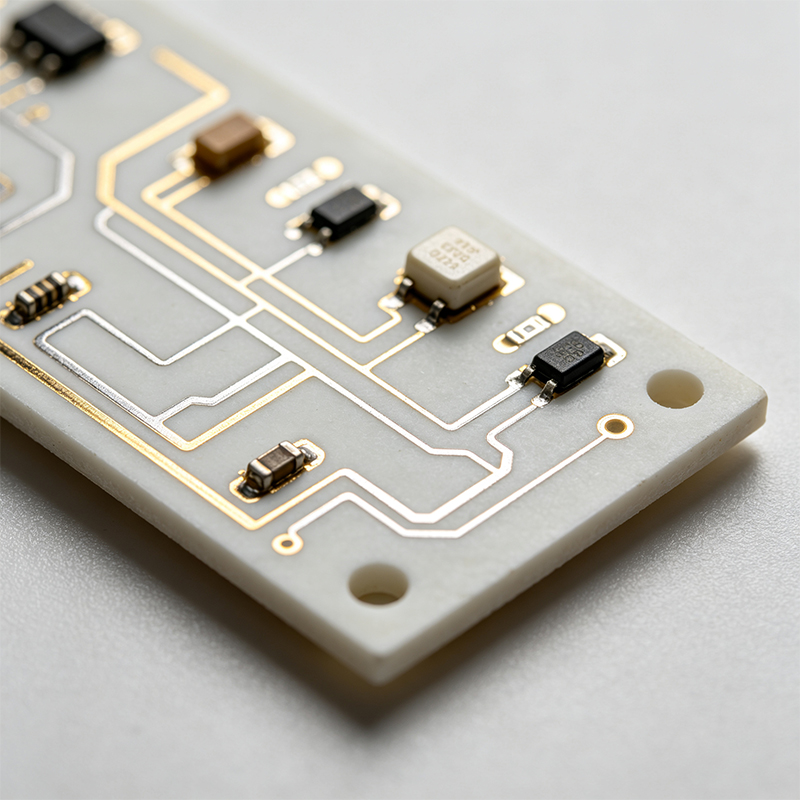
Where Are Ceramic PCBs Actually Used?
Because ceramic PCBs are expensive (200+ per board vs. 20 for FR4), they're not for everything. They're used in applications where failure is not an option:
High‑power LEDs – LED chips generate lots of heat. A ceramic PCB pulls that heat away, keeping the LED cool and extending its life. Almost every high‑power LED module uses a ceramic substrate.
Power electronics – IGBT modules, power converters, and inverters generate serious heat. Ceramic PCBs keep them running reliably in electric vehicles, industrial drives, and solar inverters.
RF and microwave systems – Radar, 5G base stations, satellite communications, and military radios need stable dielectric properties and low signal loss. Ceramics deliver.
Automotive electronics – Engine control units, ABS modules, and ADAS sensors face extreme temperature swings and vibration. Silicon nitride ceramic is especially popular in cars because it's tough and resists cracking.
Medical devices – Implantable sensors and surgical instruments need materials that are biocompatible, chemically inert, and reliable. Ceramic PCBs fit the bill.
Aerospace and defense – Avionics, missile guidance systems, and satellite electronics need boards that can survive extreme heat, cold, vacuum, and radiation. Ceramic PCBs are often the only choice.
Wait, How Can Ceramic PCB Operate at 800°C?
If you're used to FR4's 130°C limit, 800°C sounds impossible. Here's the key: the ceramic substrate itself can handle those temperatures. But the copper traces? Not so much. Copper melts at 1085°C. The solder joints will fail long before that. So the practical operating temperature of a ceramic PCB assembly is limited by the solder (typically 150–200°C for standard solders) or the components you attach.
However, the ceramic substrate allows you to use high‑temperature solders or sintered connections that ordinary FR4 couldn't survive. For example, some ceramic PCB assemblies work reliably at 350°C or even higher in specialized applications.
How Are Ceramic PCBs Made? The Four Main Methods
Unlike standard PCBs, you can't just etch copper on a ceramic board. The copper won't stick. Ceramic PCBs require special manufacturing processes:
1. DBC (Direct Bonded Copper)
A high‑temperature oxidation process bonds thick copper (4oz to 10oz, or 140–350μm) directly to the ceramic substrate. DBC is great for power electronics because you get very thick copper for high currents. But through‑hole plating isn't available, and fine traces are difficult.
2. DPC (Direct Plated Copper)
This is the newest method. A thin layer of copper is sputtered onto the ceramic in a vacuum chamber, then plated up to the required thickness. DPC allows for fine traces (tight spacing), plated through‑holes, and good tolerances. It's ideal for complex, high‑density ceramic PCBs.
3. Thick Film (Screen Printed)
Conductive pastes (usually silver, gold, or palladium‑silver) are screen‑printed onto the ceramic and fired at high temperatures. This is a lower‑cost method but doesn't give you super fine traces. Good for simple circuits and hybrid microelectronics.
4. AMB (Active Metal Brazing)
A brazing material containing reactive metals (like silver, copper, and titanium) bonds the copper to the ceramic. AMB offers very strong bonding and good thermal performance, often used in high‑reliability power modules.
HTCC and LTCC – Multilayer Ceramic PCBs
Most ceramic PCBs are single‑layer or double‑layer because multi‑layer ceramics are tricky – they can break during lamination. But when you need complex multilayer circuits, you use co‑firing technology:
HTCC (High‑Temperature Co‑Fired Ceramic) – The ceramic layers are stacked with tungsten or molybdenum conductors and fired at 1300–1600°C. HTCC substrates are very strong and have excellent mechanical properties. But because the firing temperature is so high, you can't use low‑melting metals like gold or silver – you're stuck with tungsten or molybdenum, which have lower conductivity.
LTCC (Low‑Temperature Co‑Fired Ceramic) – Glass particles are mixed into the ceramic powder to lower the firing temperature to 850–950°C. This allows the use of gold, silver, and copper conductors – much more conductive. LTCC is the mainstream technology for complex ceramic multilayer boards.
Why Are Ceramic PCBs So Expensive?
If you've ever priced a ceramic PCB, you know they cost 5–50 times more than FR4. Here's why:
1. Raw material cost – High‑purity alumina (>95% purity) is expensive to produce. Aluminum nitride costs 5–8 times more than alumina. The ceramic powder itself is much more costly than fiberglass and epoxy resin.
2. Expensive manufacturing equipment – DBC and DPC require vacuum chambers, high‑temperature furnaces, sputtering equipment, and other expensive tools. Standard PCB fabs can't make ceramic boards without massive investment.
3. Lower production volumes – FR4 boards are made by the millions. Ceramic PCBs are made in smaller batches, so the fixed costs (tooling, NRE) get spread over fewer boards.
4. Lower yields – Ceramic is brittle. It cracks during handling, drilling, and lamination. That means more waste and higher cost per good board.
5. Special materials – DPC often uses oxygen‑free high‑conductivity copper (99.9% purity) and sometimes gold or silver for conductors – all much more expensive than standard copper foil.
What About Size? Can You Make Large Ceramic PCBs?
Not really. Most ceramic PCBs are small – typically 115mm × 115mm, with maximum sizes around 138–190mm. Why? Because ceramic is brittle. A large, thin ceramic board can break under its own weight during processing. If you need a large circuit board, ceramic is probably not the right choice.
Can You Solder Components on a Ceramic PCB?
Yes, but with higher temperatures. Standard reflow soldering for FR4 runs around 250–260°C. Ceramic PCBs can handle much higher reflow temperatures – sometimes up to 400°C or even 800°C. That's useful if you're attaching components with high‑temperature solder or doing multiple reflow steps.
Otherwise, assembly on a ceramic PCB is similar to any other board – pick‑and‑place, reflow, inspection, testing.
Real‑World Example: An LED Module that Wouldn't Die
A customer was building a high‑power LED light for stadiums. The LEDs drew 50 watts each. On a standard aluminum‑core PCB, the LEDs still got too hot and lost brightness after a few months. They switched to an aluminum nitride ceramic PCB. The thermal conductivity was 10 times better. The LEDs ran cooler, maintained their brightness, and lasted for years. The ceramic board cost more upfront, but the customer saved on warranty claims and replacements.
When Should You Use a Ceramic PCB?
Use a ceramic PCB if:
Your product generates lots of heat – Power modules, LED lights, RF amplifiers.
You need perfect thermal matching – Large silicon dies that could crack from expansion mismatch.
Signal integrity matters at high frequencies – Radar, 5G, satellite, microwave.
The environment is brutal – High temperature, high humidity, chemicals, or vibration.
Failure is not an option – Medical implants, aerospace, military.
When Should You Stick with FR4?
Stick with FR4 if:
Your product is low‑power and runs cool.
You're making lots of units and need low cost.
You don't need extreme thermal or high‑frequency performance.
Your board needs to be large (bigger than about 150mm).
What We Offer
We're a custom circuit board manufacturer specializing in flexible PCBs, rigid‑flex boards, HDI high‑frequency boards, and PCBA. While ceramic PCBs are not our primary focus, we understand them and can help you decide whether ceramic is right for your project – or whether a combination of HDI and high‑frequency laminates might solve your thermal and signal integrity needs at a lower cost.
Final Answer – What Is a Ceramic PCB?
A ceramic PCB is a circuit board that uses ceramic materials (like aluminum oxide or aluminum nitride) as its base instead of FR4 fiberglass. It offers dramatically better thermal conductivity (50–500x higher), excellent thermal expansion matching with silicon chips, zero moisture absorption, and stable high‑frequency performance. But it's expensive, brittle, and limited in size. Ceramic PCBs are used in high‑power LEDs, power electronics, RF systems, automotive modules, medical devices, and aerospace – anywhere that failure is not an option.

Kaboer manufacturing PCBs since 2009. Professional technology and high-precision Printed Circuit Boards involved in Medical, IOT, UAV, Aviation, Automotive, Aerospace, Industrial Control, Artificial Intelligence, Consumer Electronics etc..


 English



 Wechat
 +86 13670210335
 +86 13670210335
 E-mail