
Date: 2026-01-21
Let's get straight to it. You're probably reading about ceramic PCB material because you've hit a wall with standard boards. Your design works, but it runs hot—maybe too hot. You're not just looking for a different board; you're looking for a different foundation.
Ceramic isn't just another material. It's in a class of its own. To understand why, let's compare it to what you know.
Think of your standard FR4 PCB like a plastic picnic table. It's great for most situations. It holds your stuff, it insulates, and it's cost-effective. But leave it in the blazing sun, and it gets uncomfortably hot to touch. Place a hot pan directly on it, and it might even warp or melt.
Now, think of ceramic PCB material like a stone countertop. It's solid, handles heat directly without fuss, and actually pulls that heat away. It's built for more demanding jobs.
So, what makes it so different?
The magic of ceramic in electronics boils down to three key properties:
Thermal Conductivity: This is the big one. Ceramic materials are fantastic at moving heat. A common one like Alumina (Al₂O₃) conducts heat 5 to 10 times better than FR4. A premium one like Aluminum Nitride (AlN) can be 30 times better. This means heat from a hot chip doesn't get trapped; it spreads out across the board efficiently, preventing those dangerous hot spots.
Electrical Insulation: Even though it moves heat like a champ, it blocks electricity perfectly. This combination—great heat transfer with excellent insulation—is rare and extremely valuable.
Dimensional Stability: Unlike plastics that can expand and warp with temperature changes, ceramic is rock-solid. Its coefficient of thermal expansion (CTE) is low and stable, which means connections are less likely to crack under stress from repeated heating and cooling cycles.
Not all ceramics are the same. Here are the two you're most likely to consider:
Alumina (Al₂O₃): The industry workhorse. It offers the best balance of performance and cost. When someone says "ceramic PCB," they're usually talking about Alumina. It’s the reliable choice for most applications that need a step up from FR4.
Aluminum Nitride (AlN): The premium specialist. If Alumina is a reliable SUV, AlN is a race car built for one thing: moving heat. It's used when thermal performance is the absolute top priority, such as in high-power laser systems or advanced RF modules. It comes at a higher cost, but for the right application, it's non-negotiable.
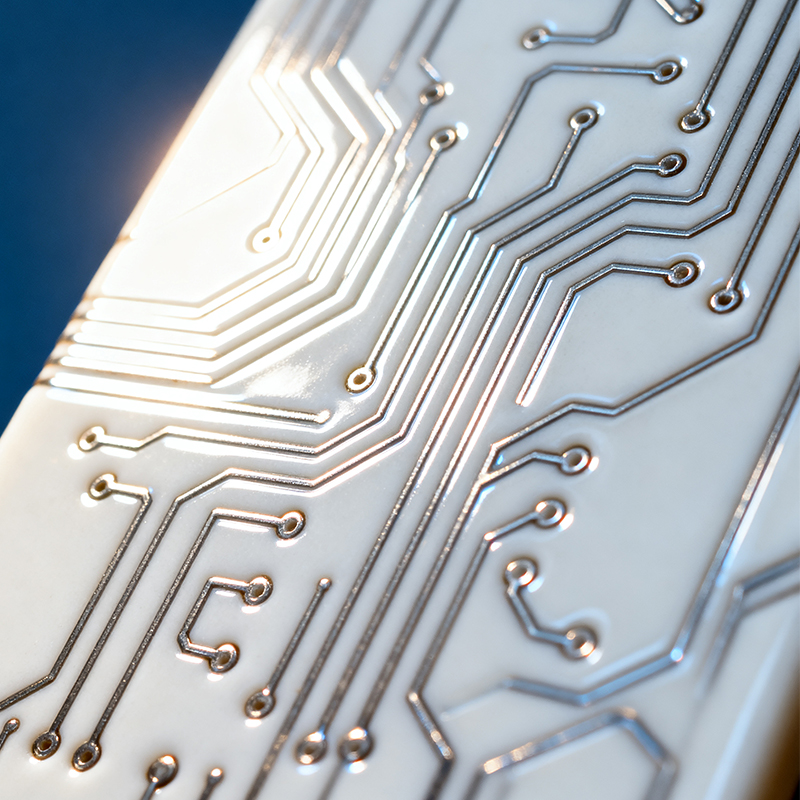
You don't choose ceramic on a whim. You choose it when your design has a specific problem.
Ask yourself these questions:
Is heat the #1 limiting factor in my design? (e.g., high-power LEDs, power converters, motor drives)
Am I working with very high frequencies? (e.g., RF/microwave circuits where signal loss in the board material is critical)
Will my product face extreme, repeated temperature swings? (e.g., under-the-hood automotive, aerospace applications)
Do I need the absolute most reliable connections over thousands of cycles?
If you answered "yes" to any of these, then ceramic PCB material isn't an extra cost—it's the enabling solution that makes your product viable and reliable.
It's not a perfect, one-size-fits-all replacement. Here's the other side of the coin:
Cost: The materials and specialized manufacturing (like laser drilling) make it more expensive than FR4.
Fragility: It's very hard but also brittle. It can be susceptible to cracking from sharp impact or if the board design creates mechanical stress points.
Design and Manufacturing Nuance: Its properties change the rules. For example, its excellent thermal conductivity means it can "steal" heat away from solder joints during assembly, requiring a carefully tuned process.
This last point about nuance is crucial. Successfully using ceramic isn't just about buying the right boards. It requires a manufacturer who understands that the material changes everything—from how you design the circuit layout to how you set up the soldering oven.
A partner familiar with ceramic knows how to design for its stiffness, how to handle it without causing micro-cracks, and how to adjust the assembly process to accommodate its unique properties. This deep understanding of both the material science and the practical manufacturing is what turns a high-performance substrate into a reliable, finished product.
For companies like Kaboer, with our own specialized factory in Shenzhen, developing this expertise across materials—from standard FR4 to advanced ceramics—is part of the job. It allows us to guide clients to the right foundation for their project and ensure it's built correctly.
In short, ceramic PCB material is a powerful tool for specific, high-stakes challenges. It's the foundation you choose not because it's easy, but because your product demands the exceptional performance that only it can provide.

Kaboer manufacturing PCBs since 2009. Professional technology and high-precision Printed Circuit Boards involved in Medical, IOT, UAV, Aviation, Automotive, Aerospace, Industrial Control, Artificial Intelligence, Consumer Electronics etc..


 English



 Wechat
 +86 13670210335
 +86 13670210335
 E-mail