
Date: 2026-03-10
You've probably seen the videos. A machine whirs to life, depositing perfect silver traces onto a flexible substrate, creating a working circuit in minutes. It looks like magic. And for a certain type of project, it really is.
Circuit printers—machines that print functional electronics directly onto substrates using conductive inks—have been getting a lot of attention lately. And honestly, it's deserved. They're opening doors that have been locked for decades.
But here's the thing no one tells you in those glossy demo videos: circuit printers are tools, not solutions. They excel at some things and fall flat at others. Knowing which is which can save you a lot of time, money, and frustration.
Let's break down what circuit printers actually do, where they shine, where they struggle, and when you're better off sending your design to a professional PCB fabricator.
A circuit printer is a machine that creates electronic circuits by depositing conductive and insulating materials directly onto a substrate . Instead of starting with a copper-clad board and etching away unwanted material (the traditional "subtractive" method), circuit printers build up traces layer by layer—an "additive" process .
Think of it like the difference between carving a sculpture from a block of marble (subtractive) and 3D-printing one from nothing (additive). Both get you a sculpture, but the process, the possibilities, and the limitations are completely different.
The inks used in circuit printing are typically nanoparticle formulations—silver, copper, or graphene—suspended in a carrier that evaporates or cures after deposition . When printed correctly, these traces conduct electricity, forming functional circuits.
Not all circuit printers are the same. Depending on the technology, you get very different capabilities:
These printers deposit specialized conductive inks onto substrates using methods similar to screen printing or dispensing . They're the most common type for flexible and wearable electronics.
What they're good for: Printing on unconventional materials like fabric, plastic, or paper. Perfect for smart textiles, disposable sensors, and rapid design iterations .
The trade-offs: Conductivity is lower than etched copper, ink costs can be high (especially silver-based), and durability under mechanical stress is limited .
Like the printer on your desk, but instead of ink, it deposits microscopic droplets of conductive and insulating materials . Layer by layer, it builds up functional circuits.
What they're good for: Multi-layer circuits, high resolution, and compatibility with flexible and 3D surfaces . Great for wearables, RFID tags, and embedded electronics.
The trade-offs: Slower than industrial methods, requires precise environmental control, and ink clogging can be a reliability issue . Most prints need post-processing (sintering) to achieve full conductivity .
These use high-precision lasers to remove copper from rigid substrates, creating circuit patterns without physical contact .
What they're good for: Exceptional precision and resolution. Ideal for complex, high-density circuits in aerospace, medical devices, and RF applications .
The trade-offs: Limited to rigid copper-clad boards, higher equipment cost, and material waste from ablated copper .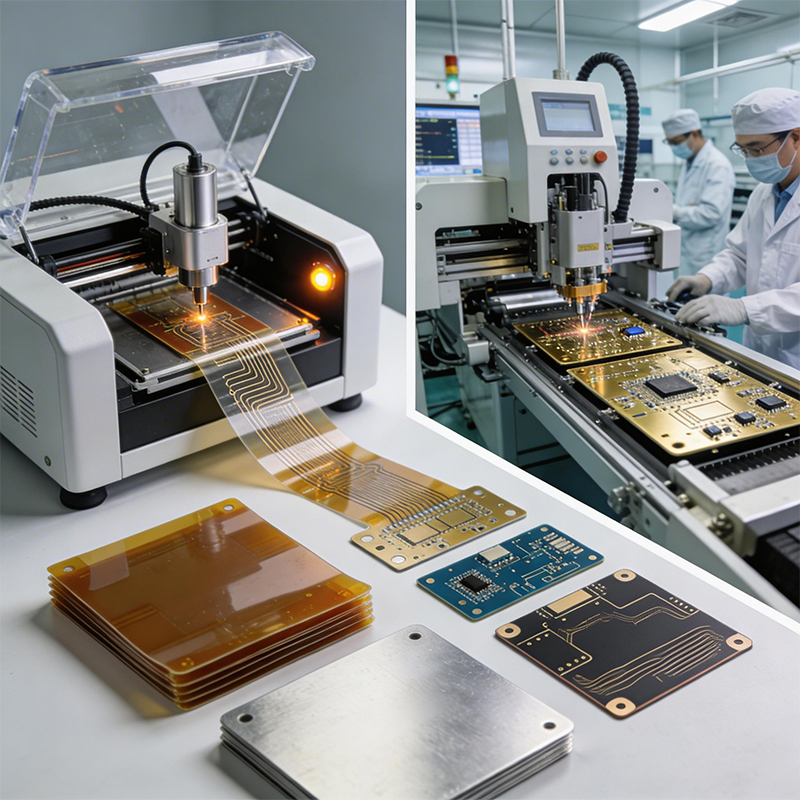
These combine multiple technologies—inkjet, screen printing, laser ablation—to enable 3D circuit fabrication and integration of passive components directly into the board .
What they're good for: Advanced R&D, aerospace systems, medical implants, and next-generation PCBs with integrated functionality .
The trade-offs: Very high initial investment, complex operation, and limited availability of expertise .
Here's a quick comparison table to help you see the differences at a glance :
| Technology | Resolution | Material Flexibility | Best Use Case | Key Limitation |
|---|---|---|---|---|
| Conductive Ink | Medium | Excellent | Flexible circuits, smart fabrics | Lower conductivity, durability |
| Inkjet | High | Very Good | Wearables, sensors, multi-layer | Slow speed, post-processing needed |
| Laser Etching | Very High | Low (rigid only) | Precision PCBs, RF, medical | High cost, material waste |
| Hybrid | Very High | Excellent | 3D circuits, embedded components | Very expensive, complex |
After reading through countless case studies and talking with engineers who use these machines daily, here's where circuit printers genuinely deliver value:
Rapid prototyping on unconventional substrates. If you need a circuit on fabric, paper, or a curved surface, a circuit printer might be your only practical option .
Design iteration speed. Change the file, hit print, and you've got a new circuit in hours instead of days. That speed is invaluable during early-stage development .
Low-volume production of flexible electronics. For specialized applications like medical sensors or wearable tech where volumes are low and flexibility is critical, circuit printers make economic sense .
Educational and research settings. Universities and labs use these machines to explore ideas without the overhead of traditional PCB fabrication .
But—and this is important—circuit printers come with limitations that aren't always obvious from the marketing materials:
Even after sintering, printed conductive traces have higher resistivity than bulk copper . For high-power applications or anything requiring minimal voltage drop, etched copper still wins. Period.
While high-end systems can achieve impressive resolution, most desktop printers are limited to around 100 μm line widths . Compare that to professional PCB fabrication, which routinely does 75 μm (3 mil) and can go down to 50 μm or less for advanced designs.
Printing multi-layer circuits requires precise alignment between layers. Misalignment means shorts or opens. Advanced industrial printers manage 5-10 μm registration, but hobbyist systems are closer to 50 μm . For dense designs, that's not good enough.
A desktop circuit printer might cost $5,000. An industrial system can run over $75,000 . Then add inks ($300 per liter for conductive, $200 for dielectric), substrates, curing equipment, and your time. For most projects, professional PCB fabrication ends up being far more economical.
Printed electronics are still emerging for high-reliability applications . If your product needs to last years in the field, withstand thermal cycling, or survive harsh environments, traditional PCBs have decades of proven performance behind them.
Here's a rule of thumb I've developed after years in this industry: circuit printers are for exploration; professional PCB fabs are for production.
If any of these apply to your project, you're probably better off sending your Gerber files to a real PCB manufacturer:
You need reliable, repeatable performance. Professional fabrication gives you controlled impedance, plated through-holes, solder mask, and surface finishes that printed circuits simply can't match.
You have fine-pitch components. BGAs, QFNs, and anything with 0.5mm pitch or smaller require precision that's difficult to achieve with printing.
You're building anything that will be handled, shipped, or used in the field. Durability matters. Professional boards with proper solder mask and surface finish will outlast printed circuits by a wide margin.
You need more than a handful of boards. At scale, professional fabrication is faster, cheaper, and more consistent.
Time-to-market matters. Once your design is finalized, waiting days for professionally fabricated boards is almost always faster than printing them yourself—especially when you factor in setup, calibration, and potential reprints.
Here's what the smartest engineers I know actually do:
Phase 1: Concept exploration. Use breadboards, development kits, or even circuit printers to prove out the core idea. This is where speed matters more than precision.
Phase 2: Design and validation. Design the PCB properly in KiCad, Altium, or Eagle. Run simulations. Get it right.
Phase 3: Professional prototyping. Send your Gerber files to a professional PCB fabricator like Kaboer. Get back boards that are electrically and mechanically correct, with proper solder mask, surface finish, and plated through-holes.
Phase 4: Test and iterate. Test thoroughly. If changes are needed, update the design and order another small batch.
Phase 5: Scale to production. Once the design is locked, ramp up to volume production with the same partner who handled your prototypes. Consistency matters.
This hybrid approach gives you the best of both worlds: the exploration speed of DIY methods with the reliability and precision of professional manufacturing.
At Kaboer, we've been manufacturing custom PCBs since 2009. We've seen thousands of designs—from simple two-layer boards to complex HDI nightmares. And we've learned that the best projects usually start with a clear-eyed assessment of what makes sense to do in-house versus what should be trusted to experts.
What we offer that actually matters for someone coming from the DIY or circuit-printer world:
We speak your language. When you send us your design, our engineers don't just run files—they review them. They'll spot the things you missed, the clearances that won't work, the thermal issues you haven't considered. This DFM feedback is like having a senior engineer look over your shoulder.
We handle the hard stuff. Flexible PCBs? Rigid-flex? HDI with microvias? High-frequency materials like Rogers or PTFE? We do all of it. If your design is pushing boundaries, we have the equipment and experience to make it work .
We do quick-turn prototyping. Sometimes you need boards yesterday. We get that. Our fast prototyping service can turn your Gerbers into physical boards in days, not weeks .
We assemble too. Here's where it gets really interesting: we don't just make the boards—we populate them. Our in-house PCBA facility means you can go from design files to fully assembled, tested modules without ever touching a soldering iron .
We're certified where it matters. ISO 9001, IATF 16949 (automotive), ISO 13485 (medical), and ISO 14001—these aren't just wall plaques. They mean our processes are documented, repeatable, and reliable .
We're transparent. If you're ever in Shenzhen, come visit. Walk the floor. See how your boards are made. We believe that trust is built on transparency, not promises.
Circuit printers are fascinating tools. They've opened up new possibilities in flexible electronics, rapid prototyping, and educational exploration. But when it comes time to build something that needs to work reliably—whether it's 10 boards or 10,000—professional PCB fabrication is still the gold standard.
If you've got a design that's ready for real manufacturing, send us your Gerber files or requirements. We'll get back to you within 2 hours with a free quote and honest feedback on your design.
Whether you need bare boards, full assembly, or just advice on making your design more manufacturable, we've got your back.
Better yet—come visit our Shenzhen factory. See for yourself how real circuit boards are made. Meet the people who'll build your project. Ask all the questions you've been saving up.
Because at the end of the day, we're all just trying to build things that work.

Kaboer manufacturing PCBs since 2009. Professional technology and high-precision Printed Circuit Boards involved in Medical, IOT, UAV, Aviation, Automotive, Aerospace, Industrial Control, Artificial Intelligence, Consumer Electronics etc..


 English



 Wechat
 +86 13670210335
 +86 13670210335
 E-mail