
Date: 2026-03-10
Let's be honest. There's a special kind of satisfaction that comes from building something with your own two hands. That moment when the smoke stays inside the components, the LED blinks exactly as you commanded, and you realize—you made that. It's addictive.
I started exactly where you probably are now: hunched over a hot soldering iron, breathing in that peculiar flux fumes smell, feeling like a wizard conjuring magic from copper and silicon. And for a long time, I was convinced that real engineers did everything themselves. Breadboards, stripboards, even etching my own boards with ferric chloride in a plastic tray behind the garage.
Then I tried to build something that actually mattered. Something that needed to work reliably, not just once, but for years. Something with more than a handful of components. Something that couldn't afford to fail.
That's when I learned the hard truth about DIY circuit boards. Let me save you some of that pain.
The internet is full of beautiful pictures: people laser-engraving perfect-looking PCBs, hand-soldering 0402 components with the steady hand of a surgeon, creating works of electronic art. What those pictures don't show is the 80% failure rate on the first batch, the hours of debugging a short you can't see, or the intermittent failure that only shows up after three months of use.
DIY circuit boards occupy a very specific place in the electronics world. They're fantastic for learning. They're perfect for one-off projects where failure means a quick rework, not a customer complaint. They can even be economical—if you value your time at zero and your frustration tolerance at infinity.
But here's what the hobby blogs won't tell you: the gap between a board that works on your bench and a board that works in the field is enormous .
Let's talk numbers. I'm going to compare building a moderately complex controller yourself versus getting it done professionally. This isn't hypothetical—these are real figures from a recent project involving an ESP32-based LED controller with Wi-Fi control .
| Cost Category | Off-the-Shelf Controller | DIY Circuit Board (First Attempt) | Professional PCB Assembly (Third Iteration) |
|---|---|---|---|
| Hardware Cost (per unit) | $189 | $212 (PCB fab: $45, components: $137, shipping: $30) | $168 (bulk PCBs, optimized BOM) |
| Your Time | 0 hours | 84–120 hours (design, debugging, rework) | 12–18 hours (just design) |
| Failure Rate (first 100 hrs) | <0.5% | ~22% | <3% |
Notice something? That first DIY attempt isn't cheaper. It's actually more expensive in raw materials, and that's before we value your time at anything above zero. The failure rate is staggering—more than one in five boards will have issues in their first few days of operation .
And that's if you're good. If you're learning, expect that 22% to be much, much higher.
I'm not here to bash DIY. I still do it. There are times when rolling your own is absolutely the right call:
Learning and experimentation. If your goal is to understand how things work, DIY is irreplaceable. You learn things by messing up that you'd never learn from a perfect board .
One-off projects with no reliability requirements. A board for your desk that controls some LEDs? Go for it. A board that will be installed in a client's building? Think twice.
When you need it right now. Professional fabrication takes days, sometimes weeks. If you need a board tonight, laser-etching or toner transfer might be your only option .
Simple, single-sided circuits. If your design fits on one layer with wide traces and through-hole components, DIY is totally feasible .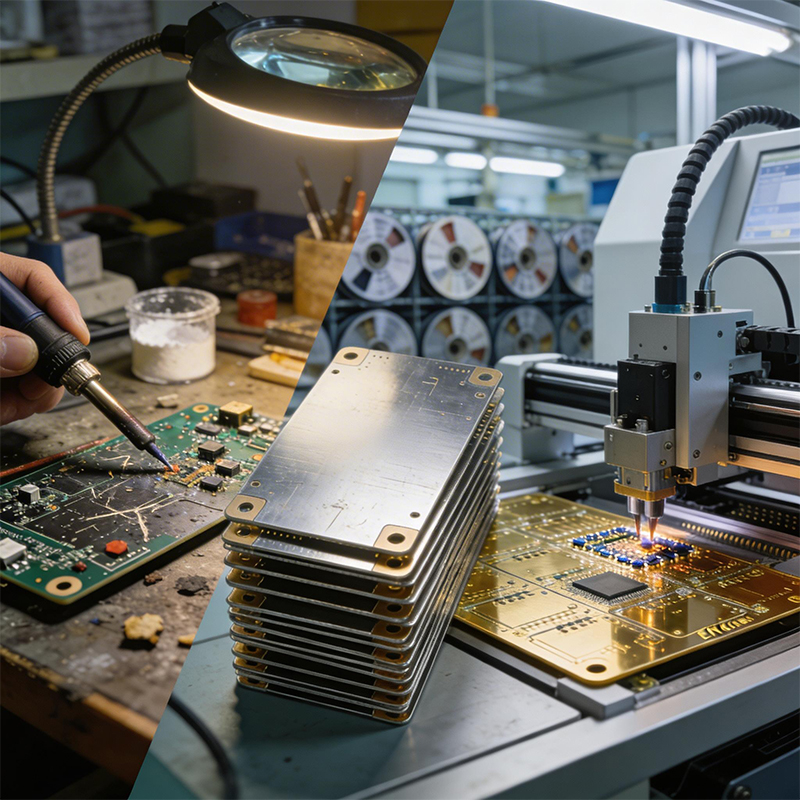
Here's what nobody warns you about. These are the issues that turned me from a DIY evangelist into someone who now tells clients "just pay for the professional boards."
A DIY laser engraver might achieve 0.2mm traces if you're incredibly careful and your machine is perfectly calibrated . Professional fabrication houses routinely do 0.1mm (4 mil) traces. For fine-pitch components, that difference matters. When you're trying to route between BGA balls, 0.1mm isn't a luxury—it's a necessity.
In professional boards, vias are drilled with micron precision and then plated with copper, creating a solid electrical connection between layers . Your drill press at home? It'll give you unplated holes that you have to manually solder wires through. It works for prototypes. It's a disaster for anything that needs to survive vibration or thermal cycling.
Try hand-soldering a TQFP-32 package without solder mask. Those fine-pitch pins? They'll bridge. You'll spend more time cleaning up shorts than actually building the circuit. Professional boards get a precisely applied solder mask that keeps solder exactly where it belongs .
Bare copper oxidizes. Within months, that beautifully etched board will develop a patina that makes soldering difficult and connections unreliable. Professional boards get HASL, ENIG, or OSP finishes that protect the copper and ensure solderability years later .
Ever tried to design a thermal relief on a hand-etched board? You can't. Those wide copper pours that look great on your layout will be impossible to solder because they suck away all the heat. Professional boards have thermal reliefs built into the design, making assembly actually possible .
A few years back, I designed a simple environmental sensor. Temperature, humidity, pressure—basic stuff. I hand-assembled five boards, tested them thoroughly, and they all worked perfectly. I was proud. I was smug. I installed them in a client's facility.
Three months later, three of them had failed.
The culprit? A combination of things I hadn't considered. My hand-soldered joints had micro-cracks from thermal stress. The bare copper had oxidized enough to increase contact resistance. The lack of conformal coating let humidity do its slow, corrosive work.
I replaced them with professionally assembled boards. Those have been running for three years now without a single failure.
That lesson cost me time, money, and reputation. Learn from my mistake.
So when should you stop messing around and send your design to a real fab? Here's my rule of thumb:
If more than five people will depend on it, go pro. Your personal project? DIY is fine. Something for a client, a product, or any situation where failure has consequences? Professional all the way.
If it has more than 50 components. At that complexity level, hand assembly becomes exponentially more error-prone.
If it needs to last more than a year. Professional boards with proper finishes and solder mask will outlast hand-built boards by a factor of ten.
If you value your time. Figure out your hourly rate. Multiply it by the hours you'll spend debugging and reworking. Compare that to the cost of professional fabrication. The math usually favors pro .
If it has fine-pitch components. Anything smaller than SOIC or 0805 passives becomes genuinely difficult by hand.
When you order from a real PCB manufacturer, you're not just paying for copper and fiberglass. You're paying for:
Precise impedance control for high-speed signals
Plated through-holes that actually connect layers reliably
Solder mask that prevents bridges and protects traces
Surface finish that keeps copper solderable for years
Electrical testing that catches shorts and opens before you ever see the board
Consistency—board #100 will be identical to board #1
That last one matters more than you think. When you're hand-building, every board is slightly different. That variability is the enemy of reliability .
At Kaboer, we've been doing this since 2009. We've seen thousands of designs—everything from simple two-layer boards to complex HDI nightmares. And we've learned that the best projects usually start with a clear-eyed assessment of what DIY can and cannot do.
Here's what we offer that actually matters for someone coming from the DIY world:
We speak your language. When you send us your design, our engineers don't just run files—they review them. They'll spot the things you missed, the clearances that won't work, the thermal issues you haven't considered. This DFM feedback is like having a senior engineer look over your shoulder .
We handle the hard stuff. Flexible PCBs? Rigid-flex? HDI with microvias? High-frequency materials like Rogers or PTFE? We do all of it. If your design is pushing boundaries, we have the equipment and experience to make it work .
We do quick-turn prototyping. Sometimes you need boards yesterday. We get that. Our fast prototyping service can turn your Gerbers into physical boards in days, not weeks .
We assemble too. Here's where it gets really interesting: we don't just make the boards—we populate them. Our in-house PCBA facility means you can go from design files to fully assembled, tested modules without ever touching a soldering iron .
We're transparent. If you're ever in Shenzhen, come visit. Walk the floor. See how your boards are made. We believe that trust is built on transparency, not promises.
Here's what I do now, and what I recommend to anyone building serious electronics:
Breadboard and prototype your core concept yourself. This is where learning happens, where you iterate quickly, where failure is cheap.
Design the PCB in KiCad or EasyEDA. Take your time. Run design rule checks. Get it right.
Order prototypes from a pro fab like Kaboer. Let them handle the fabrication. If you're confident, order them assembled too—those tiny 0402 caps are miserable by hand.
Test thoroughly. Then order production quantities once you're confident.
This hybrid approach gives you the best of both worlds: the hands-on learning of DIY with the reliability and precision of professional manufacturing .
You'll know it's time when you find yourself spending more time debugging assembly errors than actually improving your design. When the frustration of shorts and bridges outweighs the satisfaction of doing it yourself. When you realize that your time is worth something, and that there's no shame in letting professionals handle what they're good at.
The mark of a good engineer isn't doing everything themselves. It's knowing what to do themselves and what to trust to experts.
If you've got a design that's outgrown your soldering iron, or if you're just tired of fighting with DIY limitations, we're here to help.
Send us your Gerber files or requirements. We'll get back to you within 2 hours with a free quote and honest feedback on your design. Whether you need bare boards, full assembly, or just advice on making your design more manufacturable, we've got your back.
Better yet—come visit our Shenzhen factory. See for yourself how real circuit boards are made. Meet the people who'll build your project. Ask all the questions you've been saving up.
Because at the end of the day, we're all just makers trying to build something that works.

Kaboer manufacturing PCBs since 2009. Professional technology and high-precision Printed Circuit Boards involved in Medical, IOT, UAV, Aviation, Automotive, Aerospace, Industrial Control, Artificial Intelligence, Consumer Electronics etc..


 English



 Wechat
 +86 13670210335
 +86 13670210335
 E-mail