
Date: 2026-03-10
If you've ever had a batch of boards come back from assembly with shifted components, mysterious shorts, or that sinking feeling when you realize an entire production run is scrap, there's a good chance the culprit was something you barely noticed: the fiducials.
Or rather, the lack of them.
Here's the thing about modern PCB assembly: pick-and-place machines are incredibly fast and precise, but they're also blind. They need visual reference points to understand where your board actually is—not where it's supposed to be in some perfect theoretical world. Those reference points are called fiducials. And if you get them wrong, nothing else matters.
Let's talk about what fiducials actually do, how to design them properly, and why this tiny detail separates boards that assemble perfectly from ones that end up in the scrap bin.
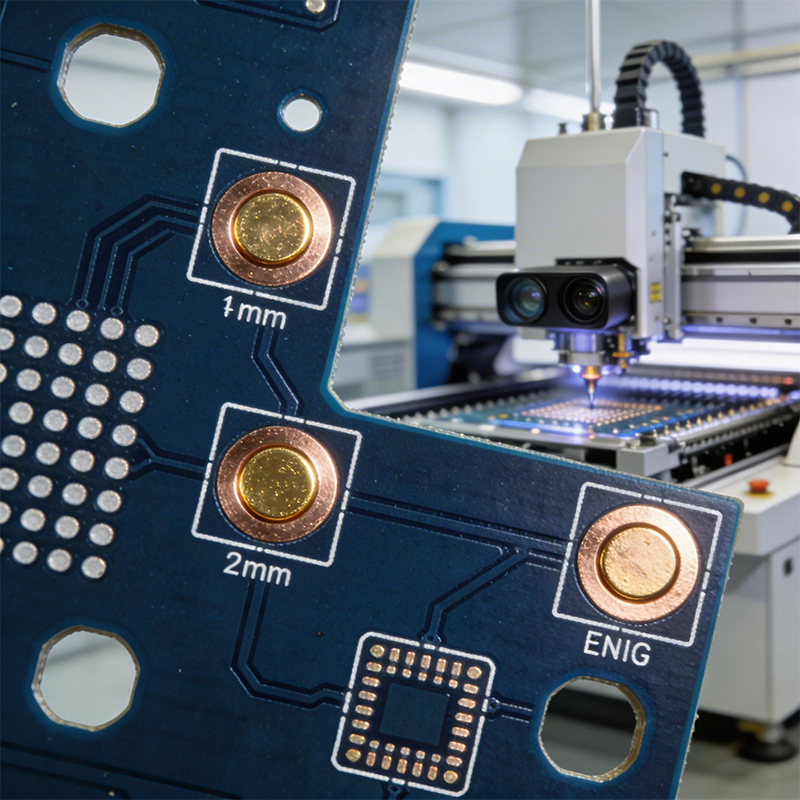
Fiducials (sometimes called fiducial marks or optical targets) are precisely engineered copper features on your PCB that act as visual reference points for automated assembly equipment . Think of them as GPS coordinates for your board.
When a pick-and-place machine loads your board, it doesn't assume it's in the exact perfect position. The conveyor system has tolerances. The board might be shifted a fraction of a millimeter left or right, or rotated slightly. Without fiducials, the machine would place components based on where the board should be, not where it actually is. With fine-pitch components, that tiny error is enough to cause complete failure .
Fiducials solve this. The machine's camera finds these marks, calculates the exact position and rotation of your board, and adjusts its placement program accordingly—in real time, for every single board .
Depending on what you're trying to achieve, you'll need different types of fiducials:
These sit on the tooling rails—the waste strips around your panel—and align the entire panel during stencil printing and initial placement . They're the first line of defense against misalignment.
Located on the individual PCB itself, typically at opposite corners, global fiducials establish the board's overall position and orientation . They correct for translational (X/Y) and rotational (θ) offsets.
How many do you need? Two are the minimum, but three are strongly recommended . Why? Two fiducials handle translation and rotation. A third allows the machine to compensate for non-linear distortions like board stretch, shrink, or twist—problems that become significant on larger boards or after thermal stress .
For fine-pitch components—typically anything with a pitch less than 0.5mm (20 mils)—global fiducials aren't enough . FR-4 expands and contracts with temperature, and over a large board, that tiny amount of movement can shift a fine-pitch BGA or QFN far enough to cause shorts.
Local fiducials sit near these critical components, usually in diagonally opposite corners of the land pattern . The machine does a second, ultra-precise alignment right before placing that specific part .
These are used in specific areas of a large board where you need extra precision but not necessarily per-component . They're a middle ground between global and local.
Fiducials look simple—just copper circles—but their design is governed by strict industry standards (IPC/SMEMA). Get these dimensions wrong, and the vision system might not see them at all.
Shape: Always a solid filled circle. Circles maintain the same geometric center regardless of rotation, which simplifies the machine's vision algorithms . Avoid squares, crosses, or other shapes—they're harder to recognize reliably.
Diameter: The sweet spot is 1.0 mm (about 40 mils) . It can range from 0.5 mm to 3.0 mm in theory, but 1.0 mm is the industry workhorse. Whatever size you choose, all fiducials on the same board must match within 25 microns (0.001 inch) . Inconsistent sizes confuse the vision system.
A fiducial needs its own personal space—a "keep-out" area completely free of copper, solder mask, silkscreen, or any other features .
Solder mask opening: At least 2× the fiducial diameter. For a 1.0 mm fiducial, that's a 2.0 mm opening . A 3× opening is even better for machine recognition .
Copper clearance: The same as the solder mask opening. No traces, vias, or copper pours within that radius .
Why such a big clear zone? The vision system needs high contrast between the shiny copper fiducial and the bare substrate around it. Any nearby copper creates reflections that confuse the camera .
Fiducials need to stay visible after the board is clamped in the assembly machine. The clamps can cover features too close to the edge.
Minimum distance from fiducial center to board edge: 3.85 mm (about 0.15 inches) . This ensures the fiducial stays within the machine's field of view .
Fiducials must be exposed copper—never covered by solder mask . The surface finish matters too:
ENIG (Electroless Nickel Immersion Gold) is ideal. It's flat, consistent, and provides excellent contrast .
HASL (Hot Air Solder Leveling) works but leaves a slightly domed, reflective surface that can be harder for vision systems to read with maximum precision .
Flatness requirement: The surface must be flat within 15 microns (0.0006 inches) . This is critical because modern 3D solder paste inspection (SPI) systems use fiducials as their Z-axis zero reference. An uneven fiducial throws off the entire height measurement.
Quantity: Three per side of the board . If you have components on both sides, you need global fiducials on both sides.
Placement: In an "L" configuration, spaced as far apart as possible . Maximizing the distance between them improves alignment accuracy . One near the origin (0,0), one at the far X extreme, and one at the far Y extreme works well.
Symmetry warning: Avoid placing them symmetrically. If two fiducials are perfectly opposite each other, the machine might not detect a 180° rotation of the board . Asymmetric layout ensures correct orientation detection.
Quantity: Two per fine-pitch component .
Placement: Diagonally opposite corners of the component's land pattern .
When to use: Any component with pitch less than 0.5 mm (20 mils)—BGAs, QFNs, fine-pitch QFPs—absolutely needs local fiducials .
Skipping or misdesigning fiducials isn't a minor oversight. It's a production-stopping error. Here's what actually happens:
Assembly line stops. Your manufacturer's automated SMT line literally cannot run without valid reference points. Your job goes on hold until you fix the files .
Solder paste misalignment. The stencil printer uses fiducials first. If they're wrong, paste ends up off-pad, causing defects before components even get placed .
Component shifting. Without accurate alignment, fine-pitch parts end up in the wrong place. For BGAs and QFNs with hidden pads, this is catastrophic—and often undetectable without X-ray inspection .
Defect cascade. Misalignment leads to solder bridges, open circuits, tombstoning, and a whole host of failures that may not show up until functional test—or worse, in the field .
A common question: "Can I just use tooling holes instead?"
The answer is no—at least not for precision alignment. Tooling holes and fiducials serve different purposes .
Tooling holes are mechanical. They physically locate the board in fixtures for processes like in-circuit test (ICT), depaneling, or assembly jigs. They're fast and don't require expensive cameras, but their positional tolerance is much looser—typically on the order of 100 microns or more .
Fiducials are optical. They're created at the same time as your copper features, during the same etching process, which means their position relative to your pads is incredibly precise—almost negligible tolerance .
For fine-pitch components, that precision isn't optional. You need both: tooling holes for rough mechanical positioning, and fiducials for fine optical alignment .
At Kaboer, we've been manufacturing custom PCBs since 2009. Over the years, we've processed tens of thousands of designs, and we've seen every fiducial mistake imaginable. That's why we don't just take your files and run them.
Every single design goes through a DFM review. Our engineers check your fiducials against industry standards: size consistency, clearance zones, edge distance, surface finish compatibility. If something's off, we flag it early—before your boards go into production, not after they've failed assembly.
We're equipped to handle the full spectrum:
Flexible PCBs (FPC) : 1-20 layers, 0.075mm to 0.4mm thick
Rigid-Flex Boards: 2-30 layers
Rigid PCBs: 1-30 layers, standard FR-4 to high-performance materials
HDI High-Density Boards: Microvias, fine lines down to 2mil
High-Frequency Boards: Rogers, PTFE, other low-loss materials
Full PCBA services with in-house assembly
Our certifications—ISO 9001, IATF 16949, ISO 14001, UL, RoHS—mean our processes are documented, repeatable, and reliable. And because we own our factory, there's no middleman, no finger-pointing between fabrication and assembly.
We're in Shenzhen, and we welcome overseas customers to visit our factory. Walk the floor, meet the team, see how your boards are made. We believe trust is built on transparency.
Fiducials are tiny, but they're one of the most critical details in your entire PCB design. Get them right, and your assembly runs smoothly. Get them wrong, and you're looking at delays, rework, and scrap.
If you have questions about fiducial design, or need custom PCB/PCBA solutions with high-precision fiducial positioning, send us your requirements. We'll reply with a free quote and technical guidance within 2 hours.
Better yet—come visit our Shenzhen factory. See for yourself how we turn designs into boards that assemble perfectly, every time.

Kaboer manufacturing PCBs since 2009. Professional technology and high-precision Printed Circuit Boards involved in Medical, IOT, UAV, Aviation, Automotive, Aerospace, Industrial Control, Artificial Intelligence, Consumer Electronics etc..


 English



 Wechat
 +86 13670210335
 +86 13670210335
 E-mail