
Date: 2026-03-23
If you've ever looked at a circuit board, you know it's mostly green—or blue, red, black, whatever color you chose for the solder mask. But underneath that coating, the real star of the show is copper. The copper PCB board is essentially a copper circuit wearing a protective jacket.
Most people don't think much about the copper itself. They care about the final board, the components, the assembly. But here's the truth: the copper is doing all the heavy lifting. It carries your signals. It delivers your power. It keeps your components cool. Get the copper wrong, and nothing else matters.
Let's talk about what's actually going on inside that copper layer, why different copper thicknesses matter, and how to choose the right copper for your board.
A copper PCB board is exactly what it sounds like: a printed circuit board where copper is the conductive layer that carries electrical signals and power . The board itself is a sandwich—an insulating base material (usually FR-4 fiberglass) with thin copper foil laminated onto one or both sides . The copper is etched away to leave behind the traces, pads, and planes that make your circuit work.
Without copper, a PCB is just a fancy piece of plastic. With it, it becomes the nervous system of your electronic device.
The copper isn't all the same, though. The thickness, the type of foil, and how it's processed all affect how your board performs.
Copper thickness is measured in ounces per square foot. That's the weight of copper spread over one square foot of area . It sounds old-fashioned, but it's the standard.
1 oz copper: About 35 micrometers (0.0014 inches) thick. This is the standard for most boards. It carries typical signals and moderate power just fine.
0.5 oz copper: About 17 micrometers thick. Used for fine-pitch, high-density designs where traces need to be very thin. Common in smartphones and wearables.
2 oz copper: About 70 micrometers thick. Used for boards that need to carry higher currents—power supplies, motor drivers, LED lighting.
3 oz, 4 oz, or more: Even thicker. Used for serious power applications like electric vehicle chargers, industrial motor controls, and high-power RF amplifiers.
Here's the trade-off: thicker copper handles more current and spreads heat better, but it's harder to etch fine traces. If you need both high current and fine-pitch components, you might use thicker copper on power layers and standard copper on signal layers.
This is the obvious one. A trace needs to be wide enough to carry the current without overheating. Thicker copper can carry more current for a given trace width—or you can use thinner traces for the same current.
The standard rule: for 1 oz copper, a 10 mil (0.25mm) trace can safely carry about 1 amp. For 2 oz copper, that same trace can carry about 2 amps. So if you're short on board space, thicker copper lets you fit more current in less space.
Copper is an excellent conductor of heat. The more copper you have, the better your board can spread and dissipate heat from hot components. This is why power designs often use thick copper or copper pours—the copper acts as a built-in heatsink.
For LED lighting, motor drivers, or any power electronics, thicker copper can mean the difference between a board that runs cool and one that cooks itself.
For high-speed signals, copper thickness affects impedance. Thicker copper means lower resistance, but it also changes the characteristic impedance of traces. If you're doing controlled impedance designs, you need to account for copper thickness in your stackup calculations.
Thicker copper is harder to etch. Fine traces become difficult to produce reliably. If you need both thick copper and fine-pitch components, you might need a manufacturer with advanced etching capabilities—or you might need to use a different stackup strategy.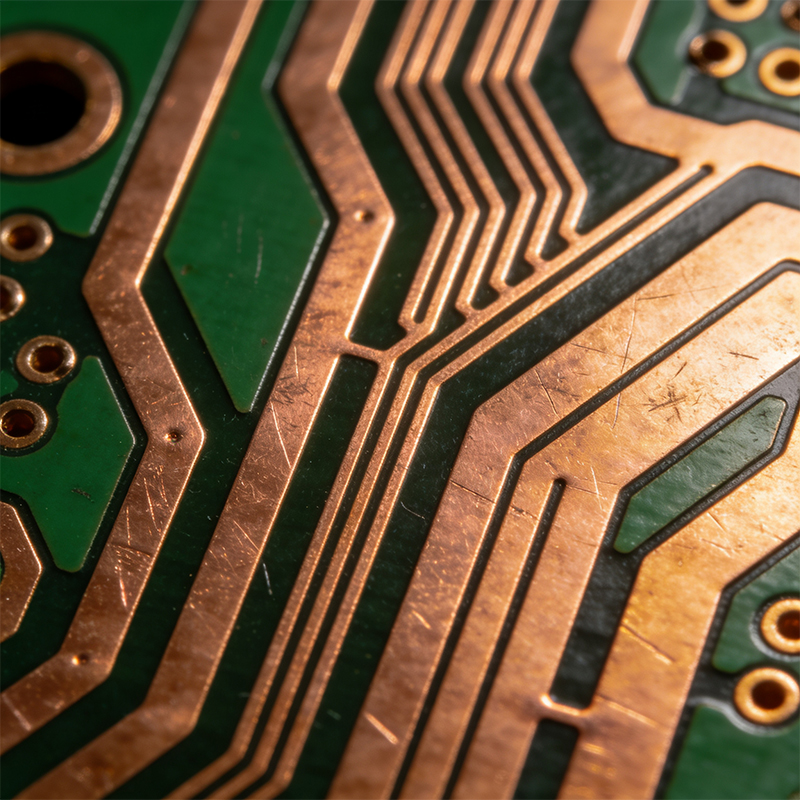
Not all copper is the same. The way the copper is made affects how it behaves.
This is the standard. Copper is electroplated onto a drum and then peeled off. The drum side is smooth; the other side is rough. The rough side bonds well to the substrate, which is good for adhesion. ED copper is cheap, widely available, and works for most applications.
The surface roughness matters for high-frequency signals. Rougher surfaces increase signal loss at high frequencies—not a big deal for audio or slow digital, but important for 5G, radar, or high-speed data.
This copper is rolled and annealed, creating a more uniform grain structure. It's smoother and more ductile than ED copper. RA copper is standard for flexible circuits—it bends without cracking and handles dynamic flexing better.
RA copper is more expensive and harder to source, but if your board needs to bend, it's worth it.
These are specialized ED copper foils with much smoother surfaces. They reduce signal loss at high frequencies, making them essential for 5G, radar, and high-speed digital designs. They cost more, but when you're pushing 10 Gbps or higher, the improved signal integrity is worth it.
Most rigid boards use 1 oz copper as the baseline. It's the sweet spot between cost and performance. For power sections, you might use 2 oz or 3 oz on specific layers. For high-density designs, you might use 0.5 oz to get finer traces.
Flex boards use RA copper—it's more ductile and survives bending without cracking. Copper thickness is typically 0.5 oz or 1 oz, with 1 oz more common for power-carrying flex circuits.
Metal-core boards use the same copper foil as rigid boards, but the base material is aluminum or copper instead of FR-4. The copper carries the signals; the metal base handles the heat.
For high-frequency designs, copper surface roughness becomes critical. VLP or ULP copper is standard for boards running at 10 GHz and above. Combined with low-loss laminates like Rogers, this ensures signals get where they're going with minimal loss.
You specify 1 oz copper, but the board comes back with thin spots or inconsistent thickness. The result: traces overheat, voltage drops, or intermittent connections.
Prevention: Work with manufacturers who monitor their plating process. Ask about their copper thickness control. For critical designs, specify that you want microsection analysis to verify plating.
The copper delaminates from the substrate during assembly or use. Pads lift, traces peel.
Prevention: Quality laminates and proper surface preparation before lamination. For high-reliability applications, use high-Tg materials that maintain adhesion at temperature.
Traces come back under-etched (too wide) or over-etched (too thin). Fine-pitch features disappear or bridge.
Prevention: For fine traces, use manufacturers with laser direct imaging and controlled etching processes. For extremely fine features, consider HDI technology with semi-additive processing.
At Kaboer, we've been building copper PCBs since 2009. Based in Shenzhen with our own PCBA factory, we understand that copper isn't just a material—it's the heart of your board.
What we offer:
Multiple copper weights: From 0.5 oz to 4 oz and beyond, depending on your current and density requirements
Flexible copper: RA copper for flex circuits that need to bend without cracking
High-frequency copper: VLP and ULP options for 5G, radar, and high-speed digital
Precision etching: Fine traces down to 2 mil (0.05mm) for dense designs
Process control: Plating thickness monitoring and microsection analysis for critical jobs
We work across the full range of boards—rigid, flexible, rigid-flex, HDI, metal-core—and we understand how copper behaves in each.
If you're working on a copper PCB board and want to make sure you're getting the right copper for your application, send us your requirements or Gerber files. We'll review your design, give you honest feedback, and get back to you with a quote. We've been at this for over 15 years, and we believe the best partnerships start with straightforward conversations.
And if you're ever in Shenzhen, we'd be happy to show you around our factory and walk you through how we turn copper into working boards.

Kaboer manufacturing PCBs since 2009. Professional technology and high-precision Printed Circuit Boards involved in Medical, IOT, UAV, Aviation, Automotive, Aerospace, Industrial Control, Artificial Intelligence, Consumer Electronics etc..


 English



 Wechat
 +86 13670210335
 +86 13670210335
 E-mail