
Date: 2026-03-23
If you've ever had a board where components just wouldn't solder right—where pads lifted, solder didn't wet, or joints cracked after a few thermal cycles—chances are the problem started with the soldering pad. Not the component. Not the assembly process. The pad itself.
It's easy to overlook. In your PCB layout software, pads look like simple shapes—circles, rectangles, maybe a teardrop here and there. But in the real world, those little copper patches are the only thing holding your components in place. Get them wrong, and nothing else matters.
Let's talk about what soldering pads actually are, what makes a good one, and how to avoid the most common problems that come back to haunt you later.
A soldering pad (or just "pad") is the exposed copper area on a PCB where a component lead gets soldered . It's the physical and electrical interface between the component and the board.
Pads come in different shapes and sizes depending on the component:
Surface mount pads: Flat copper features that sit on the board surface. For resistors and capacitors, they're usually rectangular. For ICs, they're often longer and may have thermal relief spokes connecting to planes.
Through-hole pads: A ring of copper around a drilled hole. The component lead goes through the hole, and solder fills the gap between the lead and the pad wall .
Simple as they look, pads are carefully engineered structures. Their size, shape, and connection to the rest of the board affect everything from how well the solder flows to whether the component survives thermal cycling.
There are two ways to define a pad relative to the solder mask. The choice affects reliability, especially for fine-pitch components.
In an NSMD pad, the copper pad is larger than the solder mask opening . The mask sits back from the edge of the copper, leaving the full copper pad exposed.
This is the standard for most surface mount components. Because the mask doesn't cover the copper edges, the pad is slightly raised, allowing solder to wet around the sides. This creates a stronger mechanical bond and makes inspection easier.
NSMD pads also give you tighter control over pad size, since the copper is etched, and the mask opening is defined separately.
In an SMD pad, the solder mask overlaps the edge of the copper, defining the actual soldering area . The mask opening is smaller than the copper pad underneath.
This design is used in specific situations:
Fine-pitch BGAs: The mask helps corral the solder ball and prevents it from shorting to adjacent balls.
Thermal pads: Where you want to control the exact solderable area for heat dissipation.
High-vibration environments: The mask can help anchor the pad, reducing the chance of lifting.
The trade-off is that SMD pads have less exposed copper, which can mean weaker solder joints for some components.
A quick comparison:
| Feature | NSMD | SMD |
|---|---|---|
| Copper vs. mask opening | Copper larger | Mask larger |
| Solder wetting | Around the sides | Mostly on top |
| Best for | Most SMT components | BGAs, thermal pads |
| Inspection | Easier | Harder |
A well-designed pad does a few things right:
Correct size. The pad must match the component's termination size. Too small, and the component won't sit correctly. Too large, and you risk tombstoning (where the component stands up on one end) or solder bridging.
For a standard 0603 resistor, the pad should be about 0.8-1.0mm wide and 0.8-1.2mm long. For a 0402, smaller—around 0.5mm square. For ICs, the pad length needs to extend beyond the lead to allow solder fillet formation .
Appropriate shape. Most surface mount pads are rectangular, but for fine-pitch ICs, you may use rounded corners or oval shapes to reduce stress concentration. For through-hole pads, the annular ring (the copper around the hole) needs to be wide enough to survive drilling tolerances—typically 0.15-0.25mm beyond the hole edge .
Good connection to the rest of the board. A pad that's connected directly to a large copper plane needs thermal relief—thin traces that connect the pad to the plane. Without it, the plane acts as a heatsink, making soldering almost impossible. Thermal relief spokes are typically 0.2-0.3mm wide, with 3-4 spokes per pad .
Proper clearance from other features. Pads need breathing room. Too close to other pads, and solder bridges. Too close to the board edge, and the pad might get damaged during depaneling.
This is the nightmare scenario. You're soldering, and the pad lifts off the board, taking the copper with it. It's often fatal.
What causes it: Too much heat, too long, or mechanical force. Also happens when pads are too small or when the board material is poor.
How to prevent: Use proper soldering temperature and time. Design pads with adequate size and annular ring. Choose reputable board materials.
Small components stand up on one end during reflow, looking like little grave markers.
What causes it: Uneven heating or uneven solder paste on the two pads. One side melts and wets before the other, pulling the component upright.
How to prevent: Ensure symmetrical pad design. Balance trace widths on both sides of the component. Use proper thermal relief on pads connected to large copper areas .
Solder connects adjacent pads that should be separate.
What causes it: Too much paste, pads too close, or insufficient solder mask between pads.
How to prevent: Maintain adequate pad spacing (IPC recommends at least 0.1-0.15mm between pads for fine-pitch). Ensure solder mask dams between pads are at least 0.08-0.1mm wide .
Solder balls up on the pad instead of flowing.
What causes it: Contaminated pads, oxidized surface finish, or insufficient flux.
How to prevent: Use ENIG or other flat finishes for fine-pitch components. Store boards properly to avoid oxidation. If boards have been sitting, bake them before assembly.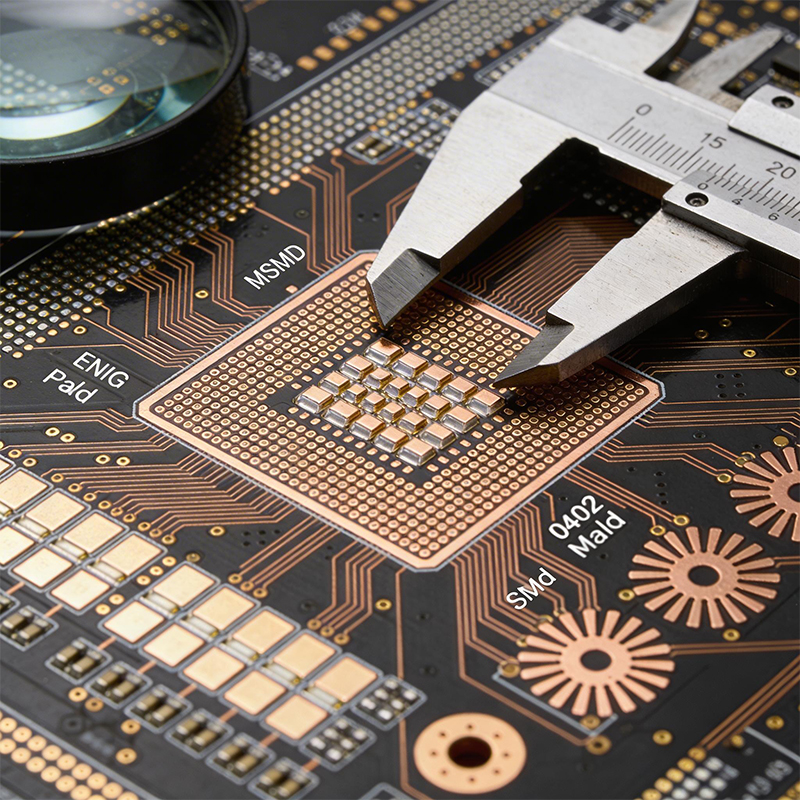
For 0402, 0603, 0805, and similar, follow these general rules:
Pad width: match component width, or slightly wider
Pad length: 1.2-1.5× component length for through-hole; for SMD, match recommended footprint from component datasheet
Spacing between pads: match component termination spacing
Thermal relief: use 3-4 spokes when connecting to large planes
For ICs with visible leads:
Pad length: extend 0.5-1.0mm beyond the lead tip to allow fillet formation
Pad width: 1.0-1.2× lead width
Pad-to-pad spacing: maintain solder mask dams between pads
Thermal relief: often not needed for signal pads; power pads need relief
For components with hidden connections:
QFN pads are typically on the bottom of the component. Use NSMD pads with 0.1-0.2mm extension beyond the component pad
Thermal pads under QFNs need arrays of thermal vias—usually 0.2-0.3mm holes spaced 0.8-1.0mm apart
BGA pads are usually 0.2-0.3mm diameter for 0.5mm pitch balls. Use NSMD design with mask opening slightly smaller than the copper pad
At Kaboer, we've been building custom PCBs since 2009. Based in Shenzhen with our own PCBA factory, we know that good pads are the foundation of good boards.
What we do:
DFM review: We check your pad designs against industry standards before production. If we see potential tombstoning risks, insufficient clearances, or thermal issues, we flag them early.
Material expertise: We work with the right laminates and surface finishes for your components. For fine-pitch BGAs, we recommend ENIG. For high-reliability applications, we discuss pad design trade-offs.
Process control: Our SMT lines are calibrated to handle fine-pitch pads, with precise solder paste printing, accurate placement, and controlled reflow profiles.
Testing: AOI, X-ray, and functional testing verify that your pads did what they were supposed to.
We work with the full range of boards—rigid, flexible, rigid-flex, HDI—and we understand that pad design changes with board type. A pad on a flex circuit needs different handling than one on a rigid board.
If you're designing a board and want to make sure your soldering pads are right, send us your requirements or Gerber files. We'll review your design, give you honest feedback, and get back to you with a quote. We've been at this for over 15 years, and we believe the best partnerships start with straightforward conversations.
And if you're ever in Shenzhen, we'd be happy to show you around our factory and walk you through how we build boards that solder right the first time.

Kaboer manufacturing PCBs since 2009. Professional technology and high-precision Printed Circuit Boards involved in Medical, IOT, UAV, Aviation, Automotive, Aerospace, Industrial Control, Artificial Intelligence, Consumer Electronics etc..


 English



 Wechat
 +86 13670210335
 +86 13670210335
 E-mail