
Date: 2026-06-24
You've seen it before. A screw head sitting perfectly flush with the surface, smooth to the touch. Or a screw head completely hidden inside a round pit with a flat bottom. These two look similar, but they're completely different — one is a countersink, the other is a counterbore.
A lot of people use these terms interchangeably, or they just don't know the difference. In this guide, I'll explain what each one is, what they look like, where they're used, and how to read them on engineering drawings. Plain English, no fluff.
This is the fundamental difference.
A countersink is cone-shaped. Imagine an upside-down funnel — wide at the top, narrow at the bottom, with sloped walls. A flat-head screw sits perfectly on that tapered surface, flush with the workpiece.
A counterbore is cylindrical with a flat bottom. It's like a round pit — straight walls, flat floor. The screw head sits entirely inside that pit, but the bottom is flat, not sloped.
Think of it this way:
A countersink is like an upside-down ice cream cone — wide at the top, pointed at the bottom.
A counterbore is like a cookie cutter pressed into dough — straight walls, flat bottom.
Countersinks and counterbores are designed for completely different screw types.
Countersinks take flat-head screws. The screw head is cone-shaped and matches the countersink's taper. When tightened, the head sits flush with or slightly below the surface.
Counterbores take socket-head cap screws, hex-head bolts, or similar fasteners. These screw heads are flat and cylindrical, not tapered. You need a cylindrical pit to hide the entire head.
You can't mix them up. Put a flat-head screw in a counterbore, and it won't seat properly — it'll wobble. Put a socket-head screw in a countersink, and the head sticks out — it won't sink in at all.
The symbols on engineering drawings are different.
The countersink symbol is "⌵" — it looks like an upside-down V. The callout format is: symbol + diameter × angle. For example, "⌵ ⌀10 × 90°" means a countersink with a 10mm diameter and a 90° included angle.
The counterbore symbol is "⌴" — it looks like an upside-down trapezoid or a little house. The callout format is: symbol + diameter × depth. For example, "⌴ ⌀12 × 3" means a counterbore with a 12mm diameter and a 3mm depth.
These two symbols look similar, but they mean completely different things. Get them wrong, and the machinist will make the wrong hole.
Countersink angles are standardized, not random. Common angles include 60°, 82°, 90°, 100°, 110°, and 120°. The two most common are 82° and 90°.
Metric screws use 90° — this is the ISO standard.
Imperial screws (inch-based) use 82° — this is the US standard.
Pick the wrong angle, and the screw won't seat. A 90° metric screw in an 82° countersink sits halfway out — it won't sink all the way in.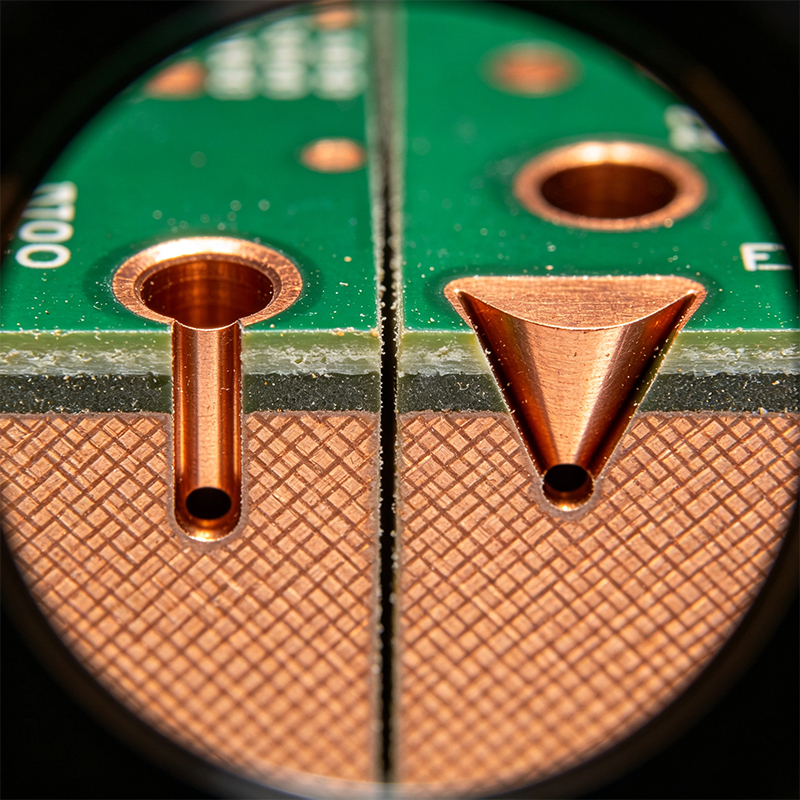
Counterbore depth depends on the screw you're using. The goal is to hide the entire screw head below the surface.
Too shallow, and the head sticks out. Too deep, and you might drill through the workpiece. The standard approach: measure the screw head thickness, then add a small clearance (0.1‑0.2mm) to make sure it sits fully below the surface.
Countersink advantages: Smooth, flush surface — no snagging. Self-centering during assembly — the tapered hole guides the screw in. Great for applications where aesthetics and aerodynamics matter. Disadvantages: Uneven load distribution — the taper creates radial stress. Requires sufficient material thickness — too thin and the taper breaks through.
Counterbore advantages: Even load distribution — excellent clamping force. Handles high torque and heavy loads. Can accommodate washers for better load distribution. Disadvantages: Less aesthetic — the surface isn't perfectly flush. Slightly more complicated to machine.
One-sentence summary: need a smooth, flush, snag-free surface? → use a countersink. Need high strength, heavy loads, and reliable clamping? → use a counterbore.
| Feature | Countersink | Counterbore |
|---|---|---|
| Shape | Conical | Cylindrical, flat-bottom |
| Symbol | ⌵ | ⌴ |
| Screw type | Flat-head screws | Socket-head, hex-head screws |
| Screw head position | Flush with surface | Below surface |
| Load distribution | Tapered contact | Flat surface contact |
| Typical use | Aerospace, furniture, consumer electronics | Heavy machinery, automotive, industrial |
Your choice depends entirely on what screw you're using and what your load requirements are. Using a flat-head screw? Choose a countersink. Using a socket-head screw? Choose a counterbore. Need a smooth, flush finish? Choose a countersink. Need maximum strength and load capacity? Choose a counterbore.
Countersinks and counterbores are two of the most common hole types in machining. One is conical, takes flat-head screws, and delivers a smooth, flush surface. The other is cylindrical with a flat bottom, takes socket-head screws, and handles heavy loads. On engineering drawings, countersinks use "⌵" and counterbores use "⌴" — the symbols look similar, but they mean completely different things.

Kaboer manufacturing PCBs since 2009. Professional technology and high-precision Printed Circuit Boards involved in Medical, IOT, UAV, Aviation, Automotive, Aerospace, Industrial Control, Artificial Intelligence, Consumer Electronics etc..


 English


 Wechat
 +86 13670210335
 +86 13670210335
 E-mail