
Date: 2026-06-24
You've definitely seen holes on a circuit board. Some have a shiny copper ring around them. Some are just bare holes. Some are big, some are tiny. Some hold component leads, some just connect traces between layers. The most common and basic among them is the through hole.
It's one of the most fundamental concepts in PCB design, and something everyone in electronics should understand. In this guide, I'll explain what a through hole is, what types exist, how it differs from other holes, and where it's used. Plain English, no fluff.
A through hole is exactly what it sounds like — a hole that goes all the way from the top layer of a PCB to the bottom layer, passing through the entire board. Think of it like a ventilation shaft that runs from the ground floor all the way to the basement — it passes through every single floor (circuit layer).
There are two types:
Plated Through Hole (PTH) : The hole wall is plated with copper, making it conductive. Used to connect circuits on different layers, or to solder through‑hole component leads.
Non‑Plated Through Hole (NPTH) : The hole wall has no copper plating and is not conductive. Usually used for mounting holes — like screwing the board into an enclosure.
Through holes are just one of three types of vias:
Through Via: Goes from the top layer all the way to the bottom layer, passing through every single layer of the board.
Blind Via: Starts on the top or bottom layer but stops at an inner layer — it doesn't go all the way through. Like a well that wasn't dug all the way.
Buried Via: Completely hidden inside the board, connecting two inner layers — you can't see it from the outside at all. Like a secret staircase inside a building.
The difference is simple: through holes go all the way through, blind vias go halfway, and buried vias are completely hidden inside.
Through holes are the easiest to manufacture and the cheapest, which is why the vast majority of PCBs use them. Blind and buried vias are mainly used in high‑density, multi‑layer boards where space is tight — like smartphone motherboards, where through holes take up too much room.
Through holes have two main jobs:
First, electrical connection. This is their core purpose. In multi‑layer boards, signals and power need to travel between different layers — through holes are the "tunnels" that make that happen. Current flows from a trace on one layer into the hole, through the copper plating on the hole wall, and out to a trace on another layer.
Second, mounting components. Through‑hole components have leads that are inserted into the holes and soldered on the back side of the board. This mounting method is called Through‑Hole Technology (THT) . Resistors, capacitors, connectors, and high‑power devices are still commonly mounted this way.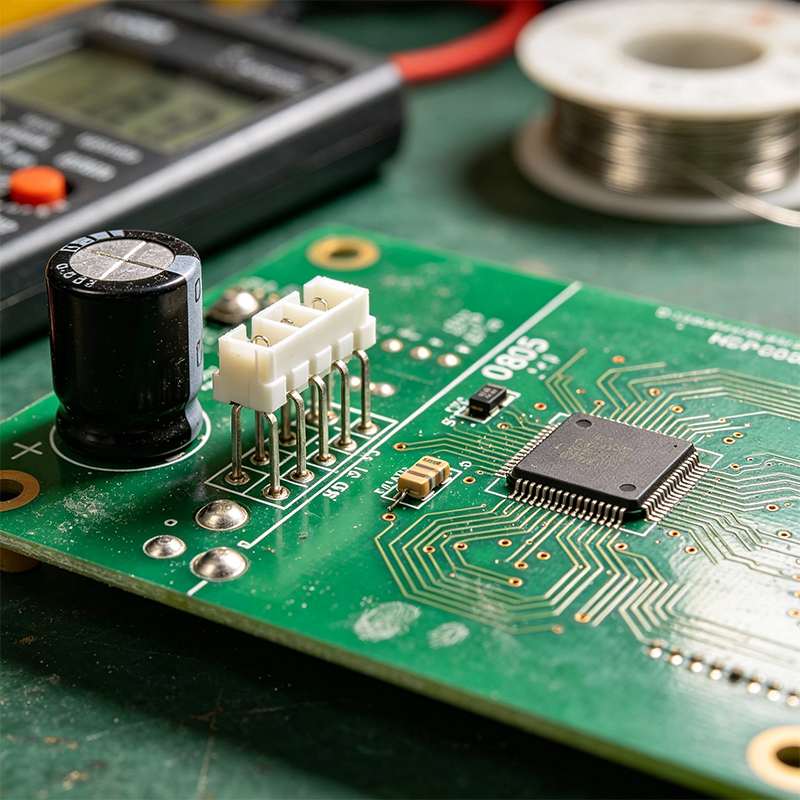
Simply put, THT pushes component leads through holes in the board and solders them on the other side. SMT solders components directly onto the surface of the board.
THT (Through‑Hole Technology) :
Requires drilling holes in the board
Component leads go through the holes and are soldered on the back
Very strong solder joints — extremely robust, great for high‑vibration environments and connectors that get plugged and unplugged frequently
Hand soldering and rework are much easier
But it takes up a lot of space and isn't suitable for high‑density designs
SMT (Surface‑Mount Technology) :
No drilling required — components sit directly on the board surface
Small footprint and high density — perfect for compact devices like phones and watches
Mass production is extremely fast and cheap
But solder joints are more fragile and less vibration‑resistant than THT
SMT now accounts for about 90% of PCB assemblies, but through‑hole technology hasn't disappeared. Many products use a hybrid approach — SMT for high‑density sections, THT for connectors, high‑power components, and anything that needs extra strength.
A few key points to keep in mind when designing through holes:
Don't make the hole too small. Tiny holes break drill bits easily, and the copper plating inside the hole might not be uniform. A general rule: the hole depth shouldn't exceed 6 times the hole diameter. For a 1.6mm thick board, the minimum hole size is about 0.25mm.
Leave enough pad around the hole. The copper ring around the hole is called the annular ring. If the drill is off‑center and the annular ring is too thin or missing, the connection between the hole and the trace can break.
Be careful with high‑frequency signals. Through holes introduce parasitic capacitance and inductance at high frequencies, which can hurt signal quality. In high‑speed designs, you want to minimize through holes, or use blind/buried vias instead.
A through hole is a hole that goes from the top layer of a PCB all the way to the bottom layer — the most basic and common type of hole on a circuit board.
It comes in two flavors: Plated Through Hole (PTH, conductive) and Non‑Plated Through Hole (NPTH, non‑conductive). Compared to blind and buried vias, through holes are simpler and cheaper to manufacture, but they take up more space. Through‑Hole Technology (THT) is strong and easy to repair, making it great for high‑vibration environments and connectors that get frequent use. Surface‑Mount Technology (SMT) is smaller and denser, perfect for high‑volume production.

Kaboer manufacturing PCBs since 2009. Professional technology and high-precision Printed Circuit Boards involved in Medical, IOT, UAV, Aviation, Automotive, Aerospace, Industrial Control, Artificial Intelligence, Consumer Electronics etc..


 English



 Wechat
 +86 13670210335
 +86 13670210335
 E-mail