
Date: 2026-06-22
You've definitely seen them. Those little holes on a circuit board surrounded by a ring of copper. That copper ring has a specific name in PCB design: the annular ring.
It's not a complicated structure — just a circular copper area around a drilled hole. But that ring of copper directly determines whether your board can conduct electricity properly, whether it can withstand vibration, and whether it will fail mysteriously down the line.
In this guide, I'll explain what an annular ring is, how to calculate it, what the common problems are, and what to watch out for in your designs. Plain English, no fluff.
Simply put, the annular ring is the ring of copper on a pad that surrounds a drilled hole.
If you zoom in on a via or a through-hole pad on a PCB, you'll see a copper pad with a hole in the middle. The copper that remains around the hole is the annular ring.
Think of it like a donut — the hole in the middle is the drill hole, and the donut itself is the annular ring. If the hole is drilled off-center, one side of the donut gets thin or disappears entirely. Same thing happens with annular rings — if it's too thin or missing, the electrical connection fails.
The width of an annular ring has a very simple formula:
Annular Ring Width = (Pad Diameter − Drill Diameter) ÷ 2
For example:
Pad diameter = 25 mils
Drill diameter = 10 mils
Annular ring width = (25 − 10) ÷ 2 = 7.5 mils
Important: The drill diameter here is the actual drill bit size, not the final hole size. After drilling, the hole is plated with copper, which reduces the inner diameter. Manufacturers use a drill bit that's larger than the final hole size to account for the plating thickness. So when calculating annular rings, always base it on the actual drill diameter, not the finished hole diameter.
Although it's small, the annular ring has two critical jobs:
1. Electrical connection
The annular ring is the bridge between the via (or through-hole) and the copper trace. Without enough annular ring, current can't flow smoothly from the trace to the plated hole wall and then to other layers. If the ring is too thin or missing, the circuit breaks.
2. Mechanical strength
During drilling and plating, if the annular ring is too small, the copper around the hole can crack from stress, especially during soldering or when the board heats up. A sufficient annular ring prevents the hole wall from separating from the pad, ensuring the board's mechanical reliability.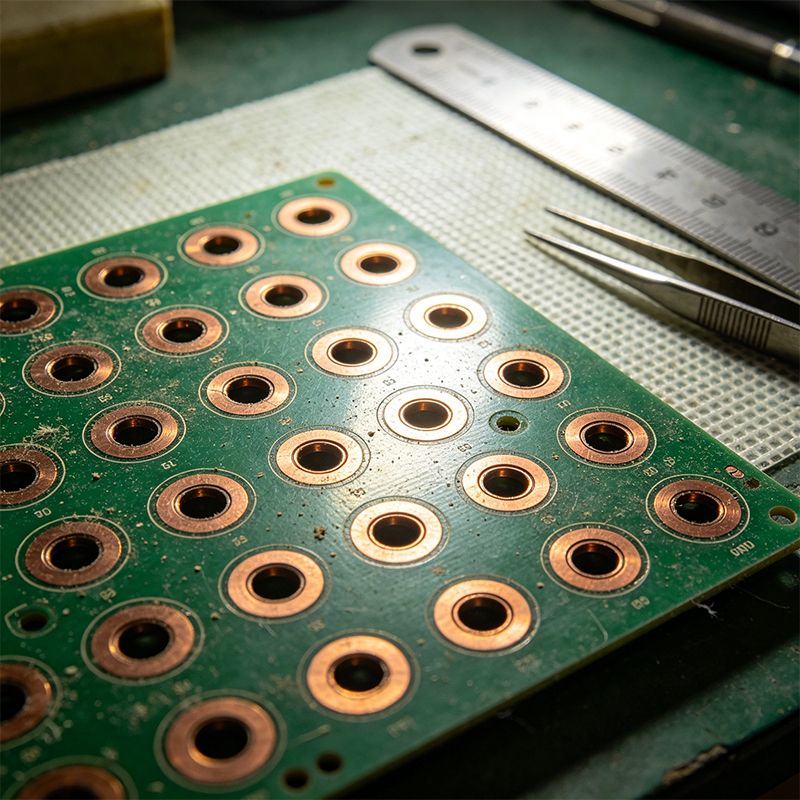
In theory, the drill should hit exactly the center of the pad. In reality, drills are never 100% precise — there's always some tolerance. Based on how far off the drill is, three things can happen:
1. Good — The drill is centered in the pad. The annular ring is complete and uniform. Electrical connection and mechanical strength are both good.
2. Tangency — The drill is off-center, and the hole wall just touches the edge of the pad. The annular ring disappears on one side. This might be acceptable in consumer electronics, but it's generally not allowed in high-reliability products (medical, automotive, aerospace).
3. Breakout — The drill is so far off-center that part of the hole extends beyond the pad boundary. The annular ring is completely gone, and the connection between the hole and the trace is very weak or broken entirely. High current can burn it out, and vibration can crack it apart.
IPC (the electronics industry standards organization) has different requirements for different product classes:
IPC Class 1 (General Electronics) : Lowest requirements. Some breakout is allowed.
IPC Class 2 (Dedicated Service Electronics) : Moderate requirements. Some breakout is allowed on inner layers, but outer layers typically require a complete ring.
IPC Class 3 (High-Reliability Electronics) : Strictest requirements. Both inner and outer layers must have a complete annular ring. Breakout is not allowed.
In terms of numbers:
Minimum annular ring is typically around 0.05mm (2 mils)
Consumer electronics: recommended ≥ 0.10mm
Industrial electronics: recommended ≥ 0.075mm
High-reliability (medical, automotive, aerospace): outer ≥ 0.05mm, inner ≥ 0.025mm
HDI microvias: can go as low as 0.015mm-0.025mm
1. Make the pad larger
A larger pad gives more margin for drilling errors, reducing the chance of annular ring problems. But larger pads also take up routing space, so you need to balance reliability against density.
2. Add teardrops
A teardrop is a water-drop-shaped copper reinforcement added where the trace meets the pad. It increases the copper area at the connection point, so even if the drill is slightly off-center, the connection between the trace and the hole wall stays intact.
3. Choose a reliable PCB manufacturer
Different fabs have different drilling accuracy. Some can keep tolerances very tight; others have more variation. Before you design, check with your manufacturer about their capabilities.
An annular ring is the ring of copper on a pad that surrounds a drilled hole. Its width is (Pad Diameter − Drill Diameter) ÷ 2. It's small, but it directly determines whether the electrical connection between a via and a trace is reliable and whether the board has enough mechanical strength.
Three things to remember in your designs: leave enough margin on your pads, account for your manufacturer's drilling tolerance, and add teardrops for high-reliability products

Kaboer manufacturing PCBs since 2009. Professional technology and high-precision Printed Circuit Boards involved in Medical, IOT, UAV, Aviation, Automotive, Aerospace, Industrial Control, Artificial Intelligence, Consumer Electronics etc..


 English



 Wechat
 +86 13670210335
 +86 13670210335
 E-mail