
Date: 2026-03-20
If you've worked with rigid PCBs, you're familiar with solder mask—that green coating that protects the copper traces. But when you move to flexible circuits, things change. You can't just use regular solder mask on a board that needs to bend thousands of times. It cracks. It peels. It fails.
That's where coverlay comes in.
Coverlay is the flexible circuit's equivalent of solder mask, but it's a completely different beast. It's a film-based material that actually bends with the circuit instead of fighting it. If you're designing or sourcing flexible PCBs, understanding coverlay is essential.
Let's break down what coverlay is, the different types available, and how to choose the right one for your application.
Coverlay (also called coverlay film or flex covercoat) is a protective layer used on flexible printed circuit boards. It serves the same basic function as solder mask on rigid boards—insulating and protecting the copper traces from oxidation, short circuits, moisture, and mechanical damage . But unlike solder mask, which is a liquid that gets screen-printed and UV-cured, coverlay is a solid film that gets laminated onto the circuit .
Think of it as a protective "skin" for your flexible circuit. It's made from a combination of materials:
Polyimide (PI) film – The flexible base material that provides the actual protection. Common thicknesses range from 12.5μm to 75μm .
Adhesive layer – Bonds the polyimide film to the copper circuit. Adhesive thicknesses typically range from 12μm to 75μm .
Release liner – Removed before lamination.
The whole assembly is aligned with the circuit pattern and then laminated under heat and pressure, curing the adhesive and permanently bonding the coverlay to the flex circuit .
When it comes to protecting flexible circuits, you actually have two options: film-based coverlay or flexible liquid solder mask. Each has its place.
This is the most common and most robust option for flexible circuits . It's constructed from a layer of polyimide film and a layer of adhesive, available in various thickness combinations.
Advantages:
Superior flexibility – Can withstand dynamic flexing and tight bend radii without cracking .
Excellent durability – More robust for applications that will experience repeated bending over the product's lifetime .
Proven reliability – The industry standard for demanding applications like aerospace, medical devices, and automotive where failure isn't an option .
Trade-offs:
More expensive – Raw material costs and processing steps add up .
Limited feature resolution – Openings are typically drilled or routed, which limits minimum sizes and shapes .
Larger annular ring required – Need extra material around openings to account for registration tolerances and adhesive squeeze-out .
This is a liquid formulation similar to standard rigid board solder mask but modified with additives to allow some flexibility .
Advantages:
Lower cost – Less expensive than film-based coverlay .
Better resolution – Can define tighter feature areas and smaller openings .
Faster processing – Can be applied using standard screen printing equipment .
Trade-offs:
Limited flexibility – Will crack under tight bending or repeated dynamic flexing .
Best for static applications – Suitable for boards that bend once during installation ("bend-to-install") but not for ongoing dynamic flexing .
The general rule of thumb: if your circuit will experience dynamic flexing (repeated bending during use), go with film-based coverlay. If it's for static applications with minimal bending, flexible solder mask might work .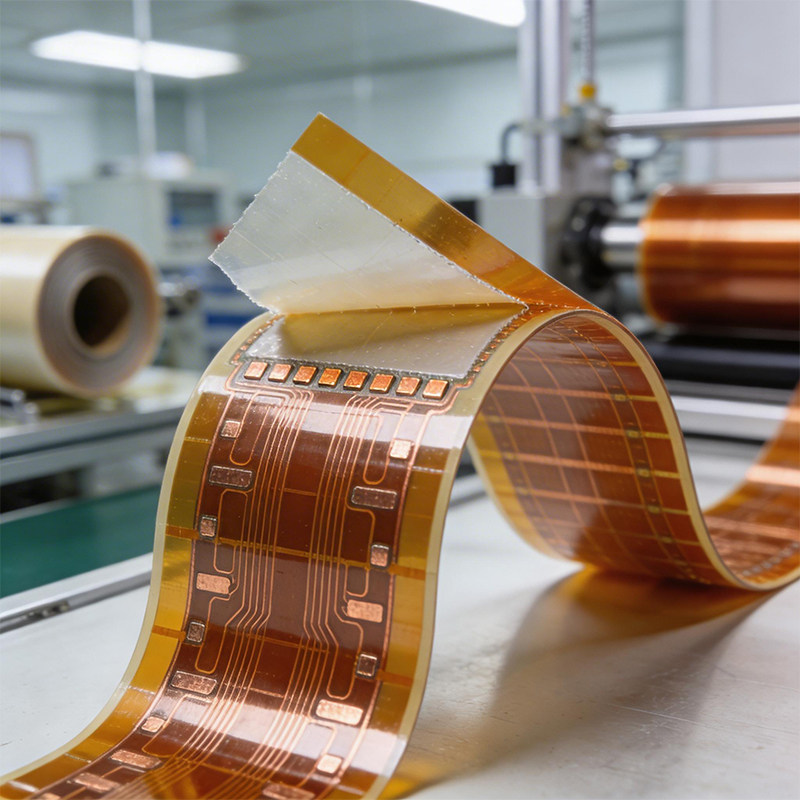
The thickness of your coverlay affects both protection and flexibility. Standard options include :
Polyimide film thickness:
12.5μm (½ mil)
25μm (1 mil) – The most common, least expensive option
50μm (2 mil)
75μm (3 mil)
Adhesive thickness:
12μm (½ mil) to 75μm (3 mil)
A good rule of thumb is to use 1 mil of adhesive for every 1 ounce of copper to ensure proper encapsulation . For standard 1oz copper designs, a 1 mil PI / 1 mil adhesive combination is typical.
If you need thinner coverlay to achieve a tighter bend radius, or thicker coverlay for heavier copper, work with your fabricator early—specialized options may affect cost and lead time .
One of the trickiest parts of coverlay design is creating openings where components will be soldered or where connectors will make contact. Unlike solder mask which can be photoimaged with high precision, coverlay openings are created mechanically .
Drilling – The most common method. Drill bits are round, so openings are typically round or oval . This works well but requires adequate spacing between openings.
Routing – For larger openings or non-round shapes.
Punching – Uses a custom die to stamp out openings. This can achieve square or rectangular shapes matching your design, but requires tooling .
Laser cutting – The most precise option, capable of handling extremely tight feature patterns. More expensive, but allows for fine resolution .
Minimum clearance (opening size): Typically 200μm for coverlay vs. 50μm for solder mask .
Minimum web (bridge) width: Around 350μm for coverlay vs. 100μm for solder mask .
Avoid "Swiss cheese effect": Too many small openings close together can make the coverlay unstable. Fabricators may suggest "ganging" multiple openings into one larger window .
Pad shape considerations: Because coverlay openings are mechanically created, square pads in your design may become rounded or oval in the final board . Some manufacturers offer punching to maintain square/rectangular shapes .
Based on the application requirements, here's a practical guide :
| Application Type | Recommended Protection | Why |
|---|---|---|
| Dynamic flexing (repeated bending, e.g., foldable phones, moving cable assemblies) | Film-based coverlay | Withstands repeated stress without cracking |
| Bend-to-install (one-time bending during assembly) | Either | Both can work, but coverlay offers more margin |
| Static applications (no bending after installation) | Flexible solder mask | Lower cost, easier processing |
| Fine-pitch SMD areas | Flexible solder mask | Better resolution for tight features |
| High-reliability applications (aerospace, medical, automotive) | Film-based coverlay | Proven durability and reliability |
The industry continues to evolve, with newer options emerging:
Liquid coverlay compositions based on polyamideimide resins can be screen-printed or dispensed, offering a middle ground between film-based coverlay and liquid solder mask. These can be cured thermally and offer good flexibility .
Photosensitive polyimides (PSPIs) represent the cutting edge. These materials can be photoimaged like solder mask but provide the flexibility and durability of polyimide. Recent developments show promise for fine-patterning with excellent thermal stability, low water absorption, and UL94 V-0 flammability rating .
At Kaboer, we've been manufacturing flexible circuits and rigid-flex boards since 2009. Based in Shenzhen with our own PCBA factory, we understand that coverlay selection is critical to your product's success.
Our capabilities include:
Multiple coverlay options – Polyimide film coverlay for dynamic applications, flexible solder mask for static designs
Various thickness combinations – Standard and custom options to meet your bend radius and copper thickness requirements
Precision opening methods – Including laser cutting for fine-pitch requirements
Stiffener integration – Polyimide, FR4, or stainless steel stiffeners where additional support is needed
We work with you to review your design and recommend the right coverlay solution for your specific application—whether that's a wearable device that will flex thousands of times or a static installation that just needs protection.
Send us your requirements or Gerber files. We'll review your design, give you honest feedback, and get back to you with a quote as soon as we can. We've been at this for over 15 years, and we believe the best partnerships start with straightforward conversations.
And if you're ever in Shenzhen, we'd be happy to show you around our factory.

Kaboer manufacturing PCBs since 2009. Professional technology and high-precision Printed Circuit Boards involved in Medical, IOT, UAV, Aviation, Automotive, Aerospace, Industrial Control, Artificial Intelligence, Consumer Electronics etc..


 English



 Wechat
 +86 13670210335
 +86 13670210335
 E-mail