
Date: 2026-03-19
Let's be honest. When you hear "single sided PCB," you probably think of the inside of a calculator, not the latest AI accelerator card. And you'd be right. These boards are the workhorses of the simple stuff—the unsung heroes that power our everyday world without any of the glory.
But here's the thing: if you're a manufacturer, overlooking the single sided PCB is a missed opportunity. For a huge range of products, from power supplies to automotive sensor interfaces, it's not just the cheapest option; it's the smartest.
In this guide, we'll cut through the hype around high-layer-count boards and talk about where the single-sided PCB still reigns supreme, why it's so cost-effective, and when it's the right tool for your job.
Just as the name suggests, a single sided PCB (also called a single-layer board) has its conductive copper layer on only one side of the insulating substrate . The other side is bare laminate, usually made from materials like FR-4, CEM-1, or CEM-3 .
Think of it as a one-lane road. It can only handle traffic in one direction on one plane, which makes it incredibly simple to design and manufacture.
The typical layers are:
Substrate (Base Material): The foundation, often made of FR-4 fiberglass or a cheaper phenolic paper for cost-sensitive consumer goods .
Conductive Layer (Copper): A thin layer of copper foil laminated onto one side of the substrate. This is etched to form the circuit traces .
Solder Mask: A protective layer, usually green, applied over the copper to prevent shorts and corrosion .
Silkscreen: The white markings that help identify components and test points during assembly .
Because there's only one layer of copper, all connections must be routed without crossing over each other. This fundamental design constraint is the source of both its limitations and its primary advantage: simplicity.
Despite the rise of complex HDI boards, the global market for single-sided PCBs is still massive and growing, projected to increase from $9.5 billion in 2016 to an estimated $16.3 billion by 2024 . Why?
This is the main event. A single-sided PCB is the cheapest type of circuit board you can manufacture . This low cost comes from two places:
Material Savings: It uses less copper and less substrate material than a double-sided or multi-layer board .
Simpler Processing: The manufacturing process is streamlined. It doesn't require the complex alignment, lamination, or drilling of via holes needed for multi-layer boards, which speeds up production and lowers labor and equipment costs .
For any product where cost is a primary concern and the circuit isn't complex, the single-sided board is the obvious choice.
Because the design and manufacturing process are straightforward, you can get single sided PCBs produced and delivered incredibly quickly . This makes them perfect for prototyping simple circuits and for high-volume production of basic electronics where time-to-market is critical.
With fewer potential points of failure (no plated through-holes to crack, fewer inter-layer connections), a well-designed single-sided board can be extremely reliable for its intended, low-stress applications . Companies like Kaboer have spent years perfecting the manufacturing processes to ensure high yields and consistent quality .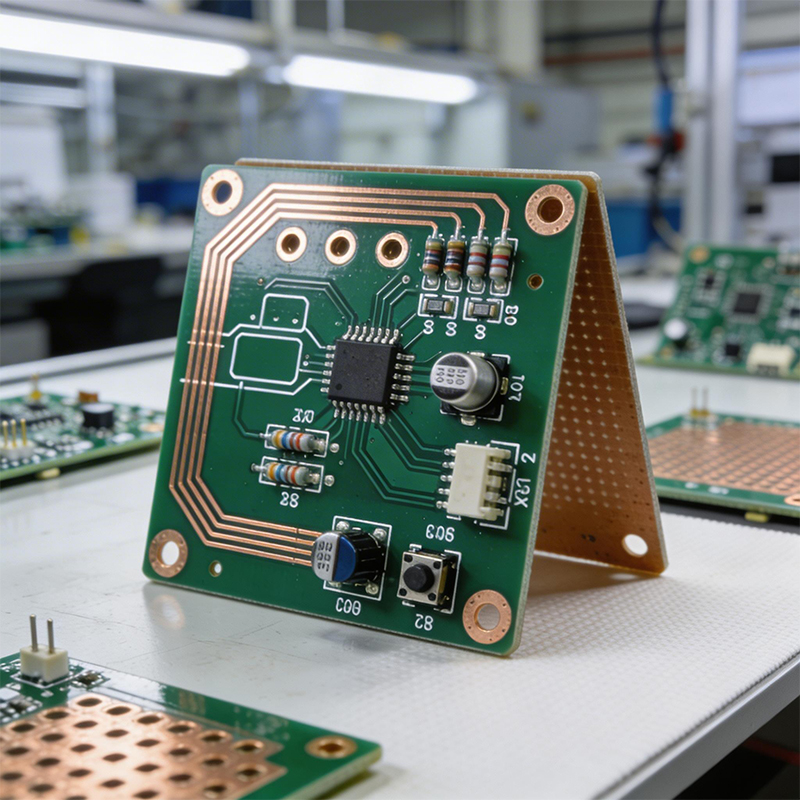
You interact with single-sided PCBs dozens of times a day, probably without realizing it. They are the hidden logic behind countless appliances and systems.
Here are their primary application areas:
Power Supplies: Almost every AC-to-DC wall adapter and basic power supply for consumer electronics uses a single-sided board. The routing is simple, and the main goal is cost.
Consumer Electronics: Think calculators, remote controls, radios, LED lighting, and simple control boards in appliances like rice cookers and washing machines .
Industrial Control: For low-cost sensors, relay control boards, and other simple industrial equipment where extreme processing power isn't required .
Automotive: In non-critical areas, such as central control button modules, power window controls, and ambient light driver boards, single-sided flexible circuits are used for their cost-effectiveness and reliability .
DIY and Education: For hobbyists and students learning electronics, the single-sided PCB is an ideal, user-friendly platform .
Designing a single-sided board is a puzzle. The main challenge is that you can't have crossing traces on a single layer. This forces you to be clever with your component placement and routing.
Here are a few design rules to keep in mind:
Strategic Component Placement: Group components logically to minimize trace lengths and avoid cross-overs. Place power and ground lines carefully .
Use Jumper Wires (Sometimes): In some designs, when a trace absolutely must cross another, a zero-ohm resistor or a simple jumper wire is used. This is a common workaround.
Trace Width and Spacing: Ensure your traces are wide enough to carry the required current and spaced far enough apart to prevent short circuits. For turns, use 45-degree angles instead of right angles to reduce signal reflections .
Consider the Return Path: A good practice is to use a large area copper pour for the ground connection. This lowers resistance and reduces noise .
You might think that single-sided boards are only for old-school through-hole components, but that's not true. Single sided surface mount PCB assembly is a very common and efficient process .
In this process, components are placed on the same side as the copper traces using a pick-and-place machine, held in place by solder paste, and then sent through a reflow oven . This allows for automated, high-speed assembly of simple boards, keeping production costs low even for larger volumes.
At Kaboer, we've been a leading provider of professional circuit board customization for over 15 years . While we're known for our advanced capabilities in flexible and HDI boards, we haven't forgotten the foundation. We are a trusted manufacturer of single-sided, double-sided, and multi-layer boards .
Our strength lies in our comprehensive approach. We don't just build your board; we partner with you.
Engineering Support: Our team of experienced engineers reviews your design to ensure it's optimized for manufacturability and cost, catching potential issues before they cost you time and money .
Full-Service Solution: From design and prototyping to production, assembly, and testing, we offer a seamless, integrated service .
Advanced Technology: Our well-equipped facility with state-of-the-art machinery ensures precision and efficiency, even for the simplest boards .
Fast Prototyping: Need to validate a simple circuit quickly? We can deliver high-quality prototypes with a rapid turnaround .
Uncompromising Quality: We adhere to strict quality control measures at every stage, following international standards like ISO 9001 to guarantee functionality and reliability .
Send us your Gerber files or requirements. We'll review your design, give you honest feedback, and get back to you with a quote as soon as we can. Whether you're a startup prototyping a new gadget or a large manufacturer sourcing for high-volume production, we're here to help.
And if you're ever in Shenzhen, we'd be happy to show you around our factory.

Kaboer manufacturing PCBs since 2009. Professional technology and high-precision Printed Circuit Boards involved in Medical, IOT, UAV, Aviation, Automotive, Aerospace, Industrial Control, Artificial Intelligence, Consumer Electronics etc..


 English



 Wechat
 +86 13670210335
 +86 13670210335
 E-mail