
Date: 2026-04-24
Let’s be honest: anybody can melt a bit of wire onto a board and call it soldering. But taking that component back off without leaving a scorched mess? That’s where the real skill comes in. Whether you’re trying to save a $50 chip from a dead board or fixing a "fat" solder bridge you made five minutes ago, desoldering is the ultimate "undo button" in electronics.
When you solder, you’re adding heat to a fresh, clean surface. When you desolder, you’re often dealing with old, oxidized solder that’s been sitting there for years, or hidden ground planes that act like a giant heat sink, sucking the life out of your soldering iron. If you get impatient and pull too hard, you’ll hear that dreaded click—the sound of a copper pad ripping right off the PCB. Game over.
You don’t need a $2,000 rework station to do a good job, but you do need the right weapon for the specific battle:
The Solder Sucker (Pump): Great for through-hole components. It’s basically a spring-loaded vacuum. Simple, loud, and effective for clearing out holes.
Desoldering Braid (Wick): This is just braided copper wire. It uses capillary action to "soak up" molten metal like a sponge. It’s my go-to for cleaning up surface mount (SMD) pads.
The Hot Air Station: If you’re dealing with multi-pin chips (QFP or BGA), you can't heat one pin at a time. You need to bathe the whole area in hot air until the component literally floats on a pool of liquid metal.
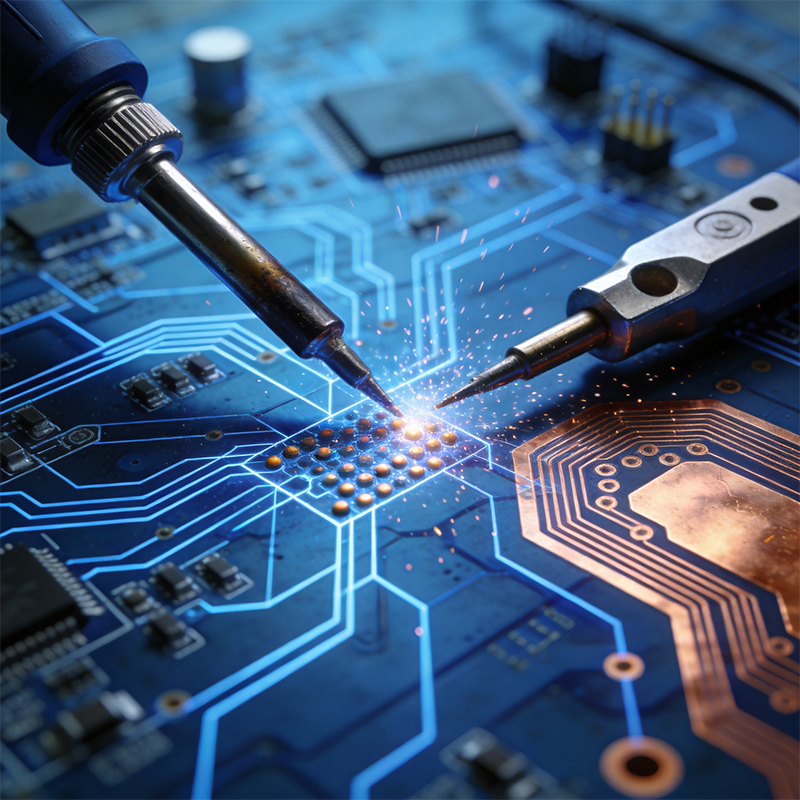
It sounds crazy, but if you’re struggling to remove old solder, the best thing to do is add new solder. Modern lead-free solder has a high melting point and gets "crusty." Adding a bit of fresh, leaded solder (or high-quality lead-free) helps the old stuff flow again. And don't forget the flux! Flux is like the lubricant of the soldering world; without it, you're just making a mess.
In 2026, PCB traces are thinner than a human hair. If you hold your iron on a pad for more than 5-8 seconds, the glue holding that copper to the board will fail.The Pro Rule: If it doesn’t come off in 5 seconds, stop. Let it cool down, add flux, and try again. Never, ever pry a component with force. If the solder isn't liquid, that component isn't moving.
With the rise of HDI (High-Density Interconnect) and stacked PCBs, things are getting crowded. We are seeing more components packed into tighter spaces. This means your heat control needs to be surgical. Using a "pre-heater" underneath the board is becoming a standard move for pros—it raises the whole board's temperature so your iron doesn't have to do all the heavy lifting.

Kaboer manufacturing PCBs since 2009. Professional technology and high-precision Printed Circuit Boards involved in Medical, IOT, UAV, Aviation, Automotive, Aerospace, Industrial Control, Artificial Intelligence, Consumer Electronics etc..


 English



 Wechat
 +86 13670210335
 +86 13670210335
 E-mail