
Date: 2026-04-24
If you’ve ever looked inside a smartphone or a laptop, you’ve seen thousands of tiny components clinging to a board like high-tech barnacles. Have you ever wondered how they stay there? It’s not glue. It’s reflow process soldering.
Think of it as the "baking stage" of electronics manufacturing. But instead of chocolate chips, we’re melting microscopic beads of metal to create permanent electrical connections. If the oven isn't set just right, your $500 graphics card becomes a high-tech paperweight.
In the simplest terms, reflow process soldering is a method where we apply a sticky mixture called "solder paste" to a circuit board, place components on top, and then send the whole thing through a massive industrial oven.
The goal? To melt (or "reflow") the solder without melting the delicate chips. It’s a delicate dance between "not hot enough" (bad connection) and "too hot" (charred board).
In the factory, we don't just "turn on the heat." We follow a strictly controlled thermal profile. It’s like a recipe that has four distinct parts:
Pre-heating: We slowly warm up the board. If you heat it too fast, the board can warp, or the components might crack from thermal shock.
Soak Zone (Thermal Equilibrium): This is where we let the whole board catch up to the same temperature. It activates the flux in the solder paste, which "cleans" the metal surfaces.
Reflow (The Peak): The temperature goes above the liquidus point. This is the magic moment where the solder turns into a liquid and "wets" the pads. You only have a few seconds here—don't overcook it!
Cooling: We bring the temperature back down. Fast cooling creates a strong, fine-grained solder joint. Slow cooling makes the joints brittle and weak.
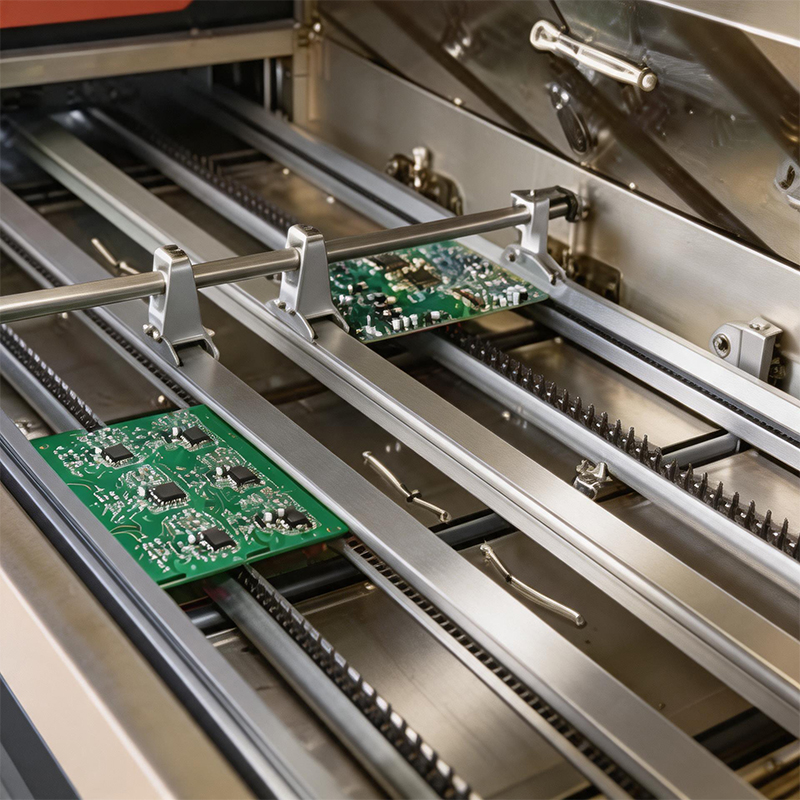
If I had a dollar for every time a bad "soak zone" ruined a batch of boards, I’d be retired. If this stage is too short, the center of the board will be colder than the edges. When you hit the peak, the edges melt, but the center stays "crunchy." This is how you get intermittent failures that drive quality control teams crazy.
Ever seen a small resistor standing up on one end like a tiny gravestone? We call that Tombstoning. It usually happens because the solder on one side of the part melts slightly before the other, and the surface tension literally pulls the component upright.
Other "fun" issues include Solder Balls (tiny metal splatters) and Bridging (when two connections accidentally touch). Most of these can be fixed by tweaking your reflow oven's belt speed or temperature settings.
Today, with AI servers and HDI (High-Density Interconnect) boards everywhere, components are getting smaller and more heat-sensitive. We’re seeing more "Vacuum Reflow" to get rid of tiny air bubbles (voids) inside the solder. If you’re building high-reliability hardware, you can't just wing it anymore—you need precision.
Reflow process soldering is as much an art as it is a science. It’s about balance, timing, and a lot of testing. When done right, it creates the invisible bonds that power our modern world.

Kaboer manufacturing PCBs since 2009. Professional technology and high-precision Printed Circuit Boards involved in Medical, IOT, UAV, Aviation, Automotive, Aerospace, Industrial Control, Artificial Intelligence, Consumer Electronics etc..


 English



 Wechat
 +86 13670210335
 +86 13670210335
 E-mail