
Date: 2026-03-10
If you've ever looked inside a piece of electronic equipment—a car's dashboard, an industrial controller, a medical monitor—you've almost certainly seen a double sided PCB. It's the quiet workhorse of the electronics world. Not as simple as a single-sided board, not as complex as multi-layer, but sitting right in that sweet spot where most real-world products actually live.
Here's the thing about double sided PCBs: they're everywhere because they just work. They give you enough space to route reasonably complex circuits without the cost and lead time of multi-layer boards. For thousands of products—from power supplies to audio equipment, from automotive controls to IoT devices—they're the perfect fit.
But finding a reliable supplier who can actually deliver quality double sided PCBs, on time, without hidden problems? That's where things get tricky.
Let's walk through what double sided PCBs actually are, why they matter, and how to find a partner who won't let you down.
A double sided PCB is exactly what it sounds like: a circuit board with conductive copper layers on both the top and bottom sides . Unlike single-sided boards, which restrict routing to one plane, double sided boards give you two full layers to work with .
But here's the key: those two layers need to talk to each other. That's where plated through-holes (PTH) come in. These are holes drilled through the board and plated with copper, creating electrical connections between the top and bottom layers . This simple innovation—connecting both sides—unlocks a huge amount of design flexibility.
The basic construction is simple:
A core insulating layer (usually FR-4 fiberglass)
Copper foil on both sides (typically 1oz or 35µm)
Plated through-holes connecting the layers
Solder mask to protect the copper
Silkscreen to label components
But simple doesn't mean simplistic. A well-made double sided PCB is a precision product, with trace widths and spacings down to 0.1mm (4 mils) or finer, and plated holes positioned with micron-level accuracy .
The PCB industry isn't one-size-fits-all. Each board type has its place. Here's where double sided fits in:
| Board Type | Layer Count | Best For | Typical Cost |
|---|---|---|---|
| Single Sided | 1 layer | Simple circuits, toys, power supplies | Lowest |
| Double Sided | 2 layers | Industrial controls, audio, automotive, IoT | Moderate |
| Multi-Layer | 4+ layers | High-speed digital, complex routing, dense designs | Higher |
When double sided makes sense:
You need more space than single layer. If your circuit doesn't fit on one side without jumping wires, double sided is the natural next step .
You're doing moderate-complexity designs. Think industrial controls, sensor interfaces, power regulation, audio circuits .
Cost matters. Multi-layer boards are significantly more expensive. Double sided gives you a lot of capability without the cost jump .
You need reliability. The plated through-holes in double sided boards are far more reliable than jumper wires on single-sided prototypes .
You're prototyping for eventual multi-layer production. Many designs start as double sided for validation, then migrate to multi-layer later.
You'll find double sided PCBs in thousands of products. Here are some of the most common:
Automotive electronics. Dashboard displays, engine control sensors, lighting modules—they all rely on double sided boards . The automotive environment demands reliability, and double sided boards deliver.
Industrial controls. PLCs, motor drives, power supplies, human-machine interfaces. These need robust connections and moderate complexity—perfect for double sided .
Consumer audio. Amplifiers, receivers, mixing consoles. Audio circuits benefit from the clean grounding and routing flexibility of double sided boards .
IoT devices. Smart home sensors, thermostats, security systems. These need to be compact and reliable without breaking the bank .
Medical monitors. Patient monitors, diagnostic tools, portable medical devices. Reliability is non-negotiable, and double sided boards provide it .
Power supplies. AC-DC converters, DC-DC modules, battery management systems. The ability to route power on one side and control signals on the other is invaluable .
Not all double sided boards are created equal. Here's what separates good boards from problem boards:
The copper should be uniform across the entire board. Variations cause impedance changes and current capacity issues. For standard boards, 1oz (35µm) is typical. For higher current, 2oz might be specified .
The holes connecting top and bottom must be perfectly plated. Poor plating leads to intermittent connections or complete failure. Look for manufacturers who do microsection analysis to verify hole wall integrity .
The top and bottom layers must align precisely with each other and with the drilled holes. Misregistration causes pads to be partially missing and connections to fail. Good manufacturers hold registration within 0.05mm (2 mils) or better .
Solder mask should cover everything except the pads. Poorly applied mask can creep onto pads, causing soldering issues. The IPC standard requires at least 0.025mm (1 mil) of mask coverage on traces, with pads properly exposed .
The finish on exposed pads affects solderability and shelf life:
HASL (Hot Air Solder Leveling) – Cost-effective, good solderability
ENIG (Electroless Nickel Immersion Gold) – Flat surface, excellent for fine-pitch, longer shelf life
OSP (Organic Solderability Preservative) – Simple, low-cost, shorter shelf life
Every board should be tested for shorts and opens. Flying probe testing is common for prototypes; fixture-based testing for production. If a manufacturer doesn't test, you're gambling .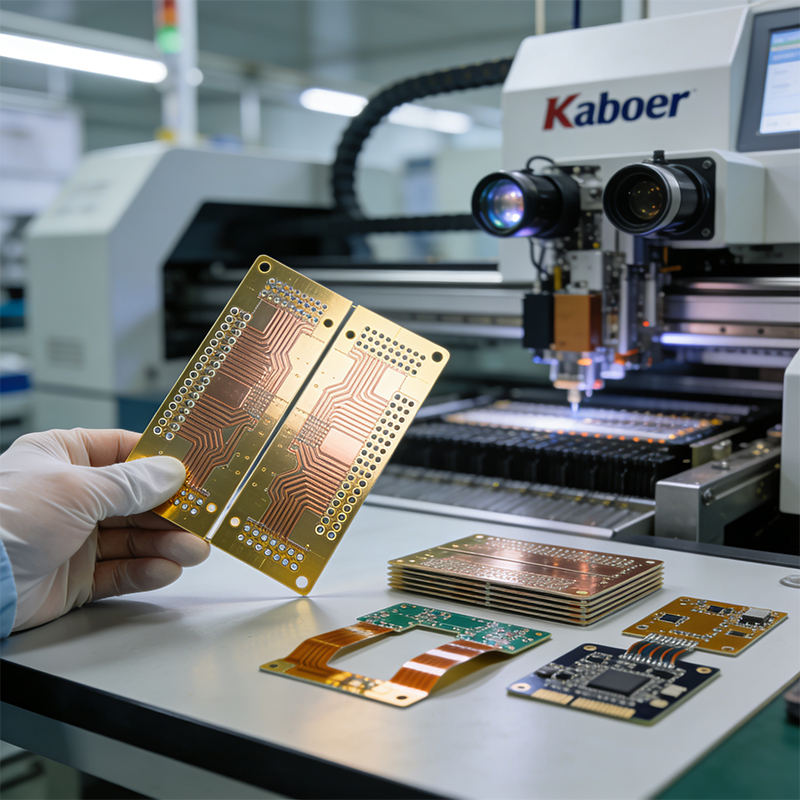
Over the years, we've seen the same issues crop up again and again:
Problem: Annular ring breakout. The copper ring around a hole gets cut into because the drill wandered or the pad was too small.
Solution: Design with adequate annular ring. IPC recommends at least 0.05mm (2 mils) of ring beyond the hole for Class 2, more for Class 3 . Good manufacturers also drill with enough precision to keep the hole centered.
Problem: Poor hole wall plating. Voids or thin spots in the plating cause intermittent connections.
Solution: Choose a manufacturer who does microsection analysis and monitors plating bath chemistry. Certification to IPC-6012 Class 2 or 3 is a good sign .
Problem: Solder mask between fine-pitch pins. Mask slivers peel off or cause assembly issues.
Solution: Ensure your design respects the manufacturer's minimum solder mask web capabilities. For most, that's 0.075-0.1mm (3-4 mils) between pads .
Problem: Delamination during assembly. Layers separate during reflow, ruining the board.
Solution: Use materials rated for your assembly temperature. For lead-free, that means Tg of at least 170°C . Also, ensure boards are properly baked before assembly if they've been stored.
At Kaboer, we've been manufacturing double sided PCBs since 2009. Over the years, we've produced tens of thousands of designs for companies around the world—automotive, industrial, medical, consumer. We know what it takes to make boards that work, board after board, batch after batch.
We handle the full spectrum of double sided boards:
Layer count: 2 layers (obviously—it's double sided!)
Board thickness: 0.4mm to 3.2mm, with standard 1.6mm in stock
Copper weight: 0.5oz to 3oz, with 1oz most common
Minimum trace/space: 0.1mm (4 mils) standard, 0.075mm (3 mils) for advanced designs
Minimum drill size: 0.2mm mechanical, 0.1mm laser for microvias
Surface finishes: HASL, lead-free HASL, ENIG, OSP, immersion silver
Solder mask colors: Green, red, blue, black, white, yellow—your choice
Quality grade: IPC Class 2 standard, Class 3 available for high-reliability needs
We own our factory. When you work with us, there's no middleman, no finger-pointing between fabrication and assembly. One partner, one quality standard, one team accountable for your boards.
We review every design. Before we build, our engineers check your files for manufacturability. We spot issues—annular rings too small, silkscreen over pads, unclear layer definitions—and flag them early, not after your boards are already in production.
We test thoroughly. Every board gets electrical testing. For critical designs, we offer X-ray inspection, microsection analysis, and impedance testing on request.
We assemble too. Our in-house PCBA facility means you can go from bare boards to fully assembled, tested modules with one partner. No shipping boards to another facility, no coordinating multiple vendors.
We're certified where it matters: ISO 9001, IATF 16949 (automotive), ISO 14001, UL, RoHS. These aren't wall plaques—they mean our processes are documented, repeatable, and reliable.
We're transparent. Our Shenzhen factory is open to clients. If you want to see how your boards are made, you're welcome to visit. Walk the floor, meet the team, ask whatever you want.
Double sided PCBs are our bread and butter, but they're not all we do. We've built our expertise across the full spectrum:
Flexible PCBs (FPC) : 1-20 layers, 0.075mm to 0.4mm thick
Rigid-Flex Boards: 2-30 layers, combining rigid stability with flexible interconnects
HDI High-Density Boards: Microvias, fine lines down to 2mil, advanced stackups
High-Frequency Boards: Rogers, PTFE, other low-loss materials for 5G and RF
Metal-Core Boards: Aluminum or copper base for excellent heat dissipation
Full PCBA: In-house assembly, from prototypes to production volumes
The point is: when your design evolves—when you need to move from double sided to multi-layer, or add flexible sections, or integrate high-frequency materials—you don't need to find a new supplier. We grow with you.
Double sided PCBs are the workhorses of the electronics industry. They're reliable, cost-effective, and versatile. But they're only as good as the manufacturer who builds them.
If you need custom double sided PCBs, flexible PCBs, or PCBA solutions, send us your requirements. We'll reply with a free quote and prototyping plan within 2 hours.
Better yet—come visit our Shenzhen factory. See for yourself how we turn designs into boards that work, every time.

Kaboer manufacturing PCBs since 2009. Professional technology and high-precision Printed Circuit Boards involved in Medical, IOT, UAV, Aviation, Automotive, Aerospace, Industrial Control, Artificial Intelligence, Consumer Electronics etc..


 English



 Wechat
 +86 13670210335
 +86 13670210335
 E-mail