
Date: 2026-07-23
You're designing an electronic product. Maybe a smartphone, a wearable device, an automotive display, or a medical device. You need to connect two components inside a tight space. Regular cables are too bulky. Rigid boards won't fit. You have two options: FFC (Flexible Flat Cable) and FPC (Flexible Printed Circuit) .
They look similar — both flat, both flexible. But they are completely different things. Choose wrong, and you'll either overpay or end up with a product that won't fit inside its enclosure.
In this guide, I'll explain what FFC and FPC are, how they differ, where each one is used, and how to choose the right one. Plain English, no fluff.
FFC (Flexible Flat Cable)
An FFC is a "ribbon cable" — multiple flat copper conductors sandwiched between two layers of insulating film. The structure is simple: flat copper foil conductors, PET insulation layers, and exposed contacts at both ends for connection. FFC conductors are "straight through" — from Point A to Point B, pin 1 to pin 1. No crossing, no branching.
Think of it as a flat "noodle" — neat, uniform, straight through.
FPC (Flexible Printed Circuit)
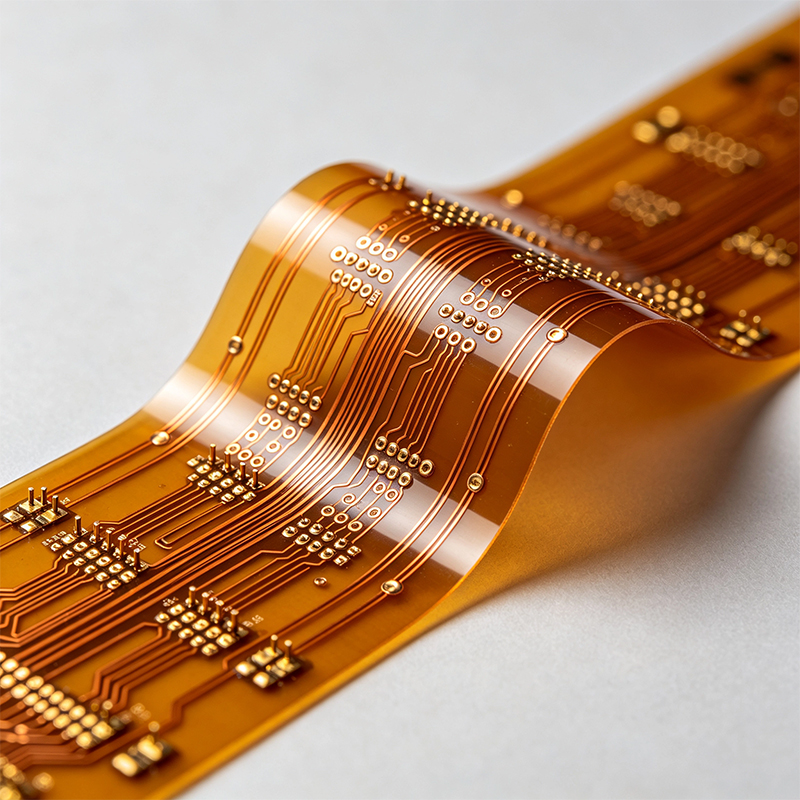
An FPC is a "circuit board" — copper traces are chemically etched onto a flexible substrate, typically polyimide (PI). The structure is much more complex: single-sided, double-sided, or even multi-layer; traces can route in any shape, cross, branch; and components can be soldered directly onto the board.
Think of it as a foldable "canvas" — you can draw any shape, place components anywhere you want.
| Feature | FFC (Flexible Flat Cable) | FPC (Flexible Printed Circuit) |
|---|---|---|
| What it is | Ribbon cable | Circuit board |
| Manufacturing | Laminated flat conductors between films | Chemically etched copper on flexible substrate |
| Routing complexity | Straight-through only — no crossing | Any routing — cross, branch, multi-layer |
| Can mount components? | No — just conductors | Yes — components can be soldered on |
| Shape | Uniform rectangular | Customizable to any shape |
| Layers | Single-layer conductor | Single/double/multi-layer |
| Cost | Low | High |
| Production efficiency | High (lamination is fast) | Lower (multiple process steps) |
| Best for | Simple straight connections, high volume, cost-sensitive | Complex routing, component mounting, irregular shapes |
Advantages:
Cheap: Simple structure, mature processes
High production efficiency: Lamination is fast and scalable
Good enough: For 1:1 straight-through signal transmission, it works perfectly
Thin and light: Can be as thin as 0.1-0.3mm
Limitations:
Straight-through only: No crossing, no branching
Fixed shape: Only uniform rectangular shapes
No components: Just conductors, not a circuit board
Advantages:
Any routing: Cross, branch, multi-layer
Any shape: Customizable to fit any enclosure
Can mount components: It's a circuit board
Better signal quality: Controlled impedance, shielding available
Limitations:
Expensive: Complex manufacturing
Longer lead time: More process steps
Higher design门槛: Requires professional PCB design capability
Use FFC when:
You just need a straight connection from Point A to Point B
No crossing or branching is required
No components need to be mounted on the cable
Cost-sensitive, high-volume production
Typical applications: laptop display cables, printer head cables
Use FPC when:
Routing needs crossing, branching, or multiple layers
Components need to be mounted on the flex board
The shape needs to conform to an irregular enclosure
Controlled impedance or shielding is required
Typical applications: smartphone camera modules, wearable device motherboards
One simple rule: If you need a straight connection from A to B, use FFC. If you need a complex circuit on a flexible board, use FPC.
The global FFC and FPC connector market was valued at approximately $7.00 billion in 2025** and is projected to grow to **$7.38 billion in 2026, with a CAGR of 6.14%, reaching $10.63 billion by 2032.
Consumer electronics (smartphones, tablets, laptops) and automotive electronics (infotainment systems, sensor connections, control units) are the two largest application segments. As devices get thinner and lighter, demand for FFC and FPC will only grow.
We are not a standard rigid-only PCB shop. We are a one-stop manufacturer that designs and makes flexible PCBs, rigid-flex boards, HDI high-frequency boards, and then does full PCBA.
FPC custom capability: Single-sided, double-sided, multi-layer flex boards — design to fabrication, all in-house
Rigid-flex expertise: No cracks at the rigid-to-flex transition — ideal for complex 3D assemblies
High-precision manufacturing: Minimum trace/space 0.05mm, minimum laser blind via 0.075mm
One-stop service: FPC design, fabrication, SMT assembly, testing — one window, one responsibility
Free DFM review: Send your design files, get a DFM report within 24 hours
Projects we've served: consumer electronics (smartphone camera module FPCs, TWS earbud FPCs), automotive (display FFC connections, sensor FPCs), medical (endoscope FPCs, wearable health monitor FPCs).
Three simple steps:
Send your requirements: Tell us your connection needs (from where to where, how many conductors, components needed, space constraints)
We review and recommend: Within 24 hours, we'll tell you whether FFC or FPC is the right choice — with pricing and lead time
Sample, then scale: We build samples. You test functionality and reliability. Then we move to volume
FFC and FPC look similar — but they are completely different things. FFC is a "ribbon cable" — cheap, simple, straight-through only. FPC is a "flexible circuit board" — expensive, complex, capable of any routing and component mounting. Choose right, and you save both money and headaches. Choose wrong, and the cost of rework will far exceed the money you saved.
If you're designing a product that needs a flexible interconnect solution, send us your requirements. We won't push a contract — we'll first run a free feasibility assessment and tell you whether FFC or FPC is the better choice.
When you contact us, please include:
Product type and application
Connection requirements (from where to where, how many conductors, components needed)
Estimated annual quantity
We'll give you an honest answer — what we can do, what we can't, and how to modify your design to make it work.

Kaboer manufacturing PCBs since 2009. Professional technology and high-precision Printed Circuit Boards involved in Medical, IOT, UAV, Aviation, Automotive, Aerospace, Industrial Control, Artificial Intelligence, Consumer Electronics etc..


 English



 Wechat
 +86 13670210335
 +86 13670210335
 E-mail