
Date: 2026-05-21
You know those stiff, green circuit boards that have been around for decades? They work fine—until you need something that bends, folds, or squeezes into a crazy tight space. That‘s when you need a flexi material.
In the world of electronics, “flexi material” usually means the flexible base that makes bendable circuit boards possible. Think of it as the backbone of flexible PCBs (FPCBs). Without it, your smartphone couldn’t fold, your fitness tracker would be bulky, and your car’s dashboard would be a mess of heavy wiring harnesses.
Let’s break down what flexi materials are, the different types available, where they’re used, and why you might need them for your next product.
What Exactly Is a Flexi Material?
A flexi material (short for flexible material) is the substrate or base layer of a flexible printed circuit board. Instead of the hard fiberglass used in rigid boards (FR4), flexi materials are thin, bendable polymer films that can twist, fold, and roll without breaking.
The most common flexi material is polyimide (PI) , but other options like PET (polyester) , PEN, PTFE, and LCP are also used depending on the application.
In plain English: If a rigid PCB is like a wooden plank, a flexi material is like a thick sheet of paper—strong enough to hold copper traces, but flexible enough to bend.
Why Do You Need Flexi Materials?
Three big reasons: space, weight, and reliability.
Space – Flexi materials let you fold circuits into shapes that rigid boards could never fit. You can snake them through hinges, wrap them around batteries, or stuff them into curved enclosures.
Weight – Flexible PCBs are incredibly thin—sometimes less than 0.1mm. That saves grams, which matters a lot in drones, wearables, and aerospace.
Reliability – A flex circuit can replace multiple connectors and a bundle of wires. Fewer connection points mean fewer things that can fail.
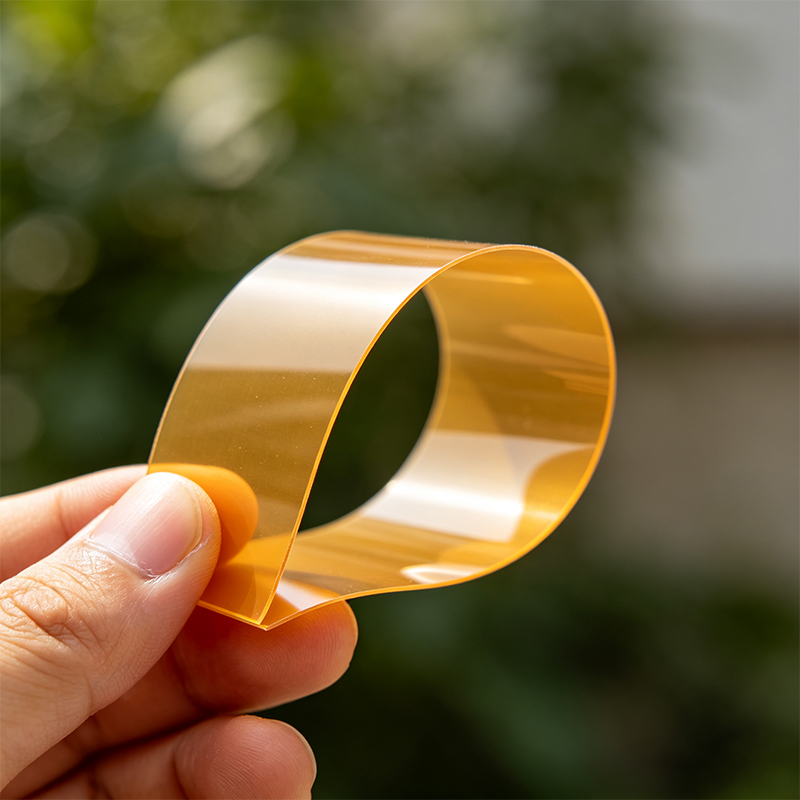
The Most Common Flexi Material: Polyimide (PI)
Polyimide is the industry standard for flex PCBs—it‘s the FR4 of the flexible world. It’s used in about 70% of flexible circuit applications.
What makes polyimide so special?
Heat resistance – It can handle soldering temperatures up to 260°C, which means you can use standard lead-free reflow processes without melting the board.
Flexibility – It‘s tough but bendable. You can’t tear it by hand, but it folds easily along designed bend lines.
Chemical resistance – It shrugs off solvents, acids, and oils, making it great for harsh environments.
Dimensional stability – It doesn’t stretch or shrink much with temperature changes, so your traces stay where they belong.
You‘ve probably seen polyimide without knowing it. That amber-colored, slightly see-through film inside your phone’s display connector? That‘s polyimide. DuPont sells it under the brand name Kapton®.
Polyimide is available in different thicknesses, typically from 12.5μm to 50μm (that’s about 0.0005 to 0.002 inches). You can also get it in different colors—yellow, amber, black—each with slightly different properties.
The Budget Option: PET (Polyester)
If polyimide is the premium choice, PET (polyethylene terephthalate) is the budget-friendly alternative. You know those clear plastic water bottles? That‘s PET. It’s cheap, flexible, and transparent.
PET is used in simpler, lower-cost flexible circuits where heat isn‘t a big concern. But it has a major limitation: it melts around 150°C, so it can’t survive standard lead‑free soldering (which peaks at 260°C).
When to use PET:
Low-cost consumer electronics
Disposable devices
Membrane switches and keyboards
Antennas (where large format and low cost matter)
PET is great when you need flexibility on a budget—just don‘t ask it to handle a reflow oven.
The Performance Upgrade: Adhesiveless Laminate
Here’s something most people don‘t know: traditional flex materials use an adhesive layer to stick the copper to the polyimide. That adhesive can cause problems under thermal stress or repeated bending.
Adhesiveless laminates remove that glue layer entirely. The copper is bonded directly to the polyimide. The result? Better thermal stability, more consistent electrical performance, and higher reliability in demanding applications like aerospace and military gear.
Adhesiveless laminates are the go‑to choice for:
Dynamic bending applications (things that bend repeatedly, like folding phone hinges)
High-density circuits with fine pitch routing
RF and high‑speed digital designs where impedance consistency matters
Spaceflight hardware where outgassing is a concern
The downside? They cost more. But for mission‑critical products, the extra reliability is worth every penny.
Specialty Flexi Materials
Depending on your application, you might need something beyond standard PI or PET.
PTFE (Teflon) – Known for extremely low dielectric loss. Used in high‑frequency circuits (think 5G, radar, satellite comms). It’s expensive and harder to process, but nothing else performs as well at GHz frequencies.
LCP (Liquid Crystal Polymer) – Another high‑performance material with excellent electrical properties and very low moisture absorption. Good for high‑speed digital and RF applications.
Transparent Polyimide – Standard polyimide is amber; transparent polyimide is clear. It lets you create see‑through flexible circuits for aesthetics or optical applications. It‘s more expensive and slightly less heat‑resistant than regular PI, but it’s becoming popular for transparent displays and fashion‑tech wearables.
Flexi Materials vs. Stiffeners – A Quick Note
A flex circuit is bendable—but sometimes you don‘t want a certain area to bend. That’s where stiffeners come in. You glue a small piece of FR4 or polyimide onto specific spots (like under a connector or a heavy chip) to keep that area rigid while the rest of the board stays flexible. Stiffeners are usually bonded with a flexible adhesive, often from the Pyralux® LF series.
How Flexi Materials Are Used in Real Products
Flexi materials aren‘t just for futuristic gadgets. They’re everywhere:
Smartphones – The foldable ones use flex circuits in the hinge. Even non‑foldable phones use flex for camera modules and display ribbons.
Wearables – Fitness trackers and smartwatches use flex circuits to curve around your wrist.
Medical devices – Implantable sensors and endoscope cameras rely on thin, biocompatible flex materials.
Automotive – Dashboard displays, steering wheel controls, and battery management systems in EVs.
Aerospace – Satellites and drones use flex circuits to save weight and survive vibration.
What About Rigid‑Flex? That Uses Flexi Materials Too
Rigid‑flex boards combine rigid FR4 sections with flexible polyimide tails in a single board. You get rigid areas for heavy components (processors, connectors) and flex tails that bend between them. It’s the best of both worlds. Rigid‑flex eliminates connectors and wiring harnesses, which means fewer failure points and a thinner overall product.
The flexi material in a rigid‑flex board is the same polyimide used in standalone flex circuits. The manufacturing process is more complex—you have to bond the rigid and flexible sections together without making the flex area brittle—but the result is incredibly versatile.
How to Choose the Right Flexi Material for Your Project
Here’s a simple decision guide:
Do you need high‑temperature soldering (lead‑free reflow)? → Use polyimide (PI). PET won‘t survive the heat.
Do you need extreme heat resistance (above 200°C) or chemical exposure? → Use polyimide or PTFE.
Is cost your main concern and the board won’t see high heat? → PET might work.
Does the board need to bend repeatedly (dynamic flex)? → Use adhesiveless polyimide or rolled‑annealed copper.
Do you need a see‑through circuit for aesthetics or optics? → Use transparent polyimide or PET.
High‑frequency signals (GHz range)? → PTFE or LCP.
What We Can Do for You
We‘re a custom circuit board manufacturer specializing in flexible PCBs, rigid‑flex boards, HDI high‑frequency boards, and PCBA. We work with a wide range of flexi materials—polyimide, adhesiveless laminates, PET, and even transparent polyimide for specialty applications.
Here’s how we help:
Material selection – We‘ll recommend the right flexi material based on your thermal, mechanical, and budget requirements.
Design for manufacturing – We’ll check your layout for bend radius, stiffener placement, and trace routing to ensure your flex circuit works reliably.
Prototyping – Fast turnaround so you can test your design before committing to volume.
Volume production – We scale up without compromising quality.
PCBA – We assemble components on your flex circuits using custom fixtures that hold the board flat during soldering.
Ready to Make Your Product Bend?
If your design is struggling with space, weight, or reliability—or you just want to create something that folds, wraps, or curves—flexi materials are the answer. Send us your schematic or a rough idea. We‘ll help you choose the right material and build a custom flex circuit that works.

Kaboer manufacturing PCBs since 2009. Professional technology and high-precision Printed Circuit Boards involved in Medical, IOT, UAV, Aviation, Automotive, Aerospace, Industrial Control, Artificial Intelligence, Consumer Electronics etc..


 English



 Wechat
 +86 13670210335
 +86 13670210335
 E-mail